
深部脑刺激可调节帕金森病患者在空间和频谱上不同的静息态网络内的同步性。
Deep brain stimulation modulates synchrony within spatially and spectrally distinct resting state networks in Parkinson's disease.
作者信息
Oswal Ashwini, Beudel Martijn, Zrinzo Ludvic, Limousin Patricia, Hariz Marwan, Foltynie Tom, Litvak Vladimir, Brown Peter
机构信息
Nuffield Department of Clinical Neurosciences, John Radcliffe Hospital, Oxford, UK Medical Research Council Brain Network Dynamics Unit, University of Oxford, UK Wellcome Trust Centre for Neuroimaging, UCL Institute of Neurology, 12 Queen Square, London, UK.
Nuffield Department of Clinical Neurosciences, John Radcliffe Hospital, Oxford, UK Unit of Functional Neurosurgery, Sobell Department of Motor Neuroscience and Movement Disorders, UCL Institute of Neurology, Queen Square, London, UK University Medical Centre Groningen, Department of Neurology, University of Groningen, The Netherlands.
出版信息
Brain. 2016 May;139(Pt 5):1482-96. doi: 10.1093/brain/aww048. Epub 2016 Mar 26.
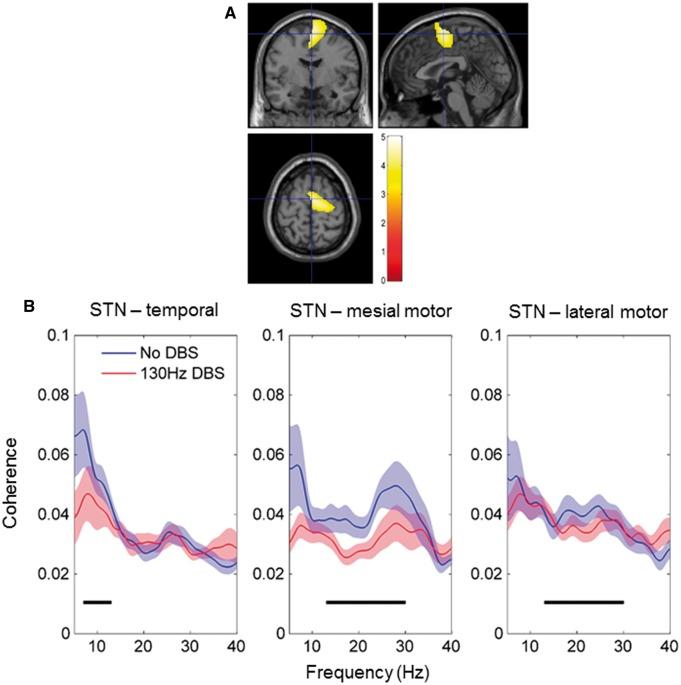
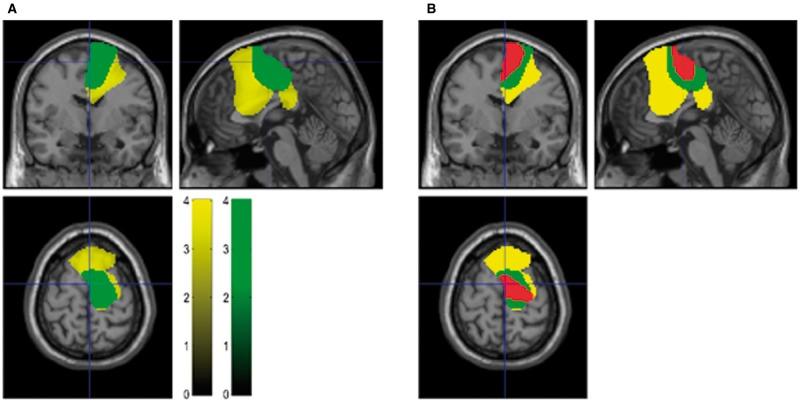
Chronic dopamine depletion in Parkinson's disease leads to progressive motor and cognitive impairment, which is associated with the emergence of characteristic patterns of synchronous oscillatory activity within cortico-basal-ganglia circuits. Deep brain stimulation of the subthalamic nucleus is an effective treatment for Parkinson's disease, but its influence on synchronous activity in cortico-basal-ganglia loops remains to be fully characterized. Here, we demonstrate that deep brain stimulation selectively suppresses certain spatially and spectrally segregated resting state subthalamic nucleus-cortical networks. To this end we used a validated and novel approach for performing simultaneous recordings of the subthalamic nucleus and cortex using magnetoencephalography (during concurrent subthalamic nucleus deep brain stimulation). Our results highlight that clinically effective subthalamic nucleus deep brain stimulation suppresses synchrony locally within the subthalamic nucleus in the low beta oscillatory range and furthermore that the degree of this suppression correlates with clinical motor improvement. Moreover, deep brain stimulation relatively selectively suppressed synchronization of activity between the subthalamic nucleus and mesial premotor regions, including the supplementary motor areas. These mesial premotor regions were predominantly coupled to the subthalamic nucleus in the high beta frequency range, but the degree of deep brain stimulation-associated suppression in their coupling to the subthalamic nucleus was not found to correlate with motor improvement. Beta band coupling between the subthalamic nucleus and lateral motor areas was not influenced by deep brain stimulation. Motor cortical coupling with subthalamic nucleus predominantly involved driving of the subthalamic nucleus, with those drives in the higher beta frequency band having much shorter net delays to subthalamic nucleus than those in the lower beta band. These observations raise the possibility that cortical connectivity with the subthalamic nucleus in the high and low beta bands may reflect coupling mediated predominantly by the hyperdirect and indirect pathways to subthalamic nucleus, respectively, and that subthalamic nucleus deep brain stimulation predominantly suppresses the former. Yet only the change in strength of local subthalamic nucleus oscillations correlates with the degree of improvement during deep brain stimulation, compatible with the current view that a strengthened hyperdirect pathway is a prerequisite for locally generated beta activity but that it is the severity of the latter that may determine or index motor impairment.
帕金森病中慢性多巴胺耗竭会导致进行性运动和认知障碍,这与皮质-基底神经节回路中同步振荡活动特征模式的出现有关。丘脑底核的深部脑刺激是治疗帕金森病的一种有效方法,但其对皮质-基底神经节环路中同步活动的影响仍有待全面阐明。在此,我们证明深部脑刺激选择性地抑制了某些在空间和频谱上分离的静息态丘脑底核-皮质网络。为此,我们采用了一种经过验证的新颖方法,即使用脑磁图同时记录丘脑底核和皮质(在同步进行丘脑底核深部脑刺激期间)。我们的结果表明,临床上有效的丘脑底核深部脑刺激在低β振荡范围内局部抑制丘脑底核内的同步性,而且这种抑制程度与临床运动改善相关。此外,深部脑刺激相对选择性地抑制了丘脑底核与内侧运动前区(包括辅助运动区)之间活动的同步性。这些内侧运动前区在高β频率范围内主要与丘脑底核耦合,但深部脑刺激相关的对其与丘脑底核耦合的抑制程度与运动改善无关。丘脑底核与外侧运动区之间的β波段耦合不受深部脑刺激影响。运动皮质与丘脑底核的耦合主要涉及对丘脑底核的驱动,与较低β波段相比,较高β频率波段中的这些驱动对丘脑底核的净延迟要短得多。这些观察结果提出了一种可能性,即高低β波段中皮质与丘脑底核的连接性可能分别反映了主要由通向丘脑底核的超直接和间接通路介导的耦合,并且丘脑底核深部脑刺激主要抑制前者。然而,只有丘脑底核局部振荡强度的变化与深部脑刺激期间的改善程度相关,这与当前观点一致,即强化的超直接通路是局部产生β活动的先决条件,但可能是后者的严重程度决定或指示运动障碍。




 Zotero 插件