
正常大鼠和荷Walker 256肿瘤大鼠口服人参皂苷Rg3后人参皂苷Rg3和人参皂苷Rh2的比较药代动力学
Comparative Pharmacokinetics of Ginsenoside Rg3 and Ginsenoside Rh2 after Oral Administration of Ginsenoside Rg3 in Normal and Walker 256 Tumor-bearing Rats.
作者信息
Fan He, Xiao-Ling Sun, Yaliu Su, Ming-Ming Lu, Xue Feng, Xian-Sheng Meng, Li Fu
机构信息
Department of Chinese Medicine Analysis, Liaoning University of Traditional Chinese Medicine, 77 Life One Road, DD Port, Dalian 116600, China.
Institute of Traditional Chinese Medicine, Liaoning Institute for Drug Control, 7 Congshan West Road, Shenyang 110036, China.
出版信息
Pharmacogn Mag. 2016 Jan-Mar;12(45):21-4. doi: 10.4103/0973-1296.176014.
BACKGROUND
Ginseng is Chinese traditional herbal medicine, and the ginsenoside Rg3 is the main bioactive ingredient for the anti-tumor effect. However, there is no study on pharmacokinetics (PKs) of ginsenoside Rg3 and its main metabolite after oral ginsenoside Rg3 in tumor-bearing plasma. The aim of this study was to investigate the PK profiles of ginsenoside Rg3 and ginsenoside Rh2 after oral administration of pure ginsenoside Rg3 were administered, and compare the difference of the PK profiles between normal and Walker 256 tumor-bearing rats.
MATERIALS AND METHODS
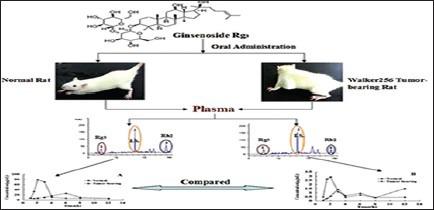
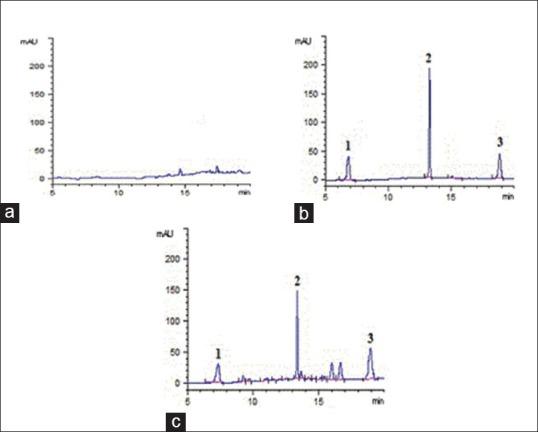
The concentrations of two ginsenosides in plasma were determined by using a simple and rapid high-performance liquid chromatography. All the rats were divided randomly into two groups (Walker 256 tumor-bearing and normal groups). Each group received oral administration of 50 mg/kg ginsenoside Rg3.
RESULTS
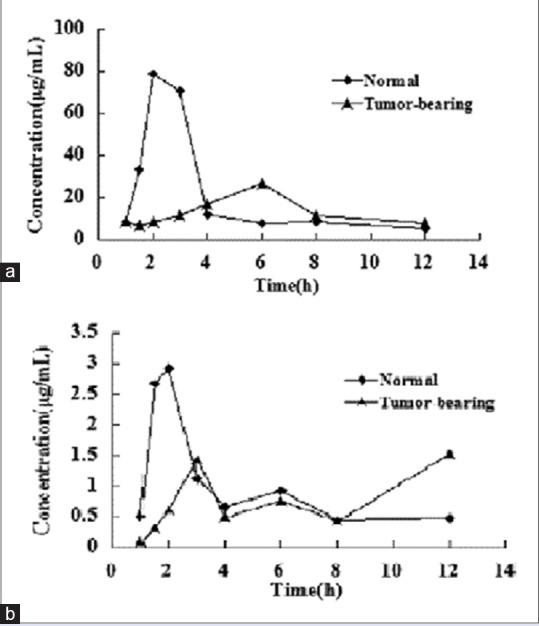
The results showed that ginsenoside Rh2, possibly as a glycosylation hydrolysis product of ginsenoside Rg3, were found in plasma after oral administration of ginsenoside Rg3 to rats. Ginsenoside Rg3 had shown better absorption than ginsenoside Rh2, whether the oral administration of ginsenoside Rg3, normal rats showed better absorption than tumor-bearing rats.
DISCUSSION AND CONCLUSION
The PKs properties of the ginsenoside Rg3 and ginsenoside Rh2 differed between tumor-bearing rats and normal rats, including area under the plasma level/time curve and concentration maximum (P < 0.05).
SUMMARY
Ginsenoside Rh2 was found in plasma after oral administration of ginsenoside Rg3 to ratsHPLC could be used to determine simultaneously, the concentration of ginsenoside Rg3 and ginsenoside Rh2 in rat plasma after oral administration of ginsenoside Rg3Normal rats showed better absorption than tumor-bearing rats after oral administration of ginsenoside Rg3.0.
背景
人参是中国传统草药,人参皂苷Rg3是其具有抗肿瘤作用的主要生物活性成分。然而,关于荷瘤血浆中口服人参皂苷Rg3后人参皂苷Rg3及其主要代谢产物的药代动力学(PKs)研究尚无报道。本研究旨在探讨口服纯人参皂苷Rg3后人参皂苷Rg3和人参皂苷Rh2的PK特征,并比较正常大鼠和荷Walker 256瘤大鼠PK特征的差异。
材料与方法
采用简单快速的高效液相色谱法测定血浆中两种人参皂苷的浓度。所有大鼠随机分为两组(荷Walker 256瘤组和正常组)。每组口服50mg/kg人参皂苷Rg3。
结果
结果显示,给大鼠口服人参皂苷Rg3后,血浆中发现了人参皂苷Rh2,其可能为人参皂苷Rg3的糖基化水解产物。无论口服人参皂苷Rg3与否,人参皂苷Rg3的吸收均优于人参皂苷Rh2,正常大鼠的吸收优于荷瘤大鼠。
讨论与结论
荷瘤大鼠和正常大鼠人参皂苷Rg3和人参皂苷Rh2的PK特性不同,包括血浆水平/时间曲线下面积和最大浓度(P<0.05)。
总结
给大鼠口服人参皂苷Rg3后血浆中发现人参皂苷Rh2高效液相色谱法可同时测定口服人参皂苷Rg3后大鼠血浆中人参皂苷Rg3和人参皂苷Rh2的浓度口服人参皂苷Rg3后正常大鼠的吸收优于荷瘤大鼠。
 Zotero 插件