
肿瘤浸润淋巴细胞与食管腺癌患者生存期的改善相关。
Tumour infiltrating lymphocytes correlate with improved survival in patients with oesophageal adenocarcinoma.
作者信息
Noble Fergus, Mellows Toby, McCormick Matthews Leo H, Bateman Adrian C, Harris Scott, Underwood Timothy J, Byrne James P, Bailey Ian S, Sharland Donna M, Kelly Jamie J, Primrose John N, Sahota Surinder S, Bateman Andrew R, Thomas Gareth J, Ottensmeier Christian H
机构信息
Cancer Sciences Unit, Faculty of Medicine, University of Southampton, Somers Cancer Research Building (MP824), Southampton General Hospital, Tremona Road, Southampton, UK.
Department of Surgery, University Hospital Southampton NHS Foundation Trust, Southampton, UK.
出版信息
Cancer Immunol Immunother. 2016 Jun;65(6):651-62. doi: 10.1007/s00262-016-1826-5. Epub 2016 Mar 28.
BACKGROUND
Oesophageal adenocarcinoma (OAC) is increasingly common in the west, and survival remains poor at 10-15 % at 5 years. Immune responses are increasingly implicated as a determining factor of tumour progression. The ability of lymphocytes to recognise tumour antigens provides a mechanism for a host immune attack against cancer providing a potential treatment strategy.
MATERIALS AND METHODS
Tumour infiltrating lymphocytes (TILs: CD3+, CD4+, CD8+ and FOXp3+) were assessed by immunohistochemistry using tissue microarrays in a contemporary and homogeneous cohort of OAC patients (n = 128) undergoing curative treatment.
RESULTS
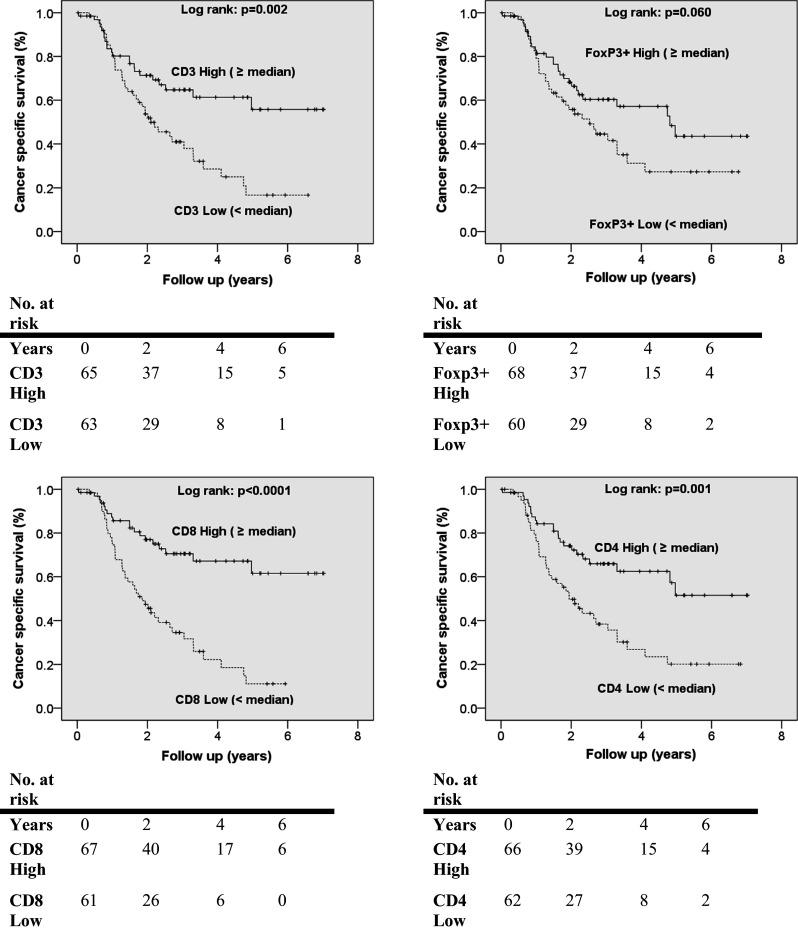
Multivariate analysis identified three independent prognostic factors for improved cancer-specific survival (CSS): increased CD8+ TILs (p = 0.003), completeness of resection (p < 0.0001) and lower pathological N stage (p < 0.0001). Independent prognostic factors for favourable disease-free survival included surgery-only treatment (p = 0.015), completeness of resection (p = 0.001), increased CD8+ TILs (p < 0.0001) and reduced pathological N stage (p < 0.0001). Higher levels of TILs in the pathological specimen were associated with significant pathological response to neoadjuvant chemotherapy (NAC). On multivariate analysis increased levels of CD4+ (p = 0.017) and CD8+ TILs (p = 0.005) were associated with significant local tumour regression and lymph node downstaging, respectively.
DISCUSSION
Our results establish an association of TILs and survival in OAC, as seen in other solid tumours, and identify particular TIL subsets that are present at higher levels in patients who responded to NAC compared to non-responders. These findings highlight potential therapeutic strategies in EAC based on utilising the host immunological response and highlight the immune responses biomarker potential.
背景
食管腺癌(OAC)在西方日益常见,5年生存率仍很低,仅为10%-15%。免疫反应越来越被认为是肿瘤进展的决定因素。淋巴细胞识别肿瘤抗原的能力为宿主对癌症的免疫攻击提供了一种机制,从而提供了一种潜在的治疗策略。
材料与方法
在一组接受根治性治疗的当代同质性OAC患者(n = 128)中,使用组织微阵列通过免疫组织化学评估肿瘤浸润淋巴细胞(TILs:CD3+、CD4+、CD8+和FOXp3+)。
结果
多变量分析确定了三个改善癌症特异性生存(CSS)的独立预后因素:CD8+ TILs增加(p = 0.003)、切除完整性(p < 0.0001)和较低的病理N分期(p < 0.0001)。有利的无病生存的独立预后因素包括仅手术治疗(p = 0.015)、切除完整性(p = 0.001)、CD8+ TILs增加(p < 0.0001)和病理N分期降低(p < 0.0001)。病理标本中较高水平的TILs与对新辅助化疗(NAC)的显著病理反应相关。多变量分析显示,CD4+(p = 0.017)和CD8+ TILs水平升高分别与显著的局部肿瘤退缩和淋巴结降期相关。
讨论
我们的结果证实了OAC中TILs与生存之间的关联,这与其他实体瘤中所见一致,并确定了与未反应者相比,在对NAC有反应的患者中水平较高的特定TIL亚群。这些发现突出了基于利用宿主免疫反应的EAC潜在治疗策略,并突出了免疫反应的生物标志物潜力。

 Zotero 插件