
个体患者数据荟萃分析中估计受限平均生存时间差异的方法的偏倚和精度。
Bias and precision of methods for estimating the difference in restricted mean survival time from an individual patient data meta-analysis.
作者信息
Lueza Béranger, Rotolo Federico, Bonastre Julia, Pignon Jean-Pierre, Michiels Stefan
机构信息
Gustave Roussy, Université Paris-Saclay, Service de biostatistique et d'épidémiologie, F-94805, Villejuif, France.
Université Paris-Saclay, Univ. Paris-Sud, UVSQ, CESP, INSERM, F-94085, Villejuif, France.
出版信息
BMC Med Res Methodol. 2016 Mar 29;16:37. doi: 10.1186/s12874-016-0137-z.
BACKGROUND
The difference in restricted mean survival time ([Formula: see text]), the area between two survival curves up to time horizon [Formula: see text], is often used in cost-effectiveness analyses to estimate the treatment effect in randomized controlled trials. A challenge in individual patient data (IPD) meta-analyses is to account for the trial effect. We aimed at comparing different methods to estimate the [Formula: see text] from an IPD meta-analysis.
METHODS
We compared four methods: the area between Kaplan-Meier curves (experimental vs. control arm) ignoring the trial effect (Naïve Kaplan-Meier); the area between Peto curves computed at quintiles of event times (Peto-quintile); the weighted average of the areas between either trial-specific Kaplan-Meier curves (Pooled Kaplan-Meier) or trial-specific exponential curves (Pooled Exponential). In a simulation study, we varied the between-trial heterogeneity for the baseline hazard and for the treatment effect (possibly correlated), the overall treatment effect, the time horizon [Formula: see text], the number of trials and of patients, the use of fixed or DerSimonian-Laird random effects model, and the proportionality of hazards. We compared the methods in terms of bias, empirical and average standard errors. We used IPD from the Meta-Analysis of Chemotherapy in Nasopharynx Carcinoma (MAC-NPC) and its updated version MAC-NPC2 for illustration that included respectively 1,975 and 5,028 patients in 11 and 23 comparisons.
RESULTS
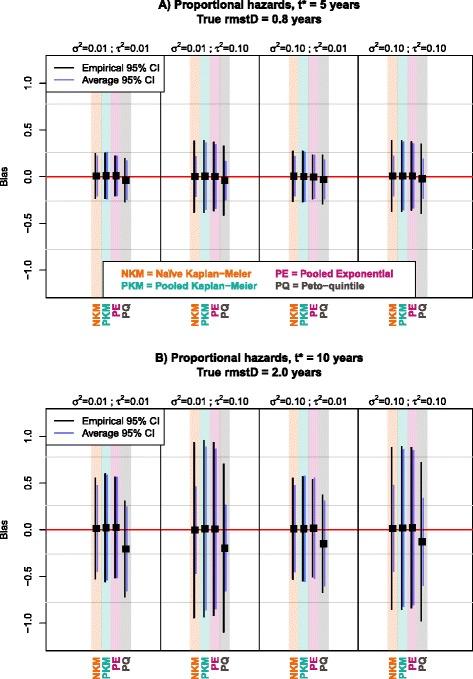
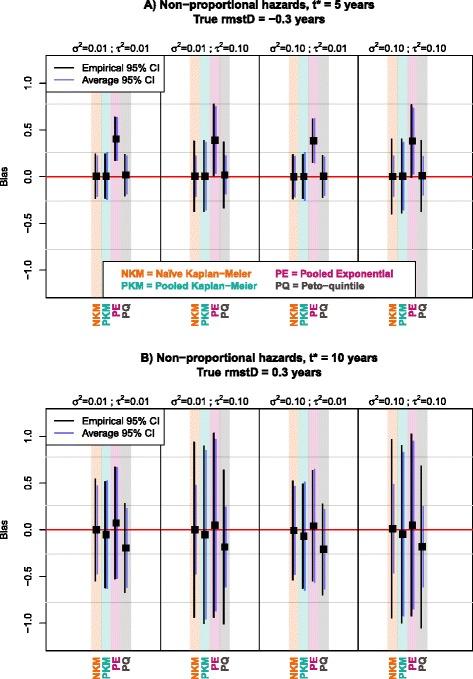
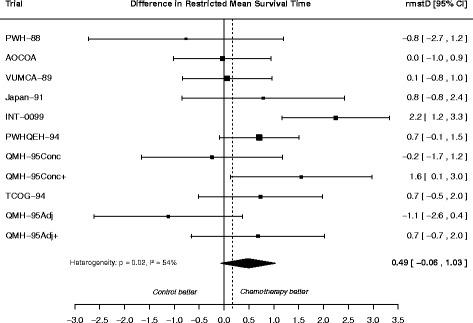
The Naïve Kaplan-Meier method was unbiased, whereas the Pooled Exponential and, to a much lesser extent, the Pooled Kaplan-Meier methods showed a bias with non-proportional hazards. The Peto-quintile method underestimated the [Formula: see text], except with non-proportional hazards at [Formula: see text]= 5 years. In the presence of treatment effect heterogeneity, all methods except the Pooled Kaplan-Meier and the Pooled Exponential with DerSimonian-Laird random effects underestimated the standard error of the [Formula: see text]. Overall, the Pooled Kaplan-Meier method with DerSimonian-Laird random effects formed the best compromise in terms of bias and variance. The [Formula: see text] estimated with the Pooled Kaplan-Meier method was 0.49 years (95% CI: [-0.06;1.03], p = 0.08) when comparing radiotherapy plus chemotherapy vs. radiotherapy alone in the MAC-NPC and 0.59 years (95% CI: [0.34;0.84], p < 0.0001) in the MAC-NPC2.
CONCLUSIONS
We recommend the Pooled Kaplan-Meier method with DerSimonian-Laird random effects to estimate the difference in restricted mean survival time from an individual-patient data meta-analysis.
背景
受限平均生存时间([公式:见正文]),即直至时间范围[公式:见正文]两条生存曲线之间的面积,常用于成本效益分析以估计随机对照试验中的治疗效果。个体患者数据(IPD)荟萃分析中的一个挑战是考虑试验效应。我们旨在比较不同方法以从IPD荟萃分析中估计[公式:见正文]。
方法
我们比较了四种方法:忽略试验效应的Kaplan-Meier曲线(试验组与对照组)之间的面积(朴素Kaplan-Meier法);在事件时间五分位数处计算的Peto曲线之间的面积(Peto-五分位数法);特定试验的Kaplan-Meier曲线(合并Kaplan-Meier法)或特定试验的指数曲线(合并指数法)之间面积的加权平均值。在一项模拟研究中,我们改变了基线风险和治疗效果(可能相关)的试验间异质性、总体治疗效果、时间范围[公式:见正文]、试验数量和患者数量、固定或DerSimonian-Laird随机效应模型的使用以及风险的比例性。我们从偏差、经验标准误差和平均标准误差方面比较这些方法。我们使用鼻咽癌化疗荟萃分析(MAC-NPC)及其更新版本MAC-NPC2的IPD进行说明,MAC-NPC分别包含11项比较中的1975例患者,MAC-NPC2包含23项比较中的5028例患者。
结果
朴素Kaplan-Meier法无偏差,而合并指数法以及在小得多的程度上合并Kaplan-Meier法在风险不成比例时显示出偏差。Peto-五分位数法低估了[公式:见正文],除了在[公式:见正文]=5年时风险不成比例的情况。在存在治疗效果异质性时,除了合并Kaplan-Meier法以及采用DerSimonian-Laird随机效应的合并指数法外,所有方法都低估了[公式:见正文]的标准误差。总体而言,采用DerSimonian-Laird随机效应的合并Kaplan-Meier法在偏差和方差方面形成了最佳折衷。在MAC-NPC中比较放疗加化疗与单纯放疗时,采用合并Kaplan-Meier法估计的[公式:见正文]为0.49年(95%CI:[-0.06;1.03],p = 0.08),在MAC-NPC2中为0.59年(95%CI:[0.34;0.84],p < 0.0001)。
结论
我们推荐采用DerSimonian-Laird随机效应的合并Kaplan-Meier法来从个体患者数据荟萃分析中估计受限平均生存时间的差异。

 Zotero 插件