
探索尿素与苯甲酰胺的共结晶潜力。
Exploring the cocrystallization potential of urea and benzamide.
作者信息
Cysewski Piotr, Przybyłek Maciej, Ziółkowska Dorota, Mroczyńska Karina
机构信息
Department of Physical Chemistry, Faculty of Pharmacy, Collegium Medicum of Bydgoszcz, Nicolaus Copernicus University in Toruń, Kurpińskiego 5, 85-950, Bydgoszcz, Poland.
Research Laboratory, Faculty of Chemical Technology and Engineering, University of Technology and Life Sciences in Bydgoszcz, Seminaryjna 3, 85-326, Bydgoszcz, Poland.
出版信息
J Mol Model. 2016 May;22(5):103. doi: 10.1007/s00894-016-2964-6. Epub 2016 Apr 6.
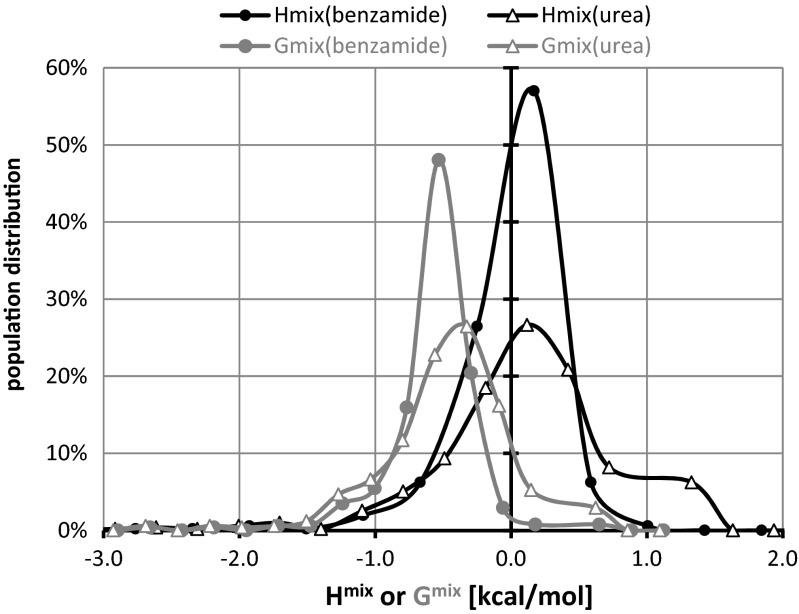
The cocrystallization landscape of benzamide and urea interacting with aliphatic and aromatic carboxylic acids was studied both experimentally and theoretically. Ten new cocrystals of benzamide were synthesized using an oriented samples approach via a fast dropped evaporation technique. Information about types of known bi-component cocrystals augmented with knowledge of simple binary eutectic mixtures was used for the analysis of virtual screening efficiency among 514 potential pairs involving aromatic carboxylic acids interacting with urea or benzamide. Quantification of intermolecular interaction was achieved by estimating the excess thermodynamic functions of binary liquid mixtures under supercooled conditions within a COSMO-RS framework. The smoothed histograms suggest that slightly more potential pairs of benzamide are characterized in the attractive region compared to urea. Finally, it is emphasized that prediction of cocrystals of urea is fairly direct, while it remains ambiguous for benzamide paired with carboxylic acids. The two known simple eutectics of urea are found within the first two quartiles defined by excess thermodynamic functions, and all known cocrystals are outside of this range belonging to the third or fourth quartile. On the contrary, such a simple separation of positive and negative cases of benzamide miscibility in the solid state is not observed. The difference in properties between urea and benzamide R2,2(8) heterosynthons is also documented by alterations of substituent effects. Intermolecular interactions of urea with para substituted benzoic acid analogues are stronger compared to those of benzamide. Also, the amount of charge transfer from amide to aromatic carboxylic acid and vice versa is more pronounced for urea. However, in both cases, the greater the electron withdrawing character of the substituent, the higher the binding energy, and the stronger the supermolecule polarization via the charge transfer mechanism.
通过实验和理论研究了苯甲酰胺和尿素与脂肪族及芳香族羧酸相互作用的共结晶情况。采用快速滴注蒸发技术,通过取向样品法合成了10种新的苯甲酰胺共晶体。利用已知双组分共晶体的类型信息,并结合简单二元低共熔混合物的知识,对514个涉及芳香族羧酸与尿素或苯甲酰胺相互作用的潜在组合进行虚拟筛选效率分析。在COSMO-RS框架下,通过估算过冷条件下二元液体混合物的过量热力学函数来实现分子间相互作用的量化。平滑直方图表明,与尿素相比,苯甲酰胺在吸引区域的潜在组合略多。最后强调,尿素共晶体的预测相当直接,而苯甲酰胺与羧酸配对的情况仍不明确。尿素的两种已知简单低共熔物在前两个由过量热力学函数定义的四分位数范围内,而所有已知共晶体都在该范围之外,属于第三或第四四分位数。相反,在固态下未观察到苯甲酰胺混溶性正负情况的这种简单区分。取代基效应的改变也证明了尿素和苯甲酰胺R2,2(8)杂合成子之间性质的差异。与苯甲酰胺相比,尿素与对位取代苯甲酸类似物的分子间相互作用更强。此外,对于尿素,从酰胺到芳香族羧酸以及反之的电荷转移量更为明显。然而,在两种情况下,取代基的吸电子性越强,结合能越高,通过电荷转移机制的超分子极化越强。




 Zotero 插件