
性别、肥胖及性腺切除术在鸢尾素分泌调节中的作用。
The role of sex, adiposity, and gonadectomy in the regulation of irisin secretion.
作者信息
Zügel M, Qiu S, Laszlo R, Bosnyák E, Weigt C, Müller D, Diel P, Steinacker J M, Schumann U
机构信息
Division of Sports Medicine, Department of Internal Medicine, University Hospital Ulm, Parkstr. 11, 89075, Ulm, Germany.
Department of Endocrinology, Zhongda Hospital, School of Medicine, Southeast University, Nanjing, People's Republic of China.
出版信息
Endocrine. 2016 Oct;54(1):101-110. doi: 10.1007/s12020-016-0913-x. Epub 2016 Apr 7.
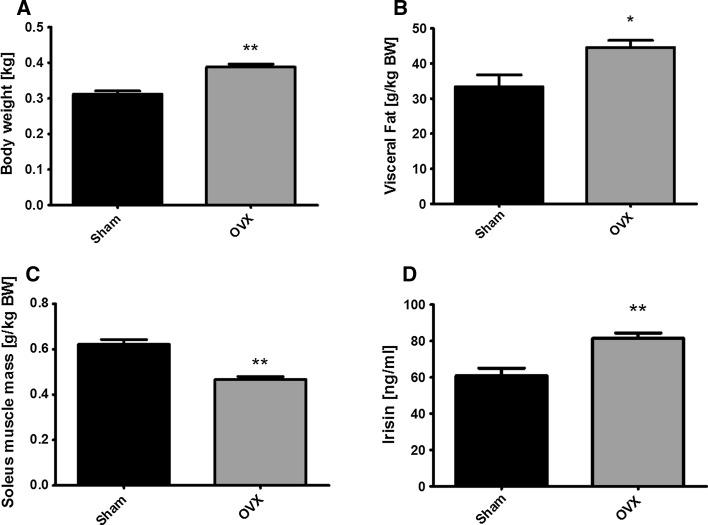
A sexual dimorphism has been reported for the adipo-myokine irisin at rest and in response to exercise. The effects of male and female sex, adiposity, and gonadectomy on irisin secretion have not been investigated before. The objective of this study was to elucidate the effects of sex, adiposity, and gonadectomy in the regulation of irisin secretion as well as PGC-1α/FNDC5 mRNA and protein expression. We hypothesized that a lack of female sex hormones by ovariectomy reduces irisin levels and inhibits skeletal muscle expression of PGC-1α and FNDC5. Circulating irisin was measured in vivo in serum samples of healthy and obese men and women at rest and in response to acute exercise. The effects of gonadectomy on serum irisin, PGC-1α and FNDC5 muscle mRNA, and protein expression were investigated in ovariectomized (OVX) and orchiectomized (ORX) Wistar rats. Serum irisin at rest was not significantly different between men and women (lean or obese). However, in response to acute aerobic exercise, irisin levels increased significantly more in lean women versus men (p ≤ 0.05). In obese individuals, resting irisin concentrations were significantly higher compared to lean subjects (p ≤ 0.001) and the irisin response to acute exercise was blunted. Only the lack of gonadal hormones in OVX but not ORX rats increased serum irisin levels (p ≤ 0.01) and resulted in significantly increased body weight (p ≤ 0.01), adipose tissue content (p ≤ 0.05), muscle FNDC5 mRNA (p ≤ 0.05), and protein (p ≤ 0.01) expression without altering PGC-1α expression. Testosterone treatment in ORX rats leads to increased PGC-1α mRNA content and reduced PGC-1α protein content without affecting FDNC5 expression or serum irisin levels. We show that a sexual dimorphism exists for the acute irisin response to exercise in normal-weight but not in obese subjects. OVX, which is associated with increased adiposity and insulin insensitivity, increases basal FNDC5 expression and serum irisin, without altering PGC-1α expression. This may be an early sign for metabolic disturbances associated with menopause, such as a developing irisin resistance or an attempt of the organism to improve glucose metabolism.
已有报道称,在静息状态及运动状态下,脂肪肌动蛋白鸢尾素存在性别差异。此前尚未研究过雄性和雌性性别、肥胖程度及性腺切除对鸢尾素分泌的影响。本研究的目的是阐明性别、肥胖程度及性腺切除在鸢尾素分泌调节以及过氧化物酶体增殖物激活受体γ辅激活因子1α(PGC-1α)/含III型纤连蛋白结构域5(FNDC5)信使核糖核酸(mRNA)和蛋白表达方面的作用。我们假设,卵巢切除导致女性性激素缺乏会降低鸢尾素水平,并抑制骨骼肌中PGC-1α和FNDC5的表达。在静息状态及急性运动状态下,对健康和肥胖男性及女性的血清样本进行体内循环鸢尾素测定。在去卵巢(OVX)和去势(ORX)的Wistar大鼠中,研究性腺切除对血清鸢尾素、PGC-1α和FNDC5肌肉mRNA及蛋白表达的影响。静息状态下,男性和女性(瘦或肥胖)的血清鸢尾素无显著差异。然而,在急性有氧运动后,瘦女性的鸢尾素水平升高幅度明显大于男性(p≤0.05)。在肥胖个体中,静息鸢尾素浓度显著高于瘦受试者(p≤0.001),且急性运动后鸢尾素反应减弱。仅OVX大鼠而非ORX大鼠缺乏性腺激素会增加血清鸢尾素水平(p≤0.01),并导致体重显著增加(p≤0.01)、脂肪组织含量增加(p≤0.05)、肌肉FNDC5 mRNA(p≤0.05)和蛋白(p≤0.01)表达增加,而不改变PGC-1α表达。对ORX大鼠进行睾酮治疗会导致PGC-1α mRNA含量增加,PGC-1α蛋白含量降低,而不影响FDNC5表达或血清鸢尾素水平。我们发现,正常体重而非肥胖受试者在运动时的急性鸢尾素反应存在性别差异。与肥胖增加和胰岛素不敏感相关的OVX会增加基础FNDC5表达和血清鸢尾素,而不改变PGC-1α表达。这可能是与更年期相关的代谢紊乱的早期迹象,如鸢尾素抵抗的发展或机体改善葡萄糖代谢的尝试。




 Zotero 插件