
耐甲氧西林金黄色葡萄球菌对细菌性肺炎的临床影响:支气管肺泡灌洗液体外培养及16S核糖体RNA基因分析
Clinical impact of methicillin-resistant staphylococcus aureus on bacterial pneumonia: cultivation and 16S ribosomal RNA gene analysis of bronchoalveolar lavage fluid.
作者信息
Kawanami Toshinori, Yatera Kazuhiro, Yamasaki Kei, Noguchi Shingo, Fukuda Kazumasa, Akata Kentarou, Naito Keisuke, Kido Takashi, Ishimoto Hiroshi, Taniguchi Hatsumi, Mukae Hiroshi
机构信息
Department of Respiratory Medicine, University of Occupational and Environmental Health, 1-1 Iseigaoka, Yahatanishiku, Kitakyushu city, Fukuoka, 807-8555, Japan.
Department of Microbiology, University of Occupational and Environmental Health, 1-1 Iseigaoka, Yahatanishiku, Kitakyushu city, Fukuoka, 807-8555, Japan.
出版信息
BMC Infect Dis. 2016 Apr 16;16:155. doi: 10.1186/s12879-016-1493-3.
BACKGROUND
Determining whether methicillin-resistant Staphylococcus aureus (MRSA) is a true causative pathogen or reflective of colonization when MRSA is cultured from the respiratory tract remains important in treating patients with pneumonia.
METHODS
We evaluated the bacterial microbiota in bronchoalveolar lavage fluid (BALF) using the clone library method with a 16S ribosomal RNA (rRNA) gene analysis in 42 patients from a pneumonia registry who had MRSA cultured from their sputum or BALF samples. Patients were divided into two groups: those treated with (Group A) or without (Group B) anti-MRSA agents, and their clinical features were compared.
RESULTS
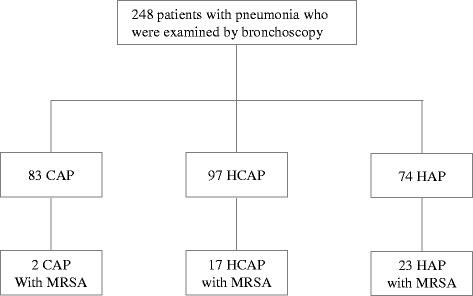
Among 248 patients with pneumonia, 42 patients who had MRSA cultured from the respiratory tract were analyzed (Group A: 13 patients, Group B: 29 patients). No clones of S. aureus were detected in the BALF of 20 out of 42 patients. Twenty-eight of 29 patients in Group B showed favorable clinical outcomes, indicating that these patients had non-MRSA pneumonia. Using a microflora analysis of the BALF, the S. aureus phylotype was predominant in 5 of 28 (17.9%) patients among the detected bacterial phylotypes, but a minor population (the percentage of clones ≤ 10%) in 19 (67.9%) of 28 patients. A statistical analysis revealed no positive relationship between the percentage of clones of the S. aureus phylotype and risk factors of MRSA pneumonia.
CONCLUSIONS
The molecular method using BALF specimens suggests that conventional cultivation method results may mislead true causative pathogens, especially in patients with MRSA pneumonia. Further studies are necessary to elucidate these clinically important issues.
背景
当从呼吸道培养出耐甲氧西林金黄色葡萄球菌(MRSA)时,确定其是真正的致病病原体还是定植的表现,对于肺炎患者的治疗仍然很重要。
方法
我们使用克隆文库法对42例肺炎登记患者的支气管肺泡灌洗液(BALF)中的细菌微生物群进行了16S核糖体RNA(rRNA)基因分析,这些患者的痰液或BALF样本中培养出了MRSA。患者分为两组:接受抗MRSA药物治疗的患者(A组)和未接受抗MRSA药物治疗的患者(B组),并比较了他们的临床特征。
结果
在248例肺炎患者中,分析了42例呼吸道培养出MRSA的患者(A组:13例,B组:29例)。42例患者中有20例的BALF中未检测到金黄色葡萄球菌克隆。B组29例患者中有28例显示出良好的临床结局,表明这些患者患有非MRSA肺炎。通过对BALF进行微生物群分析,在检测到的细菌菌型中,28例患者中有5例(17.9%)的金黄色葡萄球菌菌型占主导地位,但在28例患者中有19例(67.9%)中为少数菌型(克隆百分比≤10%)。统计分析显示,金黄色葡萄球菌菌型的克隆百分比与MRSA肺炎的危险因素之间无正相关关系。
结论
使用BALF标本的分子方法表明,传统培养方法的结果可能会误导真正的致病病原体,尤其是在MRSA肺炎患者中。需要进一步研究以阐明这些临床上重要的问题。
 Zotero 插件