
一项英国全科医疗人群队列研究,调查降脂药物与就医治疗的急性呼吸道疾病后30天死亡率之间的关联。
A UK general practice population cohort study investigating the association between lipid lowering drugs and 30-day mortality following medically attended acute respiratory illness.
作者信息
Joshi Roshni, Venkatesan Sudhir, Myles Puja R
机构信息
Division of Epidemiology and Public Health, University of Nottingham, Nottingham, United Kingdom; Quality Standards and Indicators Programme, National Institute for Health and Care Excellence, Manchester, United Kingdom.
Division of Epidemiology and Public Health, University of Nottingham , Nottingham , United Kingdom.
出版信息
PeerJ. 2016 Apr 18;4:e1902. doi: 10.7717/peerj.1902. eCollection 2016.
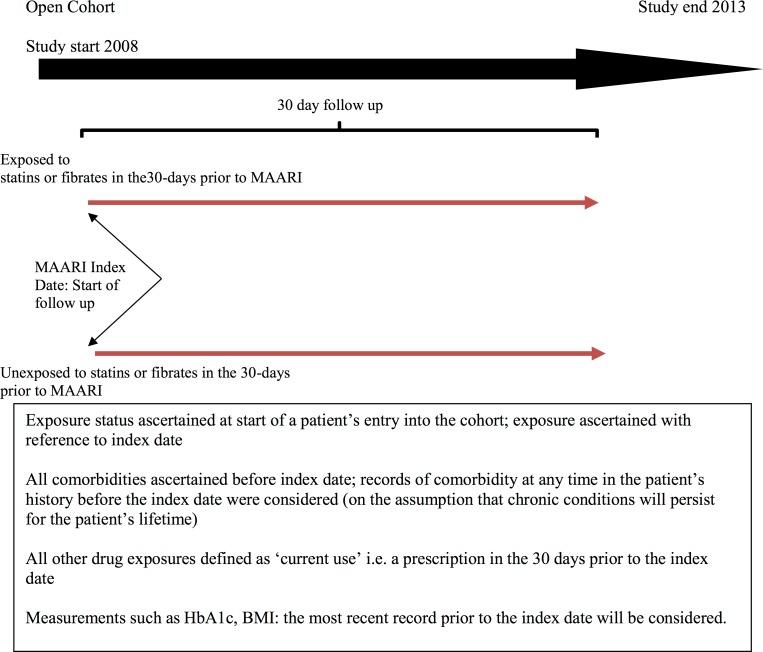
Background. Cholesterol lowering drugs HMG-CoA reductase inhibitors (statins) and PPARα activators (fibrates) have been shown to reduce host inflammation via non-disease specific immunomodulatory mechanisms. Recent studies suggest that commonly prescribed drugs in general practice, statins and fibrates, may be beneficial in influenza-like illness related mortality. This retrospective cohort study examines the association between two lipid lowering drugs, statins and fibrates, and all-cause 30-day mortality following a medically attended acute respiratory illness (MAARI). Methods. Primary care patient data were retrospectively extracted from the UK Clinical Practice Research Datalink (CPRD) database. The sample comprised 201,179 adults aged 30 years or older experiencing a MAARI episode. Patient exposure to statins or fibrates was coded as separate dichotomous variables and deemed current if the most recent GP prescription was issued in the 30 days prior to MAARI diagnosis. Multivariable logistic regression and Cox regression were used for analyses. Adjustment was carried out for chronic lung disease, heart failure, metformin and glitazones, comorbidity burden, socio-demographic and lifestyle variables such as smoking status and body mass index (BMI). Statistical interaction tests were carried out to check for effect modification by gender, body mass index, smoking status and comorbidity. Results. A total of 1,096 (5%) patients died within the 30-day follow up period. Of this group, 213 (19.4%) were statin users and 4 (0.4%) were fibrate users. After adjustment, a significant 35% reduction in odds [adj OR; 0.65 (95% CI [0.52-0.80])] and a 33% reduction in the hazard [adj HR: 0.67 (95% CI [0.55-0.83])] of all-cause 30-day mortality following MAARI was observed in statin users. A significant effect modification by comorbidity burden was observed for the association between statin use and MAARI-related mortality. Fibrate use was associated with a non-significant reduction in 30-day MAARI-related mortality. Conclusion. This study suggests that statin use may be associated with a reduction in 30-day mortality following acute respiratory illness that is severe enough to merit medical consultation. Findings from this study support and strengthen similar observational research while providing a strong rationale for a randomised controlled trial investigating the potential role of statins in acute respiratory infections.
背景。降胆固醇药物HMG-CoA还原酶抑制剂(他汀类药物)和PPARα激活剂(贝特类药物)已被证明可通过非疾病特异性免疫调节机制减轻宿主炎症。最近的研究表明,在全科医疗中常用的药物,他汀类药物和贝特类药物,可能对流感样疾病相关的死亡率有益。这项回顾性队列研究调查了两种降脂药物,他汀类药物和贝特类药物,与就医急性呼吸道疾病(MAARI)后30天全因死亡率之间的关联。方法。从英国临床实践研究数据链(CPRD)数据库中回顾性提取初级保健患者数据。样本包括201,179名30岁及以上经历MAARI发作的成年人。患者对他汀类药物或贝特类药物的暴露被编码为单独的二分变量,如果最近的全科医生处方是在MAARI诊断前30天开具的,则视为当前暴露。使用多变量逻辑回归和Cox回归进行分析。对慢性肺病、心力衰竭、二甲双胍和格列酮类药物、合并症负担、社会人口统计学和生活方式变量(如吸烟状况和体重指数(BMI))进行了调整。进行了统计交互作用检验,以检查性别、体重指数、吸烟状况和合并症的效应修饰。结果。在30天的随访期内,共有1,096名(5%)患者死亡。在这组患者中,213名(19.4%)是他汀类药物使用者,4名(0.4%)是贝特类药物使用者。调整后,观察到MAARI后30天全因死亡率的优势比显著降低35%[调整后的OR;0.65(95%CI[0.52-0.80])],风险降低33%[调整后的HR:0.67(95%CI[0.55-0.83])]。观察到合并症负担对他汀类药物使用与MAARI相关死亡率之间的关联有显著的效应修饰。使用贝特类药物与30天MAARI相关死亡率的非显著降低有关。结论。这项研究表明,使用他汀类药物可能与急性呼吸道疾病后30天死亡率的降低有关,这种疾病严重到足以值得就医咨询。这项研究的结果支持并加强了类似的观察性研究,同时为一项调查他汀类药物在急性呼吸道感染中潜在作用的随机对照试验提供了有力的理论依据。
 Zotero 插件