
中青年时期身体形态轨迹与全因死亡率及特定病因死亡率:两项美国前瞻性队列研究的结果
Trajectory of body shape in early and middle life and all cause and cause specific mortality: results from two prospective US cohort studies.
作者信息
Song Mingyang, Hu Frank B, Wu Kana, Must Aviva, Chan Andrew T, Willett Walter C, Giovannucci Edward L
机构信息
Clinical and Translational Epidemiology Unit and Division of Gastroenterology, Massachusetts General Hospital and Harvard Medical School, Boston, MA02114, USA Departments of Nutrition and Epidemiology, Harvard T H Chan School of Public Health, Boston, MA 02115, USA.
Departments of Nutrition and Epidemiology, Harvard T H Chan School of Public Health, Boston, MA 02115, USA Channing Division of Network Medicine, Department of Medicine, Harvard Medical School, Boston, MA 02115, USA.
出版信息
BMJ. 2016 May 4;353:i2195. doi: 10.1136/bmj.i2195.
OBJECTIVE
To assess body shape trajectories in early and middle life in relation to risk of mortality.
DESIGN
Prospective cohort study.
SETTING
Nurses' Health Study and Health Professionals Follow-up Study.
POPULATION
80 266 women and 36 622 men who recalled their body shape at ages 5, 10, 20, 30, and 40 years and provided body mass index at age 50, followed from age 60 over a median of 15-16 years for death.
MAIN OUTCOME MEASURES
All cause and cause specific mortality.
RESULTS
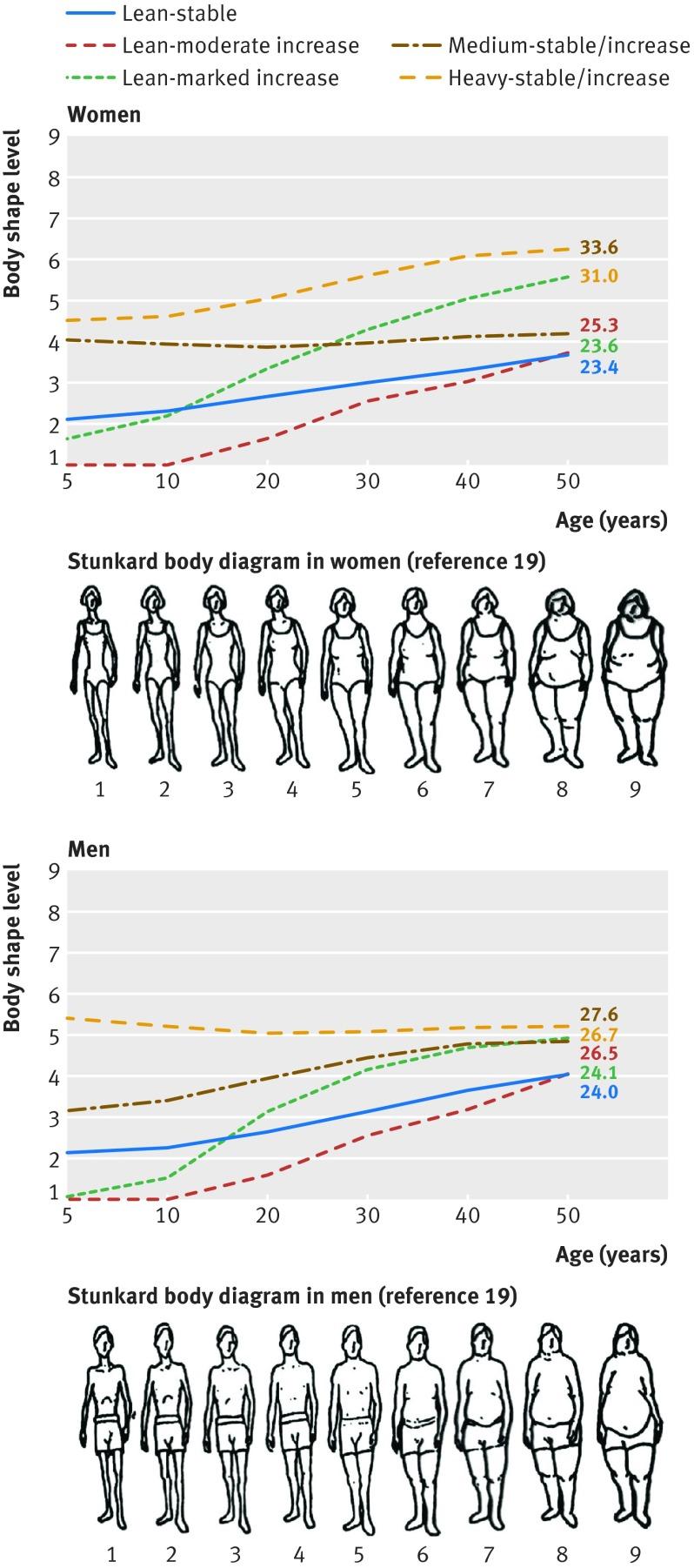
Using a group based modeling approach, five distinct trajectories of body shape from age 5 to 50 were identified: lean-stable, lean-moderate increase, lean-marked increase, medium-stable/increase, and heavy-stable/increase. The lean-stable group was used as the reference. Among never smokers, the multivariable adjusted hazard ratio for death from any cause was 1.08 (95% confidence interval 1.02 to 1.14) for women and 0.95 (0.88 to 1.03) for men in the lean-moderate increase group, 1.43 (1.33 to 1.54) for women and 1.11 (1.02 to 1.20) for men in the lean-marked increase group, 1.04 (0.97 to 1.12) for women and 1.01 (0.94 to 1.09) for men in the medium-stable/increase group, and 1.64 (1.49 to 1.81) for women and 1.19 (1.08 to 1.32) for men in the heavy-stable/increase group. For cause specific mortality, participants in the heavy-stable/increase group had the highest risk, with a hazard ratio among never smokers of 2.30 (1.88 to 2.81) in women and 1.45 (1.23 to 1.72) in men for cardiovascular disease, 1.37 (1.14 to 1.65) in women and 1.07 (0.89 to 1.30) in men for cancer, and 1.59 (1.38 to 1.82) in women and 1.10 (0.95 to 1.29) in men for other causes. The trajectory-mortality association was generally weaker among ever smokers than among never smokers (for all cause mortality: P for interaction <0.001 in women and 0.06 in men). When participants were classified jointly according to trajectories and history of type 2 diabetes, the increased risk of death associated with heavier body shape trajectories was more pronounced among participants with type 2 diabetes than those without diabetes, and those in the heavy-stable/increase trajectory and with a history of diabetes had the highest risk of death.
CONCLUSIONS
Using the trajectory approach, we found that heavy body shape from age 5 up to 50, especially the increase in middle life, was associated with higher mortality. In contrast, people who maintained a stably lean body shape had the lowest mortality. These results indicate the importance of weight management across the lifespan.
目的
评估生命早期和中年阶段的体型轨迹与死亡风险之间的关系。
设计
前瞻性队列研究。
背景
护士健康研究和卫生专业人员随访研究。
研究对象
80266名女性和36622名男性,他们回忆了自己在5岁、10岁、20岁、30岁和40岁时的体型,并提供了50岁时的体重指数,从60岁开始随访,中位随访时间为15 - 16年以观察死亡情况。
主要观察指标
全因死亡率和特定病因死亡率。
结果
采用基于群组的建模方法,确定了从5岁到50岁的五种不同体型轨迹:瘦且稳定型、瘦且适度增加型、瘦且显著增加型、中等稳定/增加型以及胖且稳定/增加型。以瘦且稳定型组作为参照。在从不吸烟者中,对于全因死亡,瘦且适度增加型组的女性多变量调整风险比为1.08(95%置信区间1.02至1.14),男性为0.95(0.88至1.03);瘦且显著增加型组的女性为1.43(1.33至1.54),男性为1.11(1.02至1.20);中等稳定/增加型组的女性为1.04(0.97至1.12),男性为1.01(0.94至1.09);胖且稳定/增加型组的女性为1.64(1.49至1.81),男性为1.19(1.08至1.32)。对于特定病因死亡率,胖且稳定/增加型组的参与者风险最高,在从不吸烟者中,该组女性患心血管疾病的风险比为2.30(1.88至2.81),男性为1.45(1.23至1.72);患癌症的风险比女性为1.37(1.14至1.65),男性为1.07(0.89至1.30);其他病因导致死亡的风险比女性为1.59(1.38至1.82),男性为1.10(0.95至1.29)。当前吸烟者中的轨迹 - 死亡率关联通常比从不吸烟者中的弱(对于全因死亡率:女性交互作用P<0.001,男性为0.06)。当根据轨迹和2型糖尿病病史对参与者进行联合分类时,与较重体型轨迹相关的死亡风险增加在患有2型糖尿病的参与者中比未患糖尿病者更为明显,且处于胖且稳定/增加轨迹且有糖尿病病史的参与者死亡风险最高。
结论
采用轨迹分析方法,我们发现从5岁到50岁的肥胖体型,尤其是中年期体型增加,与较高死亡率相关。相比之下,保持稳定瘦体型的人死亡率最低。这些结果表明了终生体重管理的重要性。

 Zotero 插件