
基于症状的诊断方法与基于聚合酶链反应(PCR)的诊断检测的对比分析显示,有症状患者中基于主观判断的滴虫病误诊/过度治疗情况。
Comparative analysis of syndromic and PCR-based diagnostic assay reveals misdiagnosis/ overtreatment for trichomoniasis based on subjective judgment in symptomatic patients.
作者信息
Sonkar Subash Chandra, Wasnik Kirti, Kumar Anita, Mittal Pratima, Saluja Daman
机构信息
Dr. B. R. Ambedkar Center for Biomedical Research, University of Delhi, Delhi, 110007, India.
Department of Obstetrics & Gynecology, Vardhman Mahavir Medical College and Safdarjung Hospital, New Delhi, 110029, India.
出版信息
Infect Dis Poverty. 2016 May 5;5:42. doi: 10.1186/s40249-016-0133-x.
BACKGROUND
Trichomoniasis, a sexually transmitted disease (STD), is caused by Trichomonas vaginalis in both men and women. Screening of trichomoniasis is problematic in resource challenged settings as currently available, inexpensive diagnostic methods are of low sensitivity and/or specificity. In India, National AIDS Control organization (NACO) recommended syndromic case management (SCM) for treatment. The objective of the present study was to compare the utility of the NACO-NACP III Algorithms for STI/RTI treatment used by clinicians with PCR based diagnosis.
METHODS
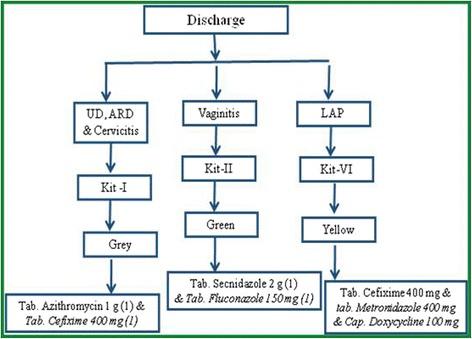
Patients visiting Department of Obstetrics & Gynecology, Vardhman Mahavir Medical College and Safdarjung Hospital, New Delhi from January 2011 to June 2014 were enrolled in the study to compare the diagnostic efficiency of PCR-based assays against SCM. Based on SCM, patients (n = 820) were treated with antibiotics using pre-packed STI/RTI kits (sexually transmitted infection/reproductive tract infection; procured by National AIDS Control/State AIDS Control Society (NACO/SACS), Ministry of Health and Family Welfare, Govt of India.) under National AIDS Control Programme (NACP III) for syndromic case management (SCM). Ectocervical dry swab samples were also obtained from these patients and out of that 634 samples were tested by PCR. Total genomic DNA was extracted from these samples and used as template for PCR amplification using pfoB, gyrA and orf1 gene specific primers for diagnosis of T. vaginalis (TV), Chlamydia trachomatis (CT) and Neisseria gonorrhoeae (NG) respectively.
RESULTS
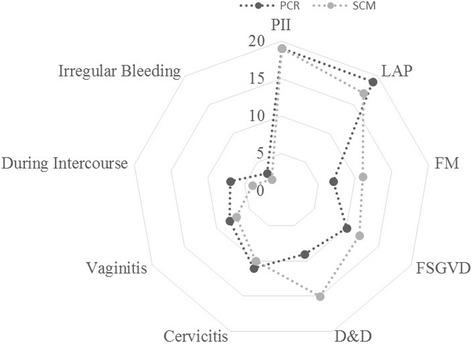
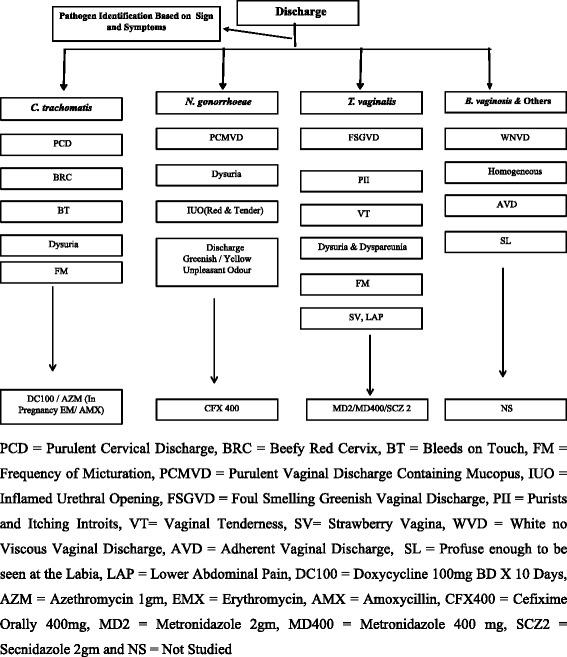
Out of 6000 patients who visited OPD, 820 (14 %) female patients reported vaginal discharge and were recommended antibiotic treatment for one or more pathogens namely, TV, CT, NG and Candida or for co-infection. On the basis of signs & symptoms and NACO guidelines, the following distribution of various infections was observed: TV (46 %), CT (20 %), coinfection with TV and CT (12 %), coinfection with CT and NG (11 %), coinfection with TV, CT and Candida (7 %) and coinfection with TV and NG (2 %). Others were infected with NG alone (1 %), coinfected with TV and Candida (0.4 %) and 0.3 % were coinfected with CT, NG and Candida. Based on PCR method, 110 (17 %) women tested positive for one or more of these three pathogens while 524 (83 %) women were negative for any of these three pathogens but could be positive for other STIs not tested in this study. Since all the patients (634) were given antibiotics, we estimate that the over-treatment was 85 % while 524 (83 %) patients were also misdiagnosed by SCM.
CONCLUSIONS
The over-treatment and inaccurate diagnosis of pathogens due to subjective judgment based on syndromic approach in symptomatic women is a large economic wastage and may also contribute towards increased resistance. The misdiagnosed patients will also serve as a reservoir for transmission of pathogens to their sexual partner.
背景
滴虫病是一种性传播疾病(STD),由阴道毛滴虫感染男性和女性引起。在资源有限的环境中,滴虫病的筛查存在问题,因为目前可用的廉价诊断方法灵敏度和/或特异性较低。在印度,国家艾滋病控制组织(NACO)推荐采用综合征病例管理(SCM)进行治疗。本研究的目的是比较临床医生使用的NACO-NACP III性传播感染/生殖系统感染治疗算法与基于聚合酶链反应(PCR)的诊断方法的效用。
方法
2011年1月至2014年6月期间,就诊于新德里瓦尔丹·马哈拉施特拉医学院和萨夫达容医院妇产科的患者被纳入本研究,以比较基于PCR的检测方法与综合征病例管理的诊断效率。根据综合征病例管理,820例患者使用预包装的性传播感染/生殖系统感染试剂盒(由印度政府卫生和家庭福利部国家艾滋病控制/邦艾滋病控制协会(NACO/SACS)采购)中的抗生素,在国家艾滋病控制项目(NACP III)下进行综合征病例管理(SCM)治疗。还从这些患者中获取了宫颈外干拭子样本,其中634份样本进行了PCR检测。从这些样本中提取总基因组DNA,并分别用作PCR扩增的模板,使用pfoB、gyrA和orf1基因特异性引物诊断阴道毛滴虫(TV)、沙眼衣原体(CT)和淋病奈瑟菌(NG)。
结果
在6000例门诊患者中,820例(14%)女性患者报告有阴道分泌物,并被建议针对一种或多种病原体(即TV、CT、NG和念珠菌)或合并感染使用抗生素治疗。根据体征和症状以及NACO指南,观察到各种感染的分布如下:TV(46%)、CT(20%)、TV和CT合并感染(12%)、CT和NG合并感染(11%)、TV、CT和念珠菌合并感染(7%)以及TV和NG合并感染(2%)。其他患者仅感染NG(1%)、TV和念珠菌合并感染(0.4%),0.3%的患者CT、NG和念珠菌合并感染。基于PCR方法,110例(17%)女性患者这三种病原体中的一种或多种检测呈阳性,而524例(83%)女性患者这三种病原体均为阴性,但可能对本研究未检测的其他性传播感染呈阳性。由于所有患者(634例)均接受了抗生素治疗,我们估计过度治疗率为85%,而524例(83%)患者也被综合征病例管理误诊。
结论
有症状女性基于综合征方法的主观判断导致病原体的过度治疗和不准确诊断,这是巨大的经济浪费,也可能导致耐药性增加。被误诊的患者也将成为病原体传播给其性伴侣的储存宿主。

 Zotero 插件