
袖状胃切除术对胰岛素抵抗的影响。
Effects of sleeve gastrectomy on insulin resistance.
作者信息
Cătoi Adriana Florinela, Pârvu Alina, Mironiuc Aurel, Galea Romeo Florin, Mureşan Adriana, Bidian Cristina, Pop Ioana
机构信息
Department of Functional Biosciences, Faculty of Medicine, Iuliu Hatieganu University of Medicine and Pharmacy, Cluj-Napoca, Romania.
Second Surgical Department, Faculty of Medicine, Iuliu Hatieganu University of Medicine and Pharmacy, Cluj-Napoca, Romania.
出版信息
Clujul Med. 2016;89(2):267-72. doi: 10.15386/cjmed-576. Epub 2016 Apr 15.
BACKGROUND AND AIM
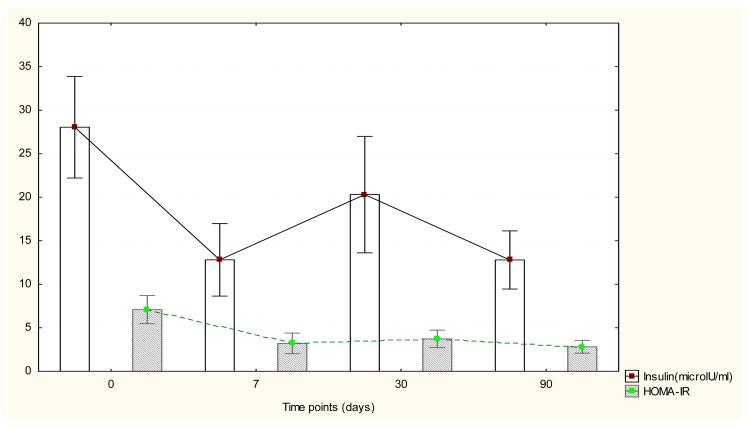
Obesity is a major risk factor for the onset of insulin resistance (IR), hyperinsulinemia and type 2 diabetes mellitus (T2DM) Evidence data has proven that beyond important weight loss bariatric surgery especially Roux-en-Y gastric bypass (RYGB) and bilio-pancreatic diversion (BPD) leads to significant early reduction of insulinemia and of IR calculated through the homeostatic model assessment (HOMA-IR), independently of fat mass decrease. Sleeve gastrectomy (SG) is now used as a sole weight loss operation with good results. Therefore, the aim of the present study was to investigate the early changes of fasting blood glucose, insulin and HOMA-IR in a group of morbidly obese (MO) patients i.e. at 7, 30 and 90 days after SG.
METHODS
The study included 20 MO patients (7 male and 13 female) submitted to SG. Anthropometrical (weight, body mass index -BMI, percent excess BMI loss -%EBMIL) and biochemical (plasma glucose, insulin and calculated HOMA-IR ) evaluation were performed before and at 7, 30 and 90 days after SG. In addition, a second group of 10 normal weight healthy subjects with a BMI ranging form 19 kg/m(2) to 23.14 kg/m(2), matched for age and gender was investigated.
RESULTS
Plasma glucose (p=0.018), insulin (p=0.004) and HOMA-IR (p=0.006) values were statistically different between the studied groups. After surgery, at every follow-up point, there were statistically different weight and BMI mean values relative to the operation day (p<0.003). BMI, decreased at 7 days (estimated reduction=2.79; 95% CI:[2.12;3.45]), at 30 days (estimated reduction=5.65; 95% CI:[3.57;7.73]) and at 90 days (estimated reduction=10.88; 95% CI:[7.35;14.41]) respectively after SG. We noted a tendency toward statistical significant change of mean insulin values at 7 days after surgery (corrected p=0.075), no statistical change at 30 days (corrected p=0.327) and a significant change at 90 days (corrected p=0.027) after SG as compared to baseline. There was a significant change in mean values of HOMA-IR at 30 days (corrected p=0.009) and at 90 days (corrected p=0.021) after the operation day.
CONCLUSIONS
The present study showed important early changes consisting in reductions of mean values of plasma insulin and HOMA-IR after SG.
背景与目的
肥胖是胰岛素抵抗(IR)、高胰岛素血症及2型糖尿病(T2DM)发病的主要危险因素。有证据表明,除了显著减重外,减重手术尤其是 Roux-en-Y 胃旁路术(RYGB)和胆胰转流术(BPD)可使胰岛素血症及通过稳态模型评估(HOMA-IR)计算得出的IR显著早期降低,且与脂肪量减少无关。袖状胃切除术(SG)目前作为一种单纯的减重手术应用,效果良好。因此,本研究的目的是调查一组病态肥胖(MO)患者在 SG 术后7天、30天和90天时空腹血糖、胰岛素及 HOMA-IR 的早期变化。
方法
本研究纳入20例接受 SG 的 MO 患者(7例男性和13例女性)。在 SG 术前及术后7天、30天和90天进行人体测量(体重、体重指数 -BMI、超重 BMI 丢失百分比-%EBMIL)和生化评估(血浆葡萄糖、胰岛素及计算得出的 HOMA-IR)。此外,还调查了另一组10名体重正常的健康受试者,其 BMI 范围为19 kg/m²至23.14 kg/m²,年龄和性别匹配。
结果
研究组之间的血浆葡萄糖(p = 0.018)、胰岛素(p = 0.004)和 HOMA-IR(p = 0.006)值存在统计学差异。手术后,在每个随访点,相对于手术日,体重和 BMI 的平均值均存在统计学差异(p < 0.003)。SG 术后7天(估计降低值 = 2.79;95% CI:[2.12;3.45])、30天(估计降低值 = 5.65;95% CI:[3.57;7.73])和90天(估计降低值 = 10.88;95% CI:[7.35;14.41])时 BMI 分别降低。我们注意到,与基线相比,术后7天胰岛素平均值有统计学显著变化趋势(校正 p = 0.075),30天无统计学变化(校正 p = 0.327),90天有显著变化(校正 p = 0.027)。手术后30天(校正 p = 0.009)和90天(校正 p = 0.021)时 HOMA-IR 的平均值有显著变化。
结论
本研究显示,SG 术后血浆胰岛素和 HOMA-IR 平均值降低,出现了重要的早期变化。
 Zotero 插件