
孕期母体尿中邻苯二甲酸酯代谢物重复测量值与甲状腺激素参数之间的关联。
Associations between Repeated Measures of Maternal Urinary Phthalate Metabolites and Thyroid Hormone Parameters during Pregnancy.
作者信息
Johns Lauren E, Ferguson Kelly K, McElrath Thomas F, Mukherjee Bhramar, Meeker John D
机构信息
Department of Environmental Health Sciences, University of Michigan School of Public Health, Ann Arbor, Michigan, USA.
出版信息
Environ Health Perspect. 2016 Nov;124(11):1808-1815. doi: 10.1289/EHP170. Epub 2016 May 6.
BACKGROUND
Maintaining thyroid homeostasis during pregnancy is essential for normal fetal growth and development. Growing evidence suggests that phthalates interfere with normal thyroid function. Few human studies have investigated the degree to which phthalates may affect thyroid hormone levels in particularly susceptible populations such as pregnant women.
OBJECTIVES
We examined the associations between repeated measures of urinary phthalate metabolites and plasma thyroid hormone levels in samples collected at up to four time points per subject in pregnancy. Additionally, we investigated the potential windows of susceptibility to thyroid hormone disturbances related to study visit of sample collection.
METHODS
Data were obtained from pregnant women (n = 439) participating in a nested case-control study of preterm birth with 116 cases and 323 controls. We measured 9 phthalate metabolite concentrations in urine samples collected at up to four study visits per subject during pregnancy (median = 10, 18, 26, and 35 weeks of gestation, respectively). We also measured a panel of thyroid function markers in plasma collected at the same four time points per subject during pregnancy.
RESULTS
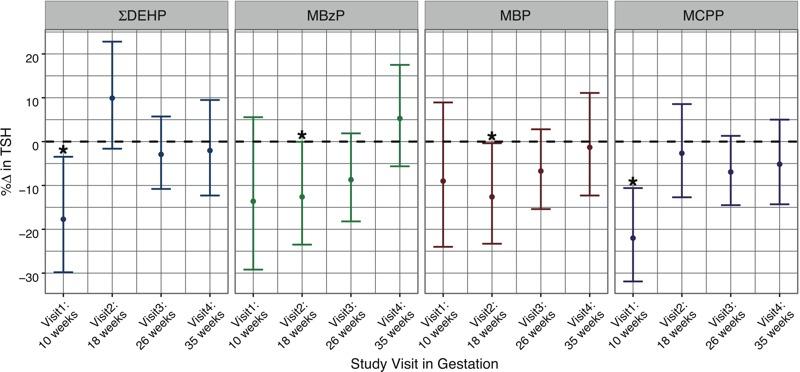
Although our results were generally null, in repeated measures analyses we observed that phthalate metabolites were largely inversely associated with thyrotropin and positively associated with free and total thyroid hormones. Cross-sectional analyses by study visit revealed that the magnitude and/or direction of these relationships varied by timing of exposure during gestation.
CONCLUSIONS
These results support previous reports showing the potential for environmental phthalate exposure to alter circulating levels of thyroid hormones in pregnant women. Citation: Johns LE, Ferguson KK, McElrath TF, Mukherjee B, Meeker JD. 2016. Associations between repeated measures of maternal urinary phthalate metabolites and thyroid hormone parameters during pregnancy. Environ Health Perspect 124:1808-1815; http://dx.doi.org/10.1289/EHP170.
背景
孕期维持甲状腺内环境稳定对胎儿正常生长发育至关重要。越来越多的证据表明,邻苯二甲酸盐会干扰正常甲状腺功能。很少有人类研究调查邻苯二甲酸盐在孕妇等特别易感人群中可能影响甲状腺激素水平的程度。
目的
我们研究了在孕期每位受试者多达四个时间点采集的样本中,尿邻苯二甲酸酯代谢物的重复测量值与血浆甲状腺激素水平之间的关联。此外,我们还研究了与样本采集研究访视相关的甲状腺激素紊乱的潜在易感期。
方法
数据来自参与早产巢式病例对照研究的孕妇(n = 439),其中有116例病例和323例对照。我们测量了每位受试者在孕期多达四次研究访视时采集的尿样中9种邻苯二甲酸酯代谢物的浓度(分别为妊娠10、18、26和35周的中位数)。我们还测量了每位受试者在孕期相同的四个时间点采集的血浆中的一组甲状腺功能标志物。
结果
尽管我们的结果总体上无统计学意义,但在重复测量分析中,我们观察到邻苯二甲酸酯代谢物在很大程度上与促甲状腺激素呈负相关,与游离甲状腺激素和总甲状腺激素呈正相关。按研究访视进行的横断面分析显示,这些关系的大小和/或方向因孕期暴露时间而异。
结论
这些结果支持了先前的报告,表明环境中邻苯二甲酸酯暴露有可能改变孕妇甲状腺激素的循环水平。引文:约翰斯LE,弗格森KK,麦克尔拉思TF,慕克吉B,米克JD。2016年。孕期孕妇尿邻苯二甲酸酯代谢物重复测量值与甲状腺激素参数之间的关联。《环境健康展望》124:1808 - 1815;http://dx.doi.org/10.1289/EHP170 。

 Zotero 插件