
对啮齿动物的回避、地形和森林结构影响一种森林鸟类的领地选择。
Rodent-avoidance, topography and forest structure shape territory selection of a forest bird.
作者信息
Pasinelli Gilberto, Grendelmeier Alex, Gerber Michael, Arlettaz Raphaël
机构信息
Swiss Ornithological Institute, Sempach, Switzerland.
Department of Evolutionary Biology and Environmental Studies, University of Zurich, Zurich, Switzerland.
出版信息
BMC Ecol. 2016 May 9;16:24. doi: 10.1186/s12898-016-0078-8.
BACKGROUND
Understanding the factors underlying habitat selection is important in ecological and evolutionary contexts, and crucial for developing targeted conservation action in threatened species. However, the key factors associated to habitat selection often remain poorly known. We evaluated hypotheses related to abiotic and biotic factors thought to affect territory selection of the wood warbler Phylloscopus sibilatrix, a passerine living in an unpredictable environment owing to irregular rodent outbreaks and showing long-term declines particularly in Western Europe.
RESULTS
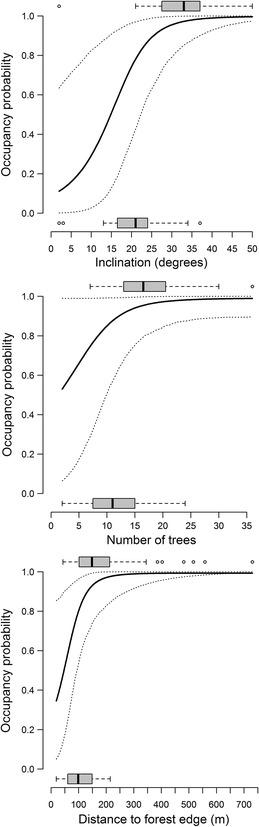
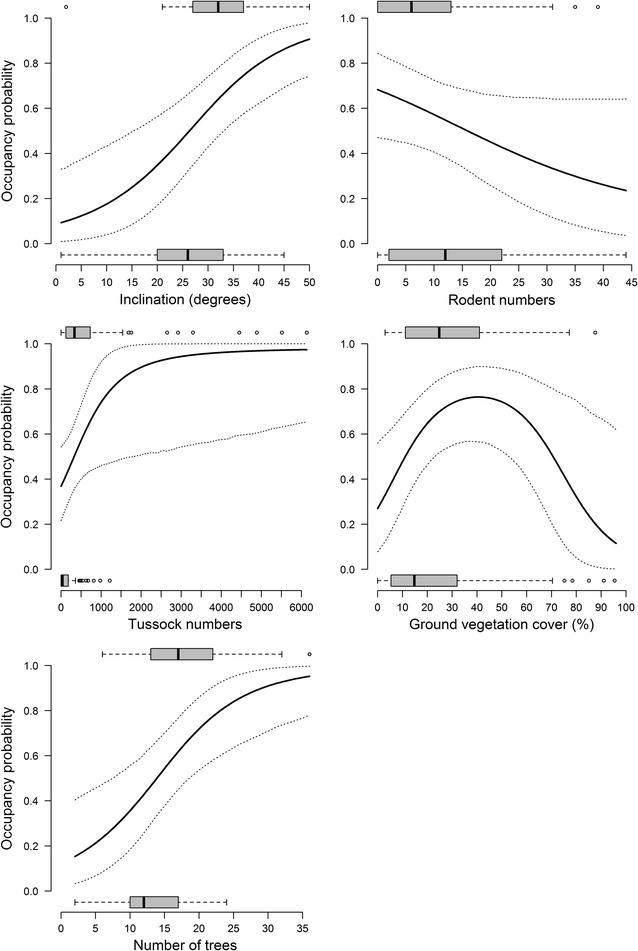
Comparing breeding territories to unoccupied areas located close-by revealed that territory occupancy in north-western Switzerland was positively related to slope steepness (topographic hypothesis supported) as well as to numbers of tussocks and trees, respectively, while it showed a unimodal relationship to cover of herb layer (forest structure hypothesis supported). Furthermore, a strong negative correlation between breeding territory occupancy and rodent numbers was found, suggesting that wood warblers avoid areas with high rodent densities (rodent-avoidance hypothesis supported). Comparing breeding territories to abandoned territories showed that breeding territories were located on steeper slopes (topography hypothesis supported), at larger distance from the forest edge (anthropogenic disturbance hypothesis supported) and harboured more trees (forest structure hypothesis supported) than abandoned territories.
CONCLUSIONS
Aside from structural and topographic features of the habitat, wood warblers are affected by rodent numbers when settling, making habitat selection unpredictable from year to year. Forestry practices promoting relatively high tree densities, few bushes and an intermediate low-growing ground vegetation cover would enhance habitat quality for this declining passerine. In contrast, forestry practices aiming at increasing light in forests (selective thinning, group-felling) or keeping forest stands permanently covered with shrubs, bushes and trees of various sizes (continuous cover forestry) do not benefit the wood warbler.
背景
了解栖息地选择背后的因素在生态和进化背景下很重要,对于制定针对濒危物种的保护行动也至关重要。然而,与栖息地选择相关的关键因素往往仍鲜为人知。我们评估了与非生物和生物因素相关的假设,这些因素被认为会影响林鹟(Phylloscopus sibilatrix)的领地选择,林鹟是一种生活在不可预测环境中的雀形目鸟类,由于啮齿动物的不定期爆发,其数量长期下降,尤其是在西欧地区。
结果
将繁殖领地与附近未被占据的区域进行比较发现,瑞士西北部的领地占有率与坡度陡度呈正相关(支持地形假设),分别与草丛和树木数量呈正相关,而与草本层覆盖度呈单峰关系(支持森林结构假设)。此外,发现繁殖领地占有率与啮齿动物数量之间存在强烈的负相关,这表明林鹟会避开啮齿动物密度高的区域(支持啮齿动物回避假设)。将繁殖领地与废弃领地进行比较表明,繁殖领地比废弃领地位于更陡峭的斜坡上(支持地形假设),离森林边缘更远(支持人为干扰假设),并且树木更多(支持森林结构假设)。
结论
除了栖息地的结构和地形特征外,林鹟在定居时会受到啮齿动物数量的影响,这使得栖息地选择每年都不可预测。促进相对较高树木密度、较少灌木和中等低生长地面植被覆盖的林业实践将提高这种数量下降的雀形目鸟类的栖息地质量。相比之下,旨在增加森林光照(选择性疏伐、群团皆伐)或将林分永久保持为各种大小的灌木、灌木丛和树木覆盖(连续覆盖林业)的林业实践对林鹟没有益处。

 Zotero 插件