
电针治疗多囊卵巢综合征的有效性:一项随机对照试验的研究方案
Effectiveness of electroacupuncture for polycystic ovary syndrome: study protocol for a randomized controlled trial.
作者信息
Chen Jiao, Feng Shuwei, Zeng Jiuzhi, Wu Xi, Yang Mingxiao, Tang Hongzhi, Fan Huaying, Yang Jie, Liang Fanrong
机构信息
Chengdu University of Traditional Chinese Medicine, Chengdu, Sichuan, China.
Maternal and Child Health Hospital of Sichuan Province, Chengdu, Sichuan, China.
出版信息
Trials. 2016 May 21;17(1):256. doi: 10.1186/s13063-016-1375-4.
BACKGROUND
Whether electroacupuncture is effective for patients with polycystic ovary syndrome is still inconclusive. Therefore, this study aims to evaluate the add-on effects of electroacupuncture to conventional drugs for the treatment of polycystic ovary syndrome.
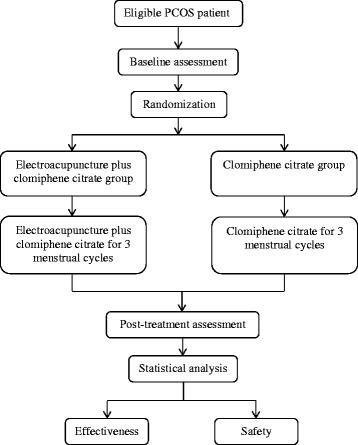
METHODS/DESIGN: This study is a two-center, open-labeled, randomized, controlled trial. A total of 116 eligible patients with polycystic ovary syndrome will be randomly allocated in a 1:1 ratio to the electroacupuncture plus clomiphene citrate group or to the clomiphene citrate group. Participants in the electroacupuncture plus clomiphene citrate group will receive electroacupuncture treatment in addition to clomiphene citrate capsules, whereas participants in the clomiphene citrate group will be prescribed clomiphene citrate capsules only. Electroacupuncture treatment will be performed from the fifth day of menstruation or withdrawal bleeding until the next menstruation, in three sessions per week for three menstrual cycles. The primary outcome is the ovulation rate. The secondary outcomes include the dominant follicle rate, mean number of dominant follicles, endometrial thickness, time point of ovulation, follicular size before ovulation, luteinizing hormone, estradiol level, and pregnancy rate. The measuring points for outcomes will be baseline and the completion of treatment. Any adverse events occurring during the trial process will be recorded. In addition, a quality-monitoring group independent from the research team will be set up to control the quality of the trial.
DISCUSSION
The design and methodological rigor of this trial will allow for the collection of valuable data to evaluate the effectiveness of electroacupuncture for treating polycystic ovary syndrome. Therefore, this trial will contribute reliable evidence for use in clinical decision-making in acupuncture therapy of polycystic ovary syndrome as well as to future research in acupuncture for polycystic ovary syndrome.
TRIAL REGISTRATION
Chinese Clinical Trial Registry, ChiCTR-IOR-15007358 , registered on 26 October 2015.
背景
电针治疗多囊卵巢综合征患者是否有效尚无定论。因此,本研究旨在评估电针辅助传统药物治疗多囊卵巢综合征的附加效果。
方法/设计:本研究为一项双中心、开放标签、随机对照试验。总共116例符合条件的多囊卵巢综合征患者将按1:1的比例随机分配至电针加枸橼酸氯米芬组或枸橼酸氯米芬组。电针加枸橼酸氯米芬组的参与者除服用枸橼酸氯米芬胶囊外,还将接受电针治疗,而枸橼酸氯米芬组的参与者仅开具枸橼酸氯米芬胶囊。电针治疗将从月经第5天或撤退性出血开始,直至下次月经,每周3次,共3个月经周期。主要结局指标为排卵率。次要结局指标包括优势卵泡率、优势卵泡平均数量、子宫内膜厚度、排卵时间点、排卵前卵泡大小、促黄体生成素、雌二醇水平及妊娠率。结局指标的测量时间点为基线和治疗结束时。试验过程中发生的任何不良事件都将被记录。此外,将设立一个独立于研究团队的质量监测小组以控制试验质量。
讨论
本试验的设计和方法严谨性将有助于收集有价值的数据,以评估电针治疗多囊卵巢综合征的有效性。因此,本试验将为多囊卵巢综合征针刺治疗的临床决策提供可靠证据,并为未来多囊卵巢综合征的针刺研究做出贡献。
试验注册
中国临床试验注册中心,ChiCTR-IOR-15007358,于2015年10月26日注册。
 Zotero 插件