
埃塞俄比亚中部奥罗米亚特别区儿童十二指肠贾第虫分离株的多位点基因分型
Multilocus genotyping of Giardia duodenalis isolates from children in Oromia Special Zone, central Ethiopia.
作者信息
Wegayehu Teklu, Karim Md Robiul, Li Junqiang, Adamu Haileeyesus, Erko Berhanu, Zhang Longxian, Tilahun Getachew
机构信息
Aklilu Lemma Institute of Pathobiology, Addis Ababa University, Addis Ababa, Ethiopia.
College of Natural Sciences, Arba Minch University, Arba Minch, Ethiopia.
出版信息
BMC Microbiol. 2016 May 21;16:89. doi: 10.1186/s12866-016-0706-7.
BACKGROUND
Giardia duodenalis is the etiologic agent of giardiasis in humans and other mammals worldwide. The burden of disease is high among children in developing countries where sanitation is inadequate. However, the epidemiology and genetic diversity of this parasite is poorly understood in Ethiopia. This study aimed to determine the prevalence and genetic diversity of G. duodenalis in asymptomatic children in Oromia Special Zone, central Ethiopia.
RESULTS
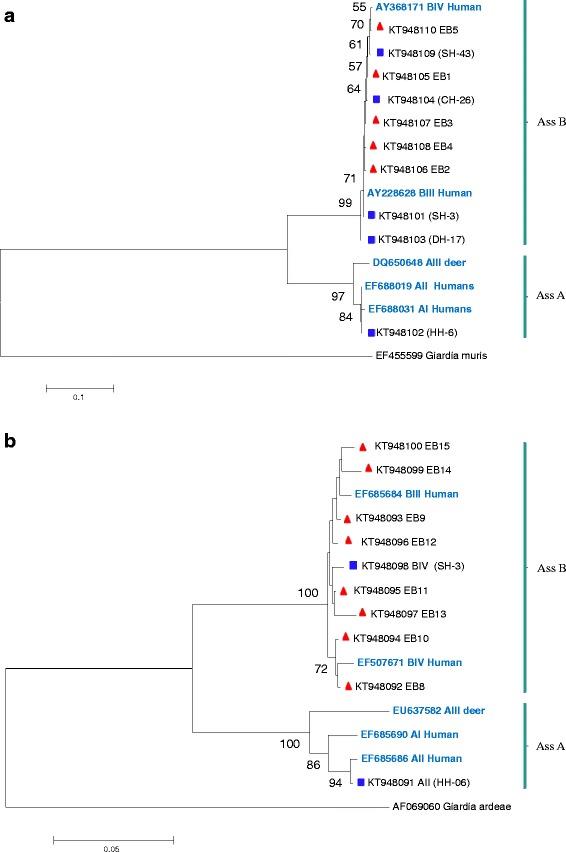
A total of 286 fresh fecal specimens were collected from children and screened using microscopy and PCR. The prevalence of Giardia duodenalis was 10.8 % (31/286) and 16.8 % (48/286) as detected by microscopy and nested PCR, respectively. The infection rate by the study area, sex and age group difference was not significant (P > 0.05). Genotyping results showed that 22.9 % (11/48) of the isolates belonged to assemblage A while 77.1 % (37/48) belonged to assemblage B. Although double peaks were observed at the chromatogram level, no mixed assemblage or sub-assemblage infections were demonstrated. Isolates of assemblage A mostly belonged to the sub-assemblage AII and showed similarity with previously described isolates. However, there was great genetic variability within assemblage B that showed heterogeneous nucleotide positions. Fifteen of them were new genotypes: 5 at the triose phosphate isomerase (tpi), 2 at the β-giardin (bg), and 8 at the glutamate dehydrogenase (gdh) genes.
CONCLUSIONS
Giardia duodenalis mainly assemblage B infection was predominant among the asymptomatic children in the study area. The high polymorphism found in isolates of assemblage B warrants a more defining tool to discriminate assemblage B at the sub-assemblage level. The findings of the present study indicate that there is a need to carry out national screening programs aiming to detect asymptomatic infections to minimize the reservoir of the disease.
背景
十二指肠贾第虫是全球人类和其他哺乳动物贾第虫病的病原体。在卫生条件不足的发展中国家,儿童的疾病负担很高。然而,在埃塞俄比亚,这种寄生虫的流行病学和遗传多样性了解甚少。本研究旨在确定埃塞俄比亚中部奥罗米亚特别区无症状儿童中十二指肠贾第虫的流行率和遗传多样性。
结果
从儿童中总共收集了286份新鲜粪便标本,并使用显微镜检查和聚合酶链反应(PCR)进行筛查。通过显微镜检查和巢式PCR检测,十二指肠贾第虫的流行率分别为10.8%(31/286)和16.8%(48/286)。按研究地区、性别和年龄组划分的感染率差异不显著(P>0.05)。基因分型结果显示,22.9%(11/48)的分离株属于A群,而77.1%(37/48)属于B群。尽管在色谱图水平观察到双峰,但未发现混合群或亚群感染。A群分离株大多属于AII亚群,与先前描述的分离株相似。然而,B群内存在很大的遗传变异性,显示出核苷酸位置的异质性。其中15个是新基因型:磷酸丙糖异构酶(tpi)基因有5个,β-贾第蛋白(bg)基因有2个,谷氨酸脱氢酶(gdh)基因有8个。
结论
在研究地区的无症状儿童中,十二指肠贾第虫主要以B群感染为主。在B群分离株中发现的高度多态性需要一种更具鉴别力的工具来在亚群水平区分B群。本研究结果表明,有必要开展全国性筛查项目,旨在检测无症状感染,以尽量减少疾病的储存宿主。
 Zotero 插件