
吸烟通过DNA损伤和精子中Chk1的下调对精液质量的潜在影响。
Potential effect of smoking on semen quality through DNA damage and the downregulation of Chk1 in sperm.
作者信息
Cui Xiangrong, Jing Xuan, Wu Xueqing, Wang Zhenqiang, Li Qiang
机构信息
Reproductive Medicine Center, Children's Hospital of Shanxi and Women Health Center of Shanxi, Taiyuan, Shanxi 030000, P.R. China.
Clinical Laboratory, Shanxi Province People's Hospital, Taiyuan, Shanxi 030000, P.R. China.
出版信息
Mol Med Rep. 2016 Jul;14(1):753-61. doi: 10.3892/mmr.2016.5318. Epub 2016 May 20.
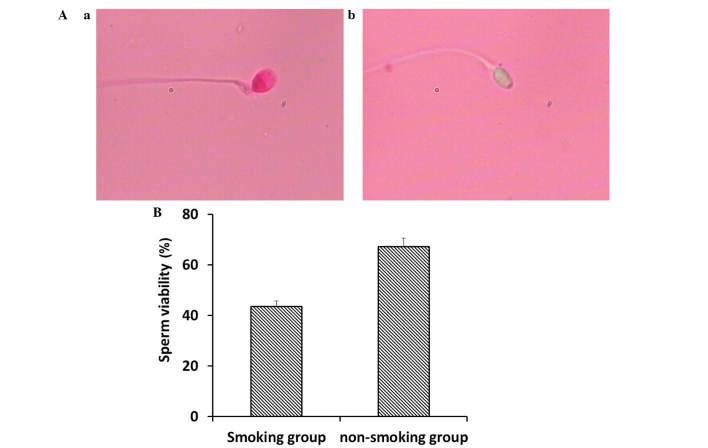
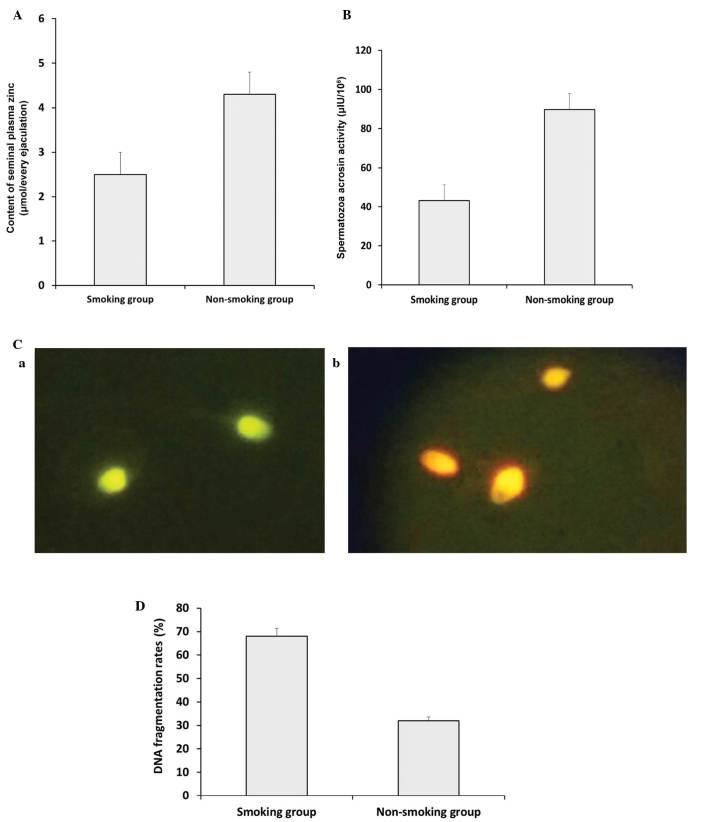
Previous studies have found that smoking is associated with decreased male fertility via altering the quality of semen. However, the mechanism by which cigarette smoking affects semen quality remains to be fully elucidated. Heavy smoking-induced DNA damage has been reported to correlate with abnormal spermatozoa and male infertility. It has been reported that, in response to DNA damage, activation of the checkpoint kinase 1 (Chk1) facilitates S and G2 checkpoint arrest. The aim of the present study was to investigate the expression levels of Chk1 in sperm cells of smoking and non‑smoking men, and to further examine the correlation between DNA fragmentation rates and the expression levels of Chk1 with smoking. The present study was performed on a cohort of 841 smoking men and 287 non‑smoking men. In the investigation, sperm concentration, motility, viability, seminal plasma zinc concentration, acrosin activity and sperm DNA fragmentation were examined. The gene and protein expression levels of Chk1 were detected using reverse transcription-quantitative polymerase chain reaction and western blot analyses, respectively. It was observed that the progressive motility of the sperm was significantly decreased in the moderate and heavy smoking groups, whereas no significant changes were observed in the mild smoking group. The sperm in the medium‑term smoking group had significantly decreased progressive motility, and the semen concentration, sperm count and progressive motility vitality were markedly decreased in the long‑term smoking group. Compared with the non‑smoking group, the abnormal head rates in the heavy smoking group and long‑term smoking group were significantly increased. The sperm viability and seminal plasma zinc concentration were markedly increased in the smoking group. Increased DNA fragmentation rates were found in the smoking group. The expression of Chk1 was significantly decreased in the smoking group, compared with the non‑smoking group. Progressive motility and sperm concentration showed a nonlinear association with the relative mRNA expression of Chk1. However, an inverse association was found between DNA fragmentation rates and the progressive motility and sperm concentration. These data suggested that the decrease of semen quality caused by cigarette smoking was not only correlated with sperm DNA fragmentation rates, but was also correlated with a decline in the expressive level of Chk1. The expression of Chk1 was associated with DNA damage and apoptosis, the reduction of which may lead to decreased sperm repair and increased sperm apoptosis, with a subsequent effect on semen quality.
以往研究发现,吸烟会通过改变精液质量导致男性生育能力下降。然而,吸烟影响精液质量的机制仍有待充分阐明。据报道,重度吸烟引起的DNA损伤与异常精子及男性不育相关。据报道,在DNA损伤反应中,检查点激酶1(Chk1)的激活促进S期和G2期检查点停滞。本研究的目的是调查吸烟男性和非吸烟男性精子细胞中Chk1的表达水平,并进一步研究DNA片段化率与Chk1表达水平和吸烟之间的相关性。本研究对841名吸烟男性和287名非吸烟男性进行了队列研究。在调查中,检测了精子浓度、活力、存活率、精浆锌浓度、顶体酶活性和精子DNA片段化情况。分别采用逆转录-定量聚合酶链反应和蛋白质印迹分析检测Chk1的基因和蛋白表达水平。结果发现,中度和重度吸烟组精子的前向运动能力显著降低,而轻度吸烟组未观察到显著变化。中期吸烟组精子的前向运动能力显著降低,长期吸烟组精液浓度、精子数量和前向运动活力显著降低。与非吸烟组相比,重度吸烟组和长期吸烟组的异常头部率显著增加。吸烟组精子存活率和精浆锌浓度显著升高。吸烟组DNA片段化率增加。与非吸烟组相比,吸烟组Chk1的表达显著降低。前向运动能力和精子浓度与Chk1的相对mRNA表达呈非线性关联。然而,DNA片段化率与前向运动能力和精子浓度呈负相关。这些数据表明,吸烟导致的精液质量下降不仅与精子DNA片段化率相关,还与Chk1表达水平下降相关。Chk1的表达与DNA损伤和细胞凋亡相关,其减少可能导致精子修复能力下降和精子凋亡增加,进而影响精液质量。

 Zotero 插件