
喀麦隆西南部基于社区的布鲁里溃疡传播方式、预防与治疗研究:知识、态度与实践
A Community Based Study on the Mode of Transmission, Prevention and Treatment of Buruli Ulcers in Southwest Cameroon: Knowledge, Attitude and Practices.
作者信息
Akoachere Jane-Francis K T, Nsai Frankline S, Ndip Roland N
机构信息
Department of Microbiology and Parasitology, Faculty of Science, University of Buea, Buea, Cameroon.
出版信息
PLoS One. 2016 May 26;11(5):e0156463. doi: 10.1371/journal.pone.0156463. eCollection 2016.
BACKGROUND
Buruli ulcer (BU) is a neglected tropical disease affecting the skin, tissues and in some cases the bones, caused by the environmental pathogen Mycobacterium ulcerans (M. ulcerans). Its mode of transmission is still elusive. Delayed treatment may cause irreversible disabilities with consequent social and economic impacts on the victim. Socio-cultural beliefs, practices and attitudes in endemic communities have been shown to influence timely treatment causing disease management, prevention and control a great challenge. An assessment of these factors in endemic localities is important in designing successful intervention strategies. Considering this, we assessed the knowledge, attitude and practices regarding BU in three endemic localities in the South West region, Cameroon to highlight existing misconceptions that need to be addressed to enhance prompt treatment and facilitate effective prevention and control.
METHODS AND FINDINGS
A cross-sectional study was executed in three BU endemic health districts. Using qualitative and quantitative approaches we surveyed 320 randomly selected household heads, interviewed BU patients and conducted three focus group discussions (FGDs) to obtain information on awareness, beliefs, treatment, and attitudes towards victims. The influence of socio-demographic factors on these variables was investigated.
RESULTS
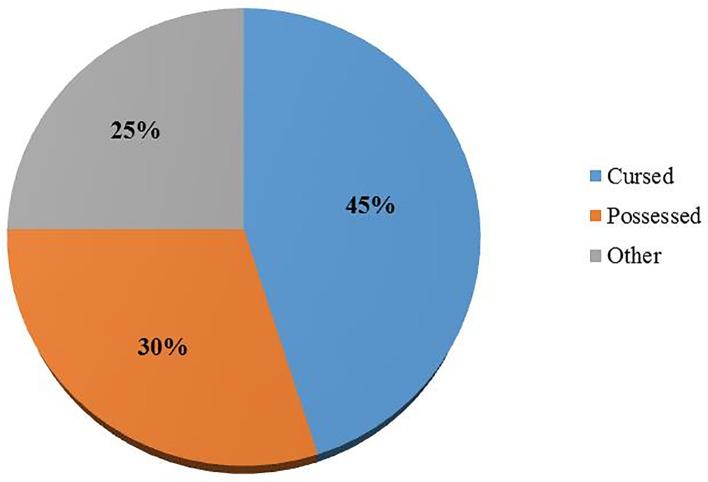
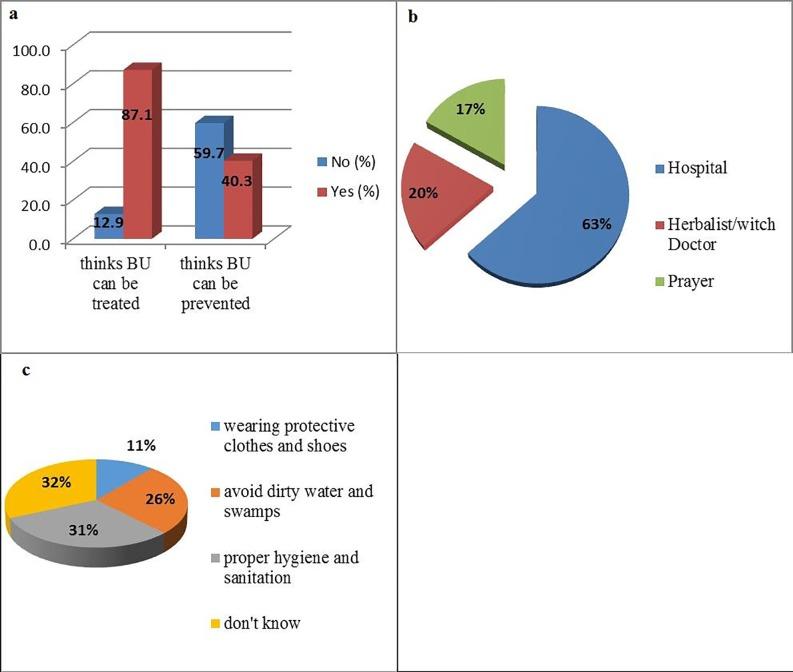
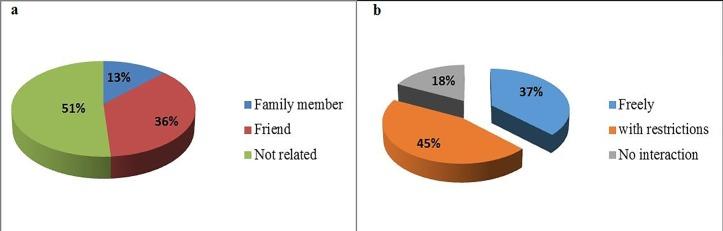
Respondents (84.4%) had a good knowledge of BU though only 65% considered it a health problem while 49.4% believed it is contagious. Socio-demographic factors significantly (P<0.05) influenced awareness of BU, knowledge and practice on treatment and attitudes towards victims. Although the majority of respondents stated the hospital as the place for appropriate treatment, FGDs and some BU victims preferred witchdoctors/herbalists and prayers, and considered the hospital as the last option. We documented beliefs about the disease which could delay treatment.
CONCLUSION
Though we are reporting a high level of knowledge of BU, there exist fallacies about BU and negative attitudes towards victims in communities studied. Efforts towards disease eradication must first of all target these misconceptions.
背景
布鲁里溃疡(BU)是一种被忽视的热带病,由环境病原体溃疡分枝杆菌(M. ulcerans)引起,可影响皮肤、组织,在某些情况下还会影响骨骼。其传播方式仍不明确。延迟治疗可能导致不可逆转的残疾,从而给受害者带来社会和经济影响。在流行社区,社会文化信仰、习俗和态度已被证明会影响及时治疗,给疾病管理、预防和控制带来巨大挑战。评估流行地区的这些因素对于设计成功的干预策略很重要。考虑到这一点,我们评估了喀麦隆西南地区三个流行地区关于布鲁里溃疡的知识、态度和做法,以突出需要解决的现有误解,从而加强及时治疗并促进有效的预防和控制。
方法与结果
在三个布鲁里溃疡流行的卫生区开展了一项横断面研究。我们采用定性和定量方法,对320名随机抽取的户主进行了调查,采访了布鲁里溃疡患者,并进行了三次焦点小组讨论(FGD),以获取有关认识、信仰、治疗以及对受害者态度的信息。研究了社会人口学因素对这些变量的影响。
结果
84.4%的受访者对布鲁里溃疡有较好的了解,不过只有65%的人认为它是一个健康问题,而49.4%的人认为它具有传染性。社会人口学因素对布鲁里溃疡的认识、治疗知识和做法以及对受害者的态度有显著(P<0.05)影响。尽管大多数受访者表示医院是进行适当治疗的场所,但焦点小组讨论和一些布鲁里溃疡患者更喜欢巫医/草药医生和祈祷,并将医院视为最后的选择。我们记录了一些可能延误治疗的关于该疾病的信仰。
结论
尽管我们报告的布鲁里溃疡知识水平较高,但在所研究的社区中,仍然存在关于布鲁里溃疡的错误观念以及对受害者的负面态度。根除该疾病的努力必须首先针对这些误解。

 Zotero 插件