
Toll样受体3与丙型肝炎病毒感染及乙肝相关疾病的风险相关。
Toll-Like Receptor 3 is Associated With the Risk of HCV Infection and HBV-Related Diseases.
作者信息
Geng Pei-Liang, Song Li-Xue, An Huaijie, Huang Jing-Yu, Li Sheng, Zeng Xian-Tao
机构信息
From the Center for Evidence-Based and Translational Medicine, Zhongnan Hospital of Wuhan University, Wuhan, China (PLG, JYH, SL, XTZ); Department of Pharmacology, General Hospital of Beijing Military Region, Beijing, China (LXS); Center of Basic Medical Sciences, Navy General Hospital of PLA Beijing, China (HA); and Department of Urology, Zhongnan Hospital of Wuhan University, Wuhan, China (JYH, SL).
出版信息
Medicine (Baltimore). 2016 May;95(21):e2302. doi: 10.1097/MD.0000000000002302.
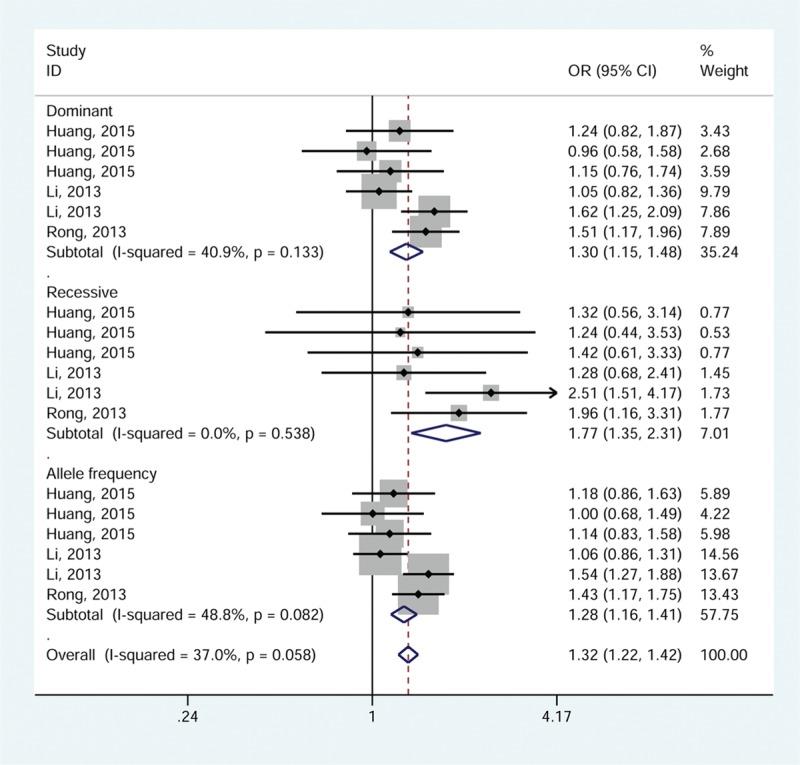
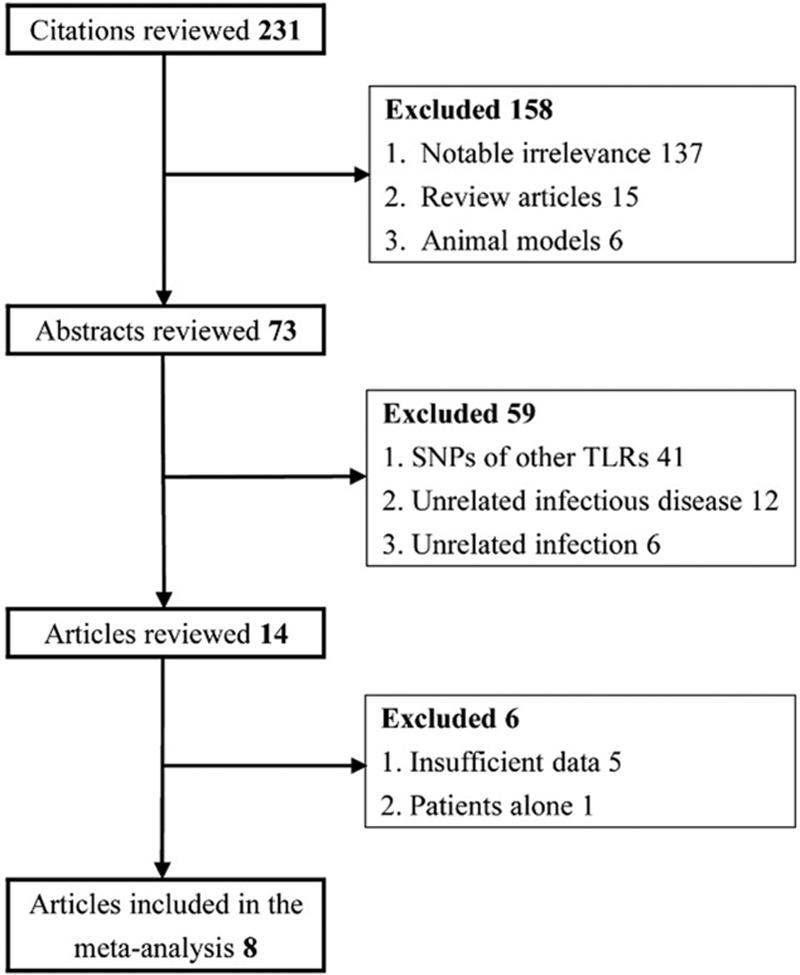
There are inconsistent data on the association of risk of hepatitis virus infection and hepatitis virus-related diseases with the toll-like receptor 3 (TLR3) gene.Several common polymorphism sites were targeted to assess the risk of HBV infection, HCV infection, and HBV-related diseases.Meta-analysis combining data for 3547 cases and 2797 controls from 8 studies was performed in this study. Pooled ORs were calculated to measure the risk of hepatitis virus infection and hepatitis virus-related diseases. Fixed-effects pooled ORs were calculated using the Mantel-Haenszel method.The TLR3 gene was associated with a significantly increased risk of HBV-related diseases among 1355 patients and 1130 controls ([pooled OR, [95%CI]: 1.30, [1.15-1.48] for dominant; 1.77, [1.35-2.31] for recessive; 1.28 [1.16-1.41] for allele frequency). Subgroup analyses by a polymorphism site indicated an increased risk of HCV infection in relation to the TT/CT genotypes of rs3775291 (1.50 [1.11-2.01]), and a decreased risk ascribed to the T allele (0.20 [0.16-0.25]). We also noted an association between rs3775291 and significantly increased risk of HBV-related diseases (2.23 [1.55-3.21]). No significant inter-study heterogeneity or publication bias was detected in the analyses.These data suggest a likely effect on the risk to infect HCV and develop HBV-related diseases for the TLR3 gene. Large-scale studies with racially diverse populations are required to validate these findings.
关于 Toll 样受体 3(TLR3)基因与肝炎病毒感染风险及肝炎病毒相关疾病之间的关联,数据并不一致。本研究针对几个常见的多态性位点,评估了乙肝病毒(HBV)感染、丙肝病毒(HCV)感染及 HBV 相关疾病的风险。本研究对来自 8 项研究的 3547 例病例和 2797 例对照的数据进行了荟萃分析。计算合并比值比(OR)以衡量肝炎病毒感染及肝炎病毒相关疾病的风险。采用 Mantel-Haenszel 方法计算固定效应合并 OR。在 1355 例患者和 1130 例对照中,TLR3 基因与 HBV 相关疾病风险显著增加相关(显性模型:合并 OR,[95%置信区间]:1.30,[1.15 - 1.48];隐性模型:1.77,[1.35 - 2.31];等位基因频率:1.28 [1.16 - 1.41])。按多态性位点进行的亚组分析表明,rs3775291 的 TT/CT 基因型与 HCV 感染风险增加相关(1.50 [1.11 - 2.01]),而 T 等位基因则与风险降低相关(0.20 [0.16 - 0.25])。我们还注意到 rs3775291 与 HBV 相关疾病风险显著增加之间存在关联(2.23 [1.55 - 3.21])。分析中未检测到显著的研究间异质性或发表偏倚。这些数据表明 TLR3 基因可能对 HCV 感染风险及 HBV 相关疾病的发生有影响。需要开展涉及不同种族人群的大规模研究来验证这些发现。

 Zotero 插件