
中国新型农村合作医疗制度的受益者是谁?以安徽省为例的一项研究。
Who benefited from the New Rural Cooperative Medical System in China? A case study on Anhui Province.
作者信息
Wang Lidan, Wang Anjue, FitzGerald Gerry, Si Lei, Jiang Qicheng, Ye Dongqing
机构信息
School of Health Management, Anhui Medical University, No.81, Mei Shan Road, Hefei, Anhui, 230032, China.
School of Public Health, Anhui Medical University, No.81, Mei Shan Road, Hefei, Anhui, 230032, China.
出版信息
BMC Health Serv Res. 2016 Jun 5;16:195. doi: 10.1186/s12913-016-1441-3.
BACKGROUND
The goal of the New Rural Cooperative Medical System (NCMS) is to decrease the financial burden and improve the health of rural areas. The purpose of the present study is to determine how government subsidies vary between poorer and wealthier groups, especially in low-income regions in rural China.
METHODS
The distribution, amount, and equity of government subsidies delivered via NCMS to rural residents at different economic levels were assessed using benefit-incidence analysis, concentration index, Kakwani index, Gini index, Lorenz curve, and concentration curve. Household and health institution surveys were conducted in 2010, covering 9701 residents. Household socio-economic status, healthcare costs, out-of-pocket payments, and utilization information were collected in household interviews, and reimbursement policy was provided by institutional survey.
RESULTS
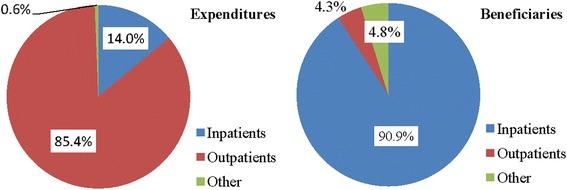
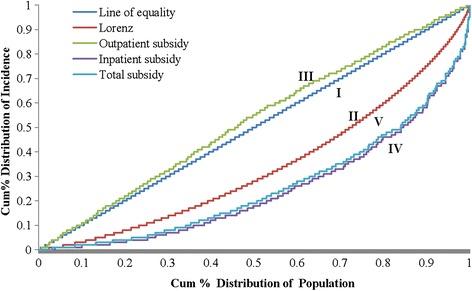
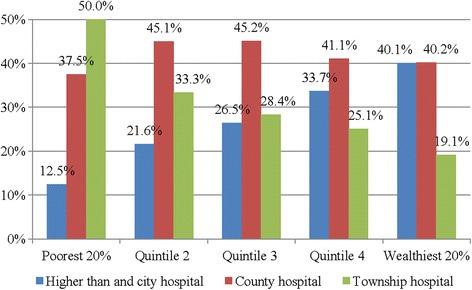
The government subsidy concentration index was -0.055 for outpatients and 0.505 for inpatients; and the outpatient and inpatient subsidy Kakwani indexes were -0.376 and 0.184, respectively. The poorest 20 % of populations received 3.4 % of the total subsidy output; while the wealthiest 20 % received 54.3 %. The results showed that the distribution of outpatient subsidies was equitable, but the hospital subsidies disproportionally benefited wealthier people.
CONCLUSIONS
Wealthier people benefited more than poorer people from the NCMS in terms of inpatient and total subsidies. For outpatients, the subsidies were unrelated to ability to pay. This contradicts the common belief that the NCMS does not exacerbate benefit inequity. Long-term policy is required to tackle this problem, specifically of redesign the NCMS reimbursement system.
背景
新型农村合作医疗制度(新农合)的目标是减轻农村地区的经济负担并改善农村居民健康状况。本研究的目的是确定政府补贴在较贫困和较富裕群体之间如何变化,尤其是在中国农村低收入地区。
方法
使用受益归宿分析、集中指数、卡克瓦尼指数、基尼指数、洛伦兹曲线和集中曲线,评估通过新农合向不同经济水平农村居民提供的政府补贴的分布、金额和公平性。2010年开展了家庭和卫生机构调查,覆盖9701名居民。在家庭访谈中收集家庭社会经济状况、医疗费用、自付费用和利用信息,并通过机构调查提供报销政策。
结果
门诊政府补贴集中指数为-0.055,住院补贴集中指数为0.505;门诊和住院补贴的卡克瓦尼指数分别为-0.376和0.184。最贫困的20%人口获得了总补贴产出的3.4%;而最富有的20%人口获得了54.3%。结果表明,门诊补贴的分布是公平的,但住院补贴使较富裕人群受益过多。
结论
就住院补贴和总补贴而言,较富裕人群从新农合中获得的益处多于较贫困人群。对于门诊患者,补贴与支付能力无关。这与新农合不会加剧受益不平等的普遍看法相矛盾。需要长期政策来解决这个问题,特别是重新设计新农合报销系统。
 Zotero 插件