
中年大脑中伴有白质高信号病变的正常灰质密度异常:一项基于DARTEL增强体素的形态学研究
Density abnormalities in normal-appearing gray matter in the middle-aged brain with white matter hyperintense lesions: a DARTEL-enhanced voxel-based morphometry study.
作者信息
Peng Yan, Li Shenhong, Zhuang Ying, Liu Xiaojia, Wu Lin, Gong Honghan, Liu Dewu, Zhou Fuqing
机构信息
Burn Center, The First Affiliated Hospital, Nanchang University, Nanchang, Jiangxi Province, People's Republic of China.
Department of Radiology, The First Affiliated Hospital, Nanchang University, Nanchang, Jiangxi Province, People's Republic of China.
出版信息
Clin Interv Aging. 2016 May 12;11:615-22. doi: 10.2147/CIA.S98409. eCollection 2016.
BACKGROUND AND PURPOSE
Little is known about the structural alterations within gray matter (GM) in middle-aged subjects with white matter hyperintense (WMH) lesions. Here, we aimed to examine the anatomical changes within the GM and their relationship to WMH lesion loads in middle-aged subjects.
PARTICIPANTS AND METHODS
Twenty-three middle-aged subjects with WMH lesions (WMH group) and 23 demographically matched healthy control subjects participated in the study. A Diffeomorphic Anatomical Registration Through Exponentiated Liealgebra-enhanced voxel-based morphometry was used to measure the GM density, and the correlations between WMH lesion volume and extracted GM values in abnormal regions were identified by voxel-based morphometry analysis.
RESULTS
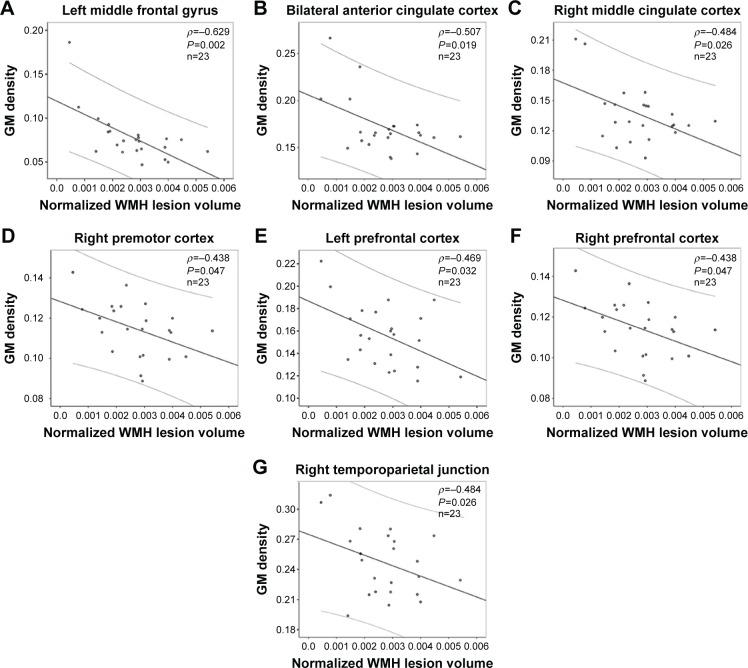
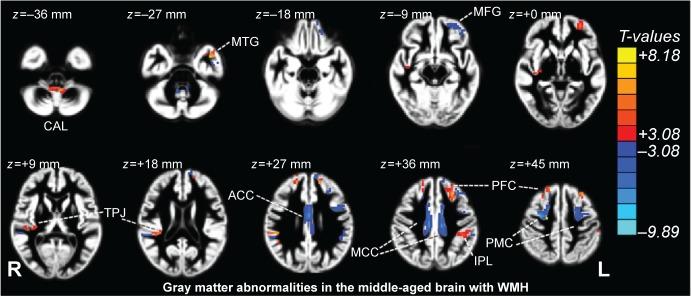
Compared with the healthy control subjects, the WMH group had a significantly decreased GM density in the left middle frontal gyrus, bilateral anterior cingulate cortex, left and right premotor cortex, and left and right middle cingulate cortex and an increased GM density in the bilateral cerebellum anterior lobe, left middle temporal gyrus, right temporoparietal junction, left and right prefrontal cortex (PFC), and left inferior parietal lobule. A relationship was observed between the normalized WMH lesion volume and the decreased GM density, including the left middle frontal gyrus (ρ=-0.629, P=0.002), bilateral anterior cingulate cortex (ρ=-0.507, P=0.019), right middle cingulate cortex (ρ=-0.484, P=0.026), and right premotor cortex (ρ=-0.438, P=0.047). The WMH lesion loads also negatively correlated with increased GM density in the right temporoparietal junction (ρ=-0.484, P=0.026), left PFC (ρ=-0.469, P=0.032), and right PFC (ρ=-0.438, P=0.047).
CONCLUSION
We observed that lesion load-associated structural plasticity corresponds to bidirectional changes in regional GM density in the WMH group.
背景与目的
关于患有白质高信号(WMH)病变的中年受试者脑灰质(GM)内的结构改变,我们所知甚少。在此,我们旨在研究中年受试者脑灰质内的解剖学变化及其与WMH病变负荷的关系。
参与者与方法
23名患有WMH病变的中年受试者(WMH组)和23名人口统计学匹配的健康对照受试者参与了本研究。通过指数李代数增强的基于体素的形态学方法进行的微分同胚解剖配准,用于测量脑灰质密度,并通过基于体素的形态学分析确定WMH病变体积与异常区域提取的脑灰质值之间的相关性。
结果
与健康对照受试者相比,WMH组在左侧额中回、双侧前扣带回皮质、左右运动前区皮质以及左右中央扣带回皮质的脑灰质密度显著降低,而在双侧小脑前叶、左侧颞中回、右侧颞顶交界区、左右前额叶皮质(PFC)以及左侧顶下小叶的脑灰质密度增加。观察到标准化的WMH病变体积与降低的脑灰质密度之间存在关联,包括左侧额中回(ρ=-0.629,P=0.002)、双侧前扣带回皮质(ρ=-0.507,P=0.019)、右侧中央扣带回皮质(ρ=-0.484,P=0.026)和右侧运动前区皮质(ρ=-0.438,P=0.047)。WMH病变负荷也与右侧颞顶交界区(ρ=-0.484,P=0.026)、左侧PFC(ρ=-0.469,P=0.032)和右侧PFC(ρ=-0.438,P=0.047)增加的脑灰质密度呈负相关。
结论
我们观察到,在WMH组中,病变负荷相关的结构可塑性对应于区域脑灰质密度的双向变化。

 Zotero 插件