
线粒体疾病诊断的新视角:一家国家儿科中心两年的全外显子组测序经验
New perspective in diagnostics of mitochondrial disorders: two years' experience with whole-exome sequencing at a national paediatric centre.
作者信息
Pronicka Ewa, Piekutowska-Abramczuk Dorota, Ciara Elżbieta, Trubicka Joanna, Rokicki Dariusz, Karkucińska-Więckowska Agnieszka, Pajdowska Magdalena, Jurkiewicz Elżbieta, Halat Paulina, Kosińska Joanna, Pollak Agnieszka, Rydzanicz Małgorzata, Stawinski Piotr, Pronicki Maciej, Krajewska-Walasek Małgorzata, Płoski Rafał
机构信息
Department of Medical Genetics, The Children's Memorial Health Institute, 04-730, Warsaw, Poland.
Department of Paediatrics, Nutrition and Metabolic Diseases,, The Children's Memorial Health Institute, Warsaw, Poland.
出版信息
J Transl Med. 2016 Jun 12;14(1):174. doi: 10.1186/s12967-016-0930-9.
BACKGROUND
Whole-exome sequencing (WES) has led to an exponential increase in identification of causative variants in mitochondrial disorders (MD).
METHODS
We performed WES in 113 MD suspected patients from Polish paediatric reference centre, in whom routine testing failed to identify a molecular defect. WES was performed using TruSeqExome enrichment, followed by variant prioritization, validation by Sanger sequencing, and segregation with the disease phenotype in the family.
RESULTS
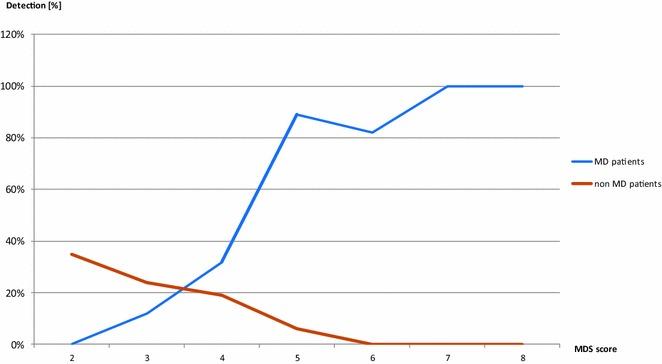
Likely causative mutations were identified in 67 (59.3 %) patients; these included variants in mtDNA (6 patients) and nDNA: X-linked (9 patients), autosomal dominant (5 patients), and autosomal recessive (47 patients, 11 homozygotes). Novel variants accounted for 50.5 % (50/99) of all detected changes. In 47 patients, changes in 31 MD-related genes (ACAD9, ADCK3, AIFM1, CLPB, COX10, DLD, EARS2, FBXL4, MTATP6, MTFMT, MTND1, MTND3, MTND5, NAXE, NDUFS6, NDUFS7, NDUFV1, OPA1, PARS2, PC, PDHA1, POLG, RARS2, RRM2B, SCO2, SERAC1, SLC19A3, SLC25A12, TAZ, TMEM126B, VARS2) were identified. The ACAD9, CLPB, FBXL4, PDHA1 genes recurred more than twice suggesting higher general/ethnic prevalence. In 19 cases, variants in 18 non-MD related genes (ADAR, CACNA1A, CDKL5, CLN3, CPS1, DMD, DYSF, GBE1, GFAP, HSD17B4, MECP2, MYBPC3, PEX5, PGAP2, PIGN, PRF1, SBDS, SCN2A) were found. The percentage of positive WES results rose gradually with increasing probability of MD according to the Mitochondrial Disease Criteria (MDC) scale (from 36 to 90 % for low and high probability, respectively). The percentage of detected MD-related genes compared with non MD-related genes also grew with the increasing MD likelihood (from 20 to 97 %). Molecular diagnosis was established in 30/47 (63.8 %) neonates and in 17/28 (60.7 %) patients with basal ganglia involvement. Mutations in CLPB, SERAC1, TAZ genes were identified in neonates with 3-methylglutaconic aciduria (3-MGA) as a discriminative feature. New MD-related candidate gene (NDUFB8) is under verification.
CONCLUSIONS
We suggest WES rather than targeted NGS as the method of choice in diagnostics of MD in children, including neonates with 3-MGA aciduria, who died without determination of disease cause and with limited availability of laboratory data. There is a strong correlation between the degree of MD diagnosis by WES and MD likelihood expressed by the MDC scale.
背景
全外显子组测序(WES)使线粒体疾病(MD)致病变异的识别呈指数级增长。
方法
我们对来自波兰儿科参考中心的113例疑似MD患者进行了WES检测,这些患者的常规检测未能识别出分子缺陷。使用TruSeqExome富集技术进行WES,随后进行变异优先级排序,通过桑格测序进行验证,并在家族中与疾病表型进行分离分析。
结果
在67例(59.3%)患者中鉴定出可能的致病突变;这些突变包括线粒体DNA(mtDNA)变异(6例)和核DNA(nDNA)变异:X连锁(9例)、常染色体显性(5例)和常染色体隐性(47例,其中11例为纯合子)。新变异占所有检测到变化的50.5%(50/99)。在47例患者中,鉴定出31个与MD相关基因(ACAD9、ADCK3、AIFM1、CLPB、COX10、DLD、EARS2、FBXL4、MTATP6、MTFMT、MTND1、MTND3、MTND5、NAXE、NDUFS6、NDUFS7、NDUFV1、OPA1、PARS2、PC、PDHA1、POLG、RARS2、RRM2B、SCO2、SERAC1、SLC19A3、SLC25A12、TAZ、TMEM126B、VARS2)的变化。ACAD9、CLPB、FBXL4、PDHA1基因的变异出现超过两次,表明其在总体/特定人群中的患病率较高。在19例患者中,发现了18个与MD无关基因(ADAR、CACNA1A、CDKL5、CLN3、CPS1、DMD、DYSF、GBE1、GFAP、HSD17B4、MECP2、MYBPC3、PEX5、PGAP2、PIGN、PRF1、SBDS、SCN2A)的变异。根据线粒体疾病标准(MDC)量表,WES阳性结果的百分比随着MD可能性的增加而逐渐上升(低可能性和高可能性分别从36%升至90%)。与非MD相关基因相比,检测到的MD相关基因的百分比也随着MD可能性的增加而增加(从20%升至97%)。在30/47例(63.8%)新生儿和17/28例(60.7%)有基底神经节受累的患者中建立了分子诊断。在以3-甲基戊二酸尿症(3-MGA)为鉴别特征的新生儿中鉴定出CLPB、SERAC1、TAZ基因的突变。新的与MD相关的候选基因(NDUFB8)正在验证中。
结论
我们建议将WES而非靶向二代测序作为儿童MD诊断的首选方法,包括患有3-MGA酸尿症、死因未明且实验室数据有限的新生儿。WES对MD的诊断程度与MDC量表所表达的MD可能性之间存在很强的相关性。


 Zotero 插件