
基因和功能定义的 NTS 到 PBN 脑回路介导厌食症。
Genetically and functionally defined NTS to PBN brain circuits mediating anorexia.
机构信息
Department of Biochemistry, University of Washington, Seattle, Washington 98195, USA.
Howard Hughes Medical Institute, University of Washington, Seattle, Washington 98195, USA.
出版信息
Nat Commun. 2016 Jun 15;7:11905. doi: 10.1038/ncomms11905.
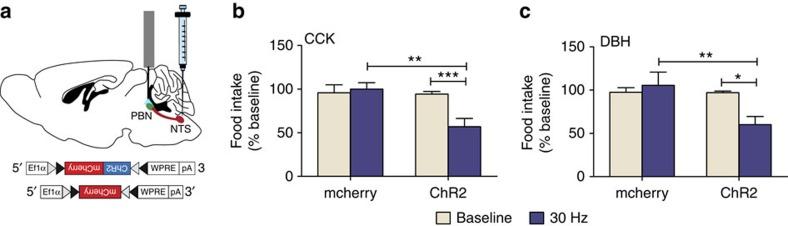
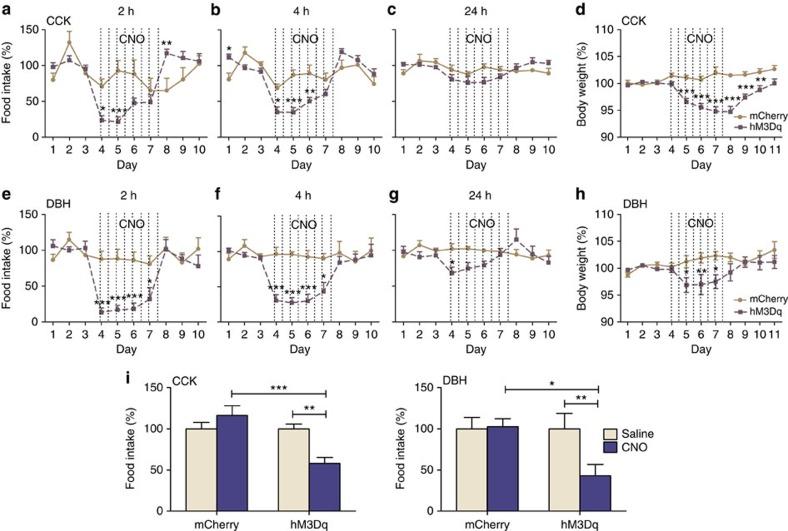
The central nervous system controls food consumption to maintain metabolic homoeostasis. In response to a meal, visceral signals from the gut activate neurons in the nucleus of the solitary tract (NTS) via the vagus nerve. These NTS neurons then excite brain regions known to mediate feeding behaviour, such as the lateral parabrachial nucleus (PBN). We previously described a neural circuit for appetite suppression involving calcitonin gene-related protein (CGRP)-expressing PBN (CGRP(PBN)) neurons; however, the molecular identity of the inputs to these neurons was not established. Here we identify cholecystokinin (CCK) and noradrenergic, dopamine β-hydroxylase (DBH)-expressing NTS neurons as two separate populations that directly excite CGRP(PBN) neurons. When these NTS neurons are activated using optogenetic or chemogenetic methods, food intake decreases and with chronic stimulation mice lose body weight. Our optogenetic results reveal that CCK and DBH neurons in the NTS directly engage CGRP(PBN) neurons to promote anorexia.
中枢神经系统控制食物摄入以维持代谢平衡。进食后,来自肠道的内脏信号通过迷走神经激活孤束核(NTS)中的神经元。这些 NTS 神经元随后兴奋已知介导进食行为的脑区,如外侧臂旁核(PBN)。我们之前描述了涉及降钙素基因相关肽(CGRP)表达的 PBN(CGRP(PBN))神经元的食欲抑制神经回路;然而,这些神经元的输入的分子身份尚未确定。在这里,我们确定胆囊收缩素(CCK)和去甲肾上腺素能、多巴胺β-羟化酶(DBH)表达的 NTS 神经元是两个直接兴奋 CGRP(PBN)神经元的独立群体。当使用光遗传学或化学遗传学方法激活这些 NTS 神经元时,食物摄入量减少,并且随着慢性刺激,小鼠体重减轻。我们的光遗传学结果表明,NTS 中的 CCK 和 DBH 神经元直接与 CGRP(PBN)神经元相互作用以促进厌食。




 Zotero 插件