
肿瘤学中的单细胞测序技术:临床治疗与研究应用
Single-Cell Sequencing Technology in Oncology: Applications for Clinical Therapies and Research.
作者信息
Ye Baixin, Gao Qingping, Zeng Zhi, Stary Creed M, Jian Zhihong, Xiong Xiaoxing, Gu Lijuan
机构信息
Department of Hematology, Renmin Hospital of Wuhan University, Wuhan, Hubei 430060, China.
Department of Pathology, Renmin Hospital of Wuhan University, Wuhan, Hubei 430060, China.
出版信息
Anal Cell Pathol (Amst). 2016;2016:9369240. doi: 10.1155/2016/9369240. Epub 2016 May 25.
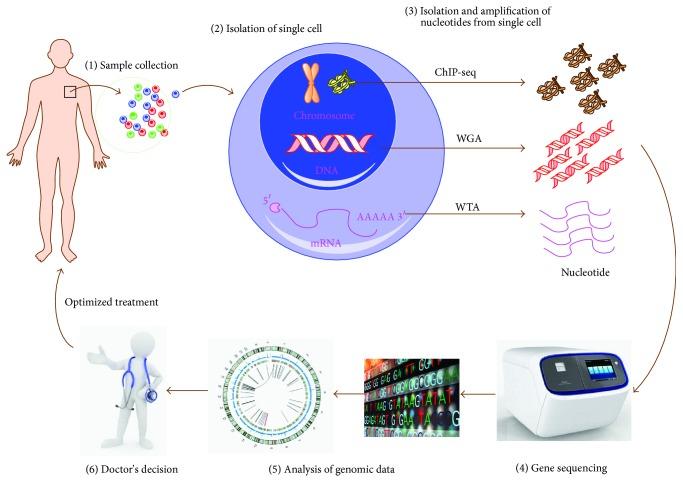
Cellular heterogeneity is a fundamental characteristic of many cancers. A lack of cellular homogeneity contributes to difficulty in designing targeted oncological therapies. Therefore, the development of novel methods to determine and characterize oncologic cellular heterogeneity is a critical next step in the development of novel cancer therapies. Single-cell sequencing (SCS) technology has been recently employed for analyzing the genetic polymorphisms of individual cells at the genome-wide level. SCS requires (1) precise isolation of the single cell of interest; (2) isolation and amplification of genetic material; and (3) descriptive analysis of genomic, transcriptomic, and epigenomic data. In addition to targeted analysis of single cells isolated from tumor biopsies, SCS technology may be applied to circulating tumor cells, which may aid in predicting tumor progression and metastasis. In this paper, we provide an overview of SCS technology and review the current literature on the potential application of SCS to clinical oncology and research.
细胞异质性是许多癌症的一个基本特征。缺乏细胞同质性导致设计靶向肿瘤治疗方法存在困难。因此,开发用于确定和表征肿瘤细胞异质性的新方法是新型癌症治疗发展的关键下一步。单细胞测序(SCS)技术最近已被用于在全基因组水平分析单个细胞的基因多态性。SCS需要(1)精确分离感兴趣的单个细胞;(2)遗传物质的分离和扩增;以及(3)对基因组、转录组和表观基因组数据的描述性分析。除了对从肿瘤活检中分离的单个细胞进行靶向分析外,SCS技术还可应用于循环肿瘤细胞,这可能有助于预测肿瘤进展和转移。在本文中,我们概述了SCS技术,并综述了关于SCS在临床肿瘤学和研究中的潜在应用的当前文献。

 Zotero 插件