
Fas配体和溶细胞颗粒对自然杀伤细胞针对癌症靶标的细胞毒性动力学具有不同的调控作用。
Fas ligand and lytic granule differentially control cytotoxic dynamics of natural killer cell against cancer target.
作者信息
Zhu Yanting, Huang Bo, Shi Jue
机构信息
Center for Quantitative Systems Biology, Department of Physics and Department of Biology, Hong Kong Baptist University, Hong Kong, China.
School of Physics, Nanjing University, Nanjing, China.
出版信息
Oncotarget. 2016 Jul 26;7(30):47163-47172. doi: 10.18632/oncotarget.9980.
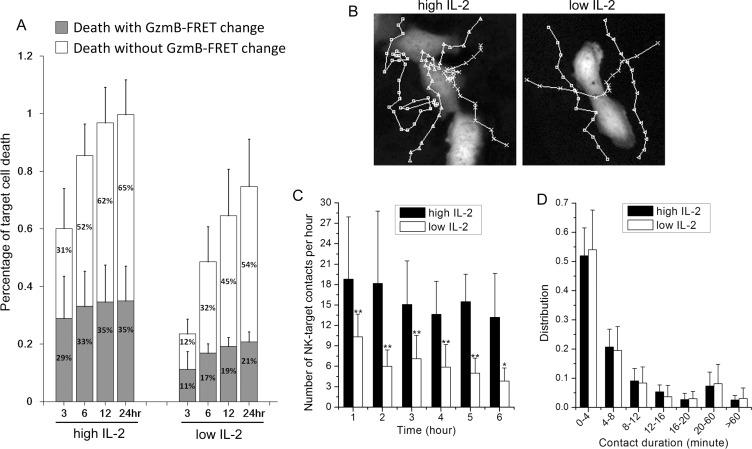
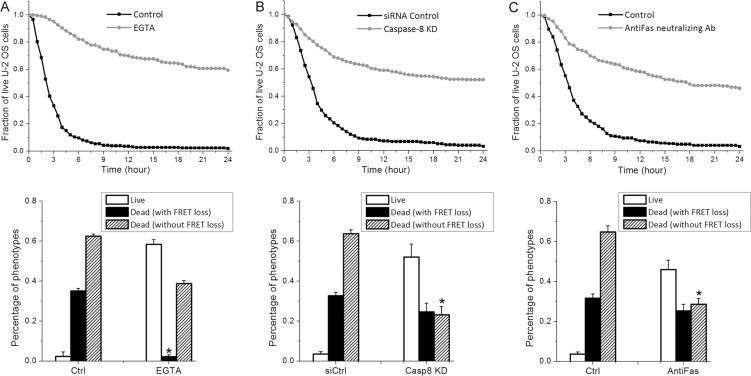
Interaction dynamics between Natural Killer (NK) cells and cancer targets have been the topic of many previous investigations, but the underlying rate-limiting kinetics and heterogeneity remain poorly understood. In this study, using quantitative single cell microscopy assay, we elucidate the differential dynamic control of NK-cancer cell interaction by multiple cytotoxic pathways. We found primary human NK cell, unlike NK cell line, killed adherent cancer target mainly by lytic granule-independent mechanism, in particular through Fas ligand (FasL). And the distinct kinetics of FasL and lytic granule pathway resulted in significant cell-to-cell variability. Killing by FasL occurred slowly, requiring transient, often multiple NK-cancer cell conjugations that gradually activated caspase-8, while lytic granule triggered rapid cytotoxicity by a switch-like induction of granzyme-B upon a single, prolonged conjugation. Moreover, interleukin 2 was observed to enhance both cytotoxic mechanisms by promoting target recognition by NK cell and increasing NK-cancer cell interaction frequency. Our results not only identify the key points of variation in the rate-limiting kinetics of NK-cancer cell cytotoxic interaction but also point to the importance of non-lytic granule mechanism for developing NK cell therapy.
自然杀伤(NK)细胞与癌症靶标的相互作用动力学一直是以往众多研究的主题,但潜在的限速动力学和异质性仍知之甚少。在本研究中,我们使用定量单细胞显微镜检测法,阐明了多种细胞毒性途径对NK细胞与癌细胞相互作用的差异动态控制。我们发现,原代人NK细胞与NK细胞系不同,主要通过非溶细胞颗粒依赖机制杀伤贴壁癌靶标,特别是通过Fas配体(FasL)。FasL和溶细胞颗粒途径的不同动力学导致了显著的细胞间变异性。FasL介导的杀伤作用发生缓慢,需要短暂的、通常是多次的NK细胞与癌细胞结合,从而逐渐激活半胱天冬酶-8,而溶细胞颗粒在单次长时间结合后通过颗粒酶B的类似开关的诱导引发快速细胞毒性。此外,观察到白细胞介素2通过促进NK细胞对靶标的识别和增加NK细胞与癌细胞的相互作用频率来增强这两种细胞毒性机制。我们的结果不仅确定了NK细胞与癌细胞细胞毒性相互作用限速动力学变化的关键点,还指出了非溶细胞颗粒机制在开发NK细胞疗法中的重要性。


 Zotero 插件