
FLT3+急性髓系白血病细胞中蛋白磷酸酶2A的激活增强了FLT3酪氨酸激酶抑制剂的细胞毒性。
Activation of protein phosphatase 2A in FLT3+ acute myeloid leukemia cells enhances the cytotoxicity of FLT3 tyrosine kinase inhibitors.
作者信息
Smith Amanda M, Dun Matthew D, Lee Erwin M, Harrison Celeste, Kahl Richard, Flanagan Hayley, Panicker Nikita, Mashkani Baratali, Don Anthony S, Morris Jonathan, Toop Hamish, Lock Richard B, Powell Jason A, Thomas Daniel, Guthridge Mark A, Moore Andrew, Ashman Leonie K, Skelding Kathryn A, Enjeti Anoop, Verrills Nicole M
机构信息
School of Biomedical Sciences and Pharmacy, University of Newcastle, Callaghan, New South Wales, Australia.
Hunter Medical Research Institute, Newcastle, New South Wales, Australia.
出版信息
Oncotarget. 2016 Jul 26;7(30):47465-47478. doi: 10.18632/oncotarget.10167.
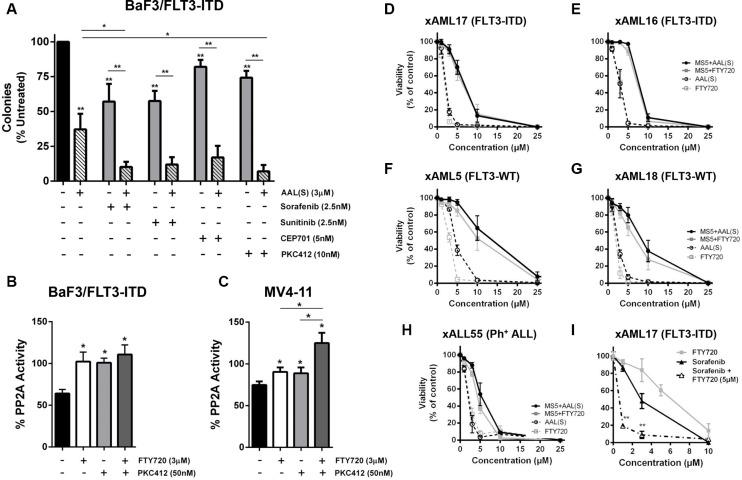
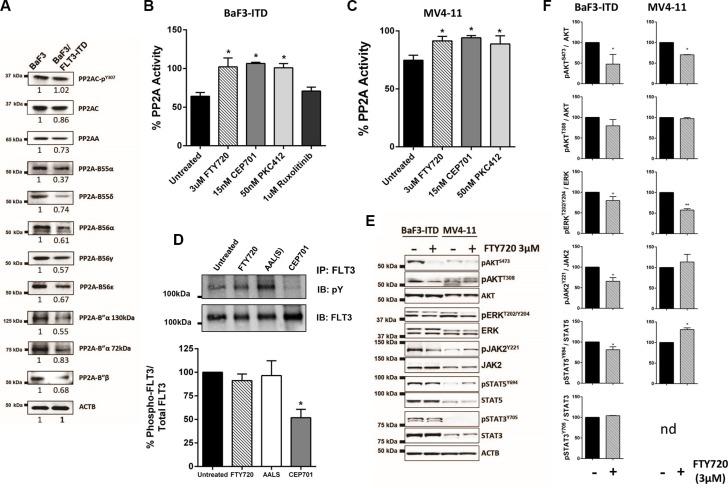
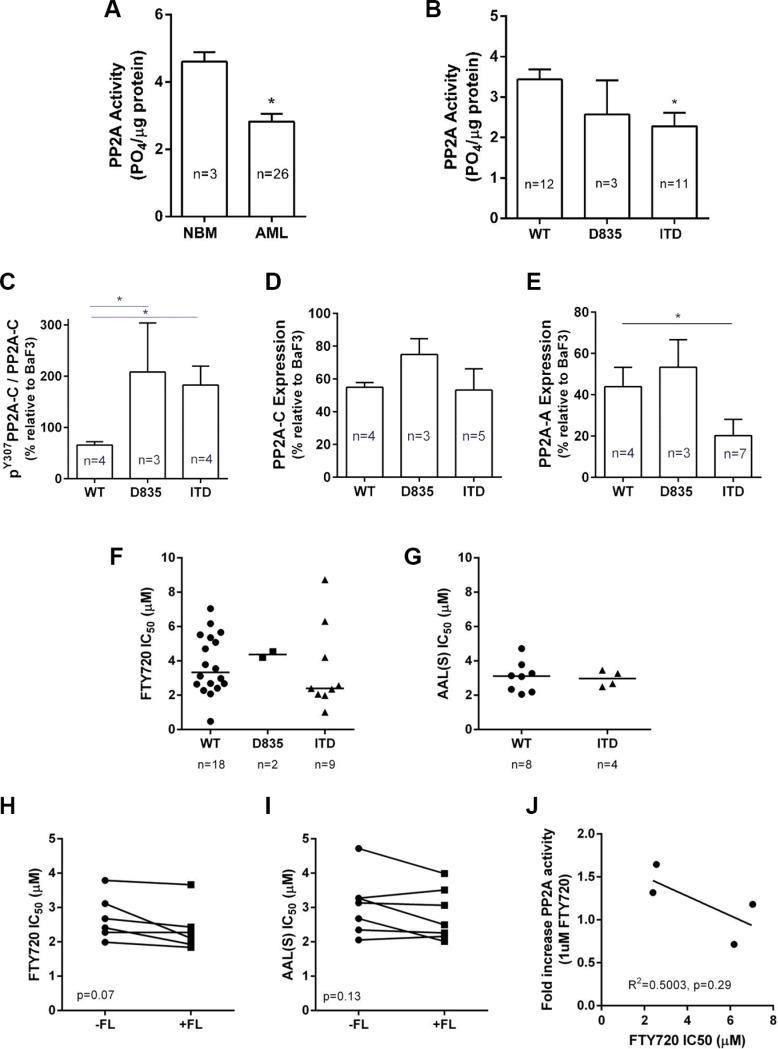
Constitutive activation of the receptor tyrosine kinase Fms-like tyrosine kinase 3 (FLT3), via co-expression of its ligand or by genetic mutation, is common in acute myeloid leukemia (AML). In this study we show that FLT3 activation inhibits the activity of the tumor suppressor, protein phosphatase 2A (PP2A). Using BaF3 cells transduced with wildtype or mutant FLT3, we show that FLT3-induced PP2A inhibition sensitizes cells to the pharmacological PP2A activators, FTY720 and AAL(S). FTY720 and AAL(S) induced cell death and inhibited colony formation of FLT3 activated cells. Furthermore, PP2A activators reduced the phosphorylation of ERK and AKT, downstream targets shared by both FLT3 and PP2A, in FLT3/ITD+ BaF3 and MV4-11 cell lines. PP2A activity was lower in primary human bone marrow derived AML blasts compared to normal bone marrow, with blasts from FLT3-ITD patients displaying lower PP2A activity than WT-FLT3 blasts. Reduced PP2A activity was associated with hyperphosphorylation of the PP2A catalytic subunit, and reduced expression of PP2A structural and regulatory subunits. AML patient blasts were also sensitive to cell death induced by FTY720 and AAL(S), but these compounds had minimal effect on normal CD34+ bone marrow derived monocytes. Finally, PP2A activating compounds displayed synergistic effects when used in combination with tyrosine kinase inhibitors in FLT3-ITD+ cells. A combination of Sorafenib and FTY720 was also synergistic in the presence of a protective stromal microenvironment. Thus combining a PP2A activating compound and a FLT3 inhibitor may be a novel therapeutic approach for treating AML.
通过共表达其配体或基因突变,受体酪氨酸激酶Fms样酪氨酸激酶3(FLT3)的组成性激活在急性髓系白血病(AML)中很常见。在本研究中,我们表明FLT3激活会抑制肿瘤抑制因子蛋白磷酸酶2A(PP2A)的活性。使用转导了野生型或突变型FLT3的BaF3细胞,我们表明FLT3诱导的PP2A抑制使细胞对PP2A药理学激活剂FTY720和AAL(S)敏感。FTY720和AAL(S)诱导细胞死亡并抑制FLT3激活细胞的集落形成。此外,PP2A激活剂降低了FLT3/ITD+ BaF3和MV4-11细胞系中ERK和AKT的磷酸化,ERK和AKT是FLT3和PP2A共有的下游靶点。与正常骨髓相比,原发性人骨髓来源的AML原始细胞中的PP2A活性较低,FLT3-ITD患者的原始细胞显示出比WT-FLT3原始细胞更低的PP2A活性。PP2A活性降低与PP2A催化亚基的过度磷酸化以及PP2A结构和调节亚基的表达降低有关。AML患者的原始细胞对FTY720和AAL(S)诱导的细胞死亡也敏感,但这些化合物对正常CD34+骨髓来源的单核细胞影响最小。最后,PP2A激活化合物与酪氨酸激酶抑制剂联合用于FLT3-ITD+细胞时显示出协同作用。在存在保护性基质微环境的情况下,索拉非尼和FTY720的组合也具有协同作用。因此,联合使用PP2A激活化合物和FLT3抑制剂可能是治疗AML的一种新的治疗方法。

 Zotero 插件