
使用生态瞬时干预改善心理健康和积极心理幸福感:一项系统评价与荟萃分析
Changing Mental Health and Positive Psychological Well-Being Using Ecological Momentary Interventions: A Systematic Review and Meta-analysis.
作者信息
Versluis Anke, Verkuil Bart, Spinhoven Philip, van der Ploeg Melanie M, Brosschot Jos F
机构信息
Health, Medical and Neuropsychology Unit, Institute of Psychology, Leiden University, Leiden, Netherlands.
出版信息
J Med Internet Res. 2016 Jun 27;18(6):e152. doi: 10.2196/jmir.5642.
BACKGROUND
Mental health problems are highly prevalent, and there is need for the self-management of (mental) health. Ecological momentary interventions (EMIs) can be used to deliver interventions in the daily life of individuals using mobile devices.
OBJECTIVES
The aim of this study was to systematically assess and meta-analyze the effect of EMI on 3 highly prevalent mental health outcomes (anxiety, depression, and perceived stress) and positive psychological outcomes (eg, acceptance).
METHODS
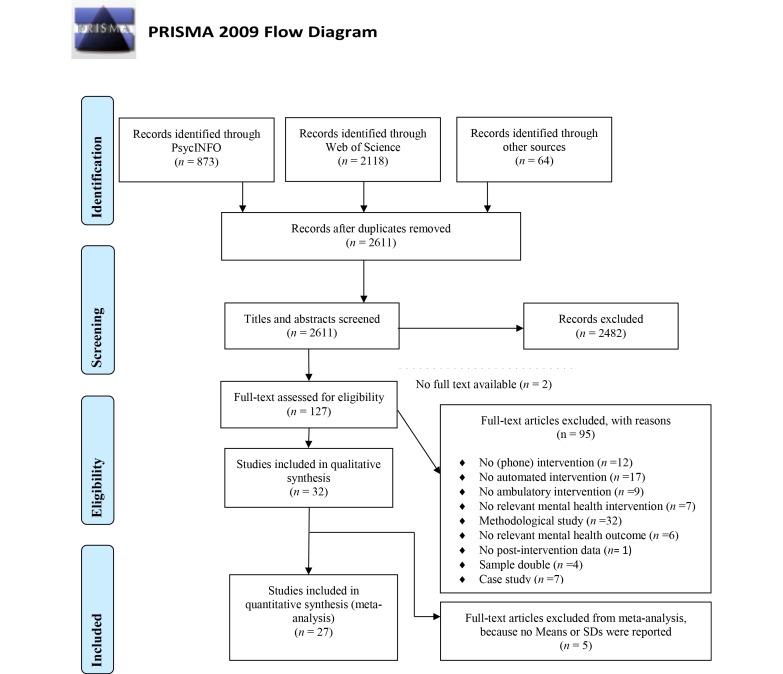
PsycINFO and Web of Science were searched for relevant publications, and the last search was done in September 2015. Three concepts were used to find publications: (1) mental health, (2) mobile phones, and (3) interventions. A total of 33 studies (using either a within- or between-subject design) including 43 samples that received an EMI were identified (n=1301), and relevant study characteristics were coded using a standardized form. Quality assessment was done with the Cochrane Collaboration tool.
RESULTS
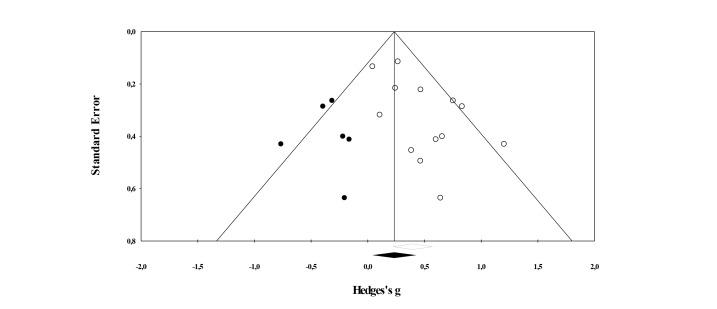
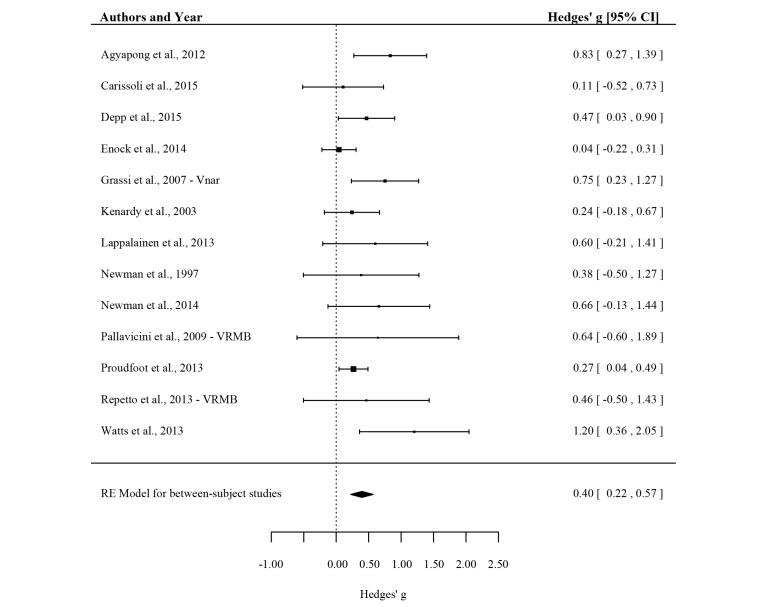
Most of the EMIs focused on a clinical sample, used an active intervention (that offered exercises), and in over half of the studies, additional support by a mental health professional (MHP) was given. The EMI lasted on average 7.48 weeks (SD=6.46), with 2.80 training episodes per day (SD=2.12) and 108.25 total training episodes (SD=123.00). Overall, 27 studies were included in the meta-analysis, and after removing 6 outliers, a medium effect was found on mental health in the within-subject analyses (n=1008), with g=0.57 and 95% CI (0.45-0.70). This effect did not differ as function of outcome type (ie, anxiety, depression, perceived stress, acceptance, relaxation, and quality of life). The only moderator for which the effect varied significantly was additional support by an MHP (MHP-supported EMI, g=0.73, 95% CI: 0.57-0.88; stand-alone EMI, g=0.45, 95% CI: 0.22-0.69; stand-alone EMI with access to care as usual, g=0.38, 95% CI: 0.11-0.64). In the between-subject studies, 13 studies were included, and a small to medium effect was found (g=0.40, 95% CI: 0.22-0.57). Yet, these between-subject analyses were at risk for publication bias and were not suited for moderator analyses. Furthermore, the overall quality of the studies was relatively low.
CONCLUSIONS
Results showed that there was a small to medium effect of EMIs on mental health and positive psychological well-being and that the effect was not different between outcome types. Moreover, the effect was larger with additional support by an MHP. Future randomized controlled trials are needed to further strengthen the results and to determine potential moderator variables. Overall, EMIs offer great potential for providing easy and cost-effective interventions to improve mental health and increase positive psychological well-being.
背景
心理健康问题极为普遍,(心理)健康的自我管理很有必要。生态瞬时干预(EMI)可利用移动设备在个体日常生活中提供干预。
目的
本研究旨在系统评估并荟萃分析EMI对三种高度常见的心理健康结果(焦虑、抑郁和感知压力)以及积极心理结果(如接纳)的影响。
方法
检索了PsycINFO和科学网中的相关出版物,最后一次检索于2015年9月进行。使用三个概念来查找出版物:(1)心理健康,(2)手机,(3)干预。共识别出33项研究(采用组内或组间设计),包括43个接受EMI的样本(n = 1301),并使用标准化表格对相关研究特征进行编码。采用Cochrane协作工具进行质量评估。
结果
大多数EMI聚焦于临床样本,采用积极干预(提供练习),并且在超过一半的研究中,有心理健康专业人员(MHP)提供额外支持。EMI平均持续7.48周(标准差 = 6.46),每天有2.80次训练环节(标准差 = 2.12),总训练环节为108.25次(标准差 = 123.00)。总体而言,27项研究纳入了荟萃分析,在去除6个离群值后,组内分析中发现对心理健康有中等效应(n = 1008),g = 0.57,95%置信区间为(0.45 - 0.70)。该效应不因结果类型(即焦虑、抑郁、感知压力、接纳、放松和生活质量)而有所不同。唯一效应有显著差异的调节因素是MHP的额外支持(MHP支持的EMI,g = 0.73,95%置信区间:0.57 - 0.88;独立EMI,g = 0.45,95%置信区间:0.22 - 0.69;可照常获得护理的独立EMI,g = 0.38,95%置信区间:0.11 - 0.64)。在组间研究中,纳入了13项研究,发现有小到中等效应(g = 0.40,95%置信区间:0.22 - 0.57)。然而,这些组间分析存在发表偏倚风险,不适合进行调节因素分析。此外,研究的总体质量相对较低。
结论
结果表明,EMI对心理健康和积极心理幸福感有小到中等效应,且该效应在不同结果类型之间无差异。此外,在MHP的额外支持下效应更大。未来需要进行进一步的随机对照试验以强化结果并确定潜在的调节变量。总体而言,EMI为提供简便且具成本效益的干预措施以改善心理健康和增强积极心理幸福感提供了巨大潜力。


 Zotero 插件