
CRISPR-dCas9介导的TET1靶向作用,用于在BRCA1启动子处进行选择性DNA去甲基化。
CRISPR-dCas9 mediated TET1 targeting for selective DNA demethylation at BRCA1 promoter.
作者信息
Choudhury Samrat Roy, Cui Yi, Lubecka Katarzyna, Stefanska Barbara, Irudayaraj Joseph
机构信息
Department of Agricultural & Biological Engineering, Bindley Bioscience Centre, Purdue University, West Lafayette, IN 47907, USA.
Department of Nutrition Science, Purdue University, West Lafayette, IN 47907, USA.
出版信息
Oncotarget. 2016 Jul 19;7(29):46545-46556. doi: 10.18632/oncotarget.10234.
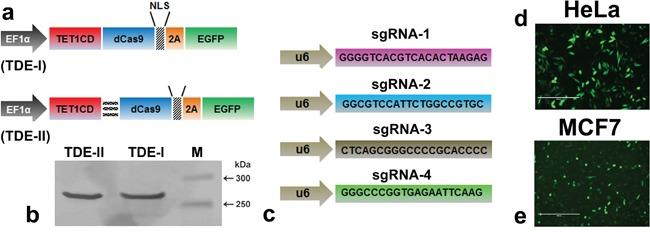
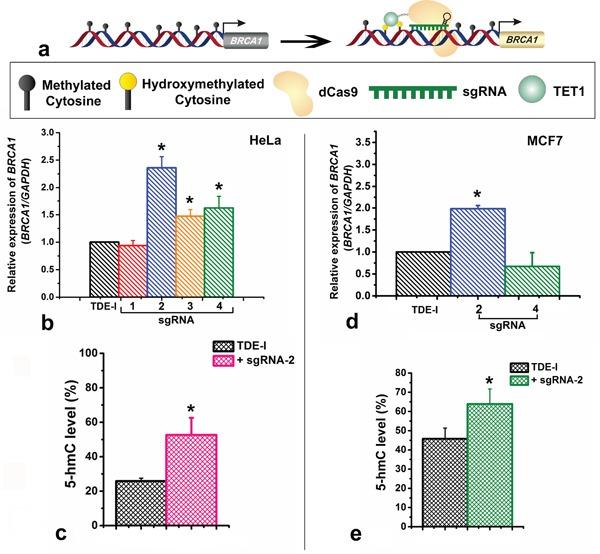
DNA hypermethylation at the promoter of tumour-suppressor genes is tightly correlated with their transcriptional repression and recognized as the hallmark of majority of cancers. Epigenetic silencing of tumour suppressor genes impairs their cellular functions and activates a cascade of events driving cell transformation and cancer progression. Here, we examine site-specific and spatiotemporal alteration in DNA methylation at a target region in BRCA1 gene promoter, a model tumour suppressor gene. We have developed a programmable CRISPR-Cas9 based demethylase tool containing the deactivated Cas9 (dCas9) fused to the catalytic domain (CD) of Ten-Eleven Translocation (TET) dioxygenase1 (TET1CD). The fusion protein selectively demethylates targeted regions within BRCA1 promoter as directed by the designed single-guide RNAs (sgRNA), leading to the transcriptional up-regulation of the gene. We also noticed the increment in 5-hydroxymethylation content (5-hmC) at the target DNA site undergoing the most profound demethylation. It confirms the catalytic activity of TET1 in TET1-dCas9 fusion proteins-mediated demethylation at these target sequences. The modular design of the fusion constructs presented here allows for the selective substitution of other chromatin or DNA modifying enzymes and for loci-specific targeting to uncover epigenetic regulatory pathways at gene promoters and other selected genomic regions.
肿瘤抑制基因启动子区域的DNA高甲基化与其转录抑制密切相关,并被认为是大多数癌症的标志。肿瘤抑制基因的表观遗传沉默会损害其细胞功能,并引发一系列驱动细胞转化和癌症进展的事件。在此,我们研究了模型肿瘤抑制基因BRCA1基因启动子中一个靶区域DNA甲基化的位点特异性和时空变化。我们开发了一种基于可编程CRISPR-Cas9的脱甲基酶工具,该工具包含与十一-易位双加氧酶1(TET1)催化结构域(CD)融合的失活Cas9(dCas9)。融合蛋白在设计的单向导RNA(sgRNA)的引导下,选择性地使BRCA1启动子内的靶向区域去甲基化,导致该基因的转录上调。我们还注意到,在经历最显著去甲基化的靶DNA位点,5-羟甲基化含量(5-hmC)有所增加。这证实了TET1在TET1-dCas9融合蛋白介导的这些靶序列去甲基化中的催化活性。本文展示的融合构建体的模块化设计允许选择性替换其他染色质或DNA修饰酶,并实现位点特异性靶向,以揭示基因启动子和其他选定基因组区域的表观遗传调控途径。

 Zotero 插件