
SIRT6缺乏所致老年骨质疏松症的表型研究
Phenotypic research on senile osteoporosis caused by SIRT6 deficiency.
作者信息
Zhang De-Mao, Cui Di-Xin, Xu Ruo-Shi, Zhou Ya-Chuan, Zheng Li-Wei, Liu Peng, Zhou Xue-Dong
机构信息
State Key Laboratory of Oral Diseases, West China Hospital of Stomatology, Sichuan University, Chengdu, China.
出版信息
Int J Oral Sci. 2016 Jun 30;8(2):84-92. doi: 10.1038/ijos.2015.57.
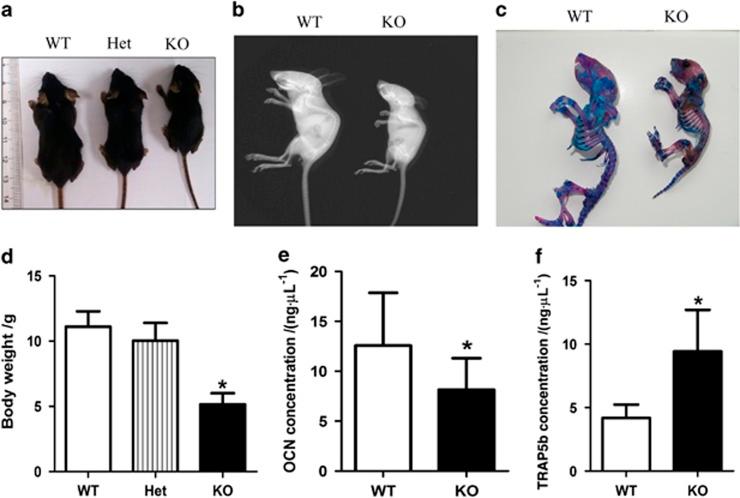
Osteoporosis is a serious public bone metabolic disease. However, the mechanisms underlying bone loss combined with ageing, which is known as senile osteoporosis, remains unknown. Here we show the detailed phenotype of this disease caused by SIRT6 knock out (KO) in mice. To the best of our knowledge, this is the first study to reveal that SIRT6 is expressed in both bone marrow stroma cells and bone-related cells in both mouse and human models, which suggests that SIRT6 is an important regulator in bone metabolism. SIRT6-KO mice exhibit a significant decrease in body weight and remarkable dwarfism. The skeleton of the SIRT6-KO mouse is deficient in cartilage and mineralized bone tissue. Moreover, the osteocalcin concentration in blood is lower, which suggests that bone mass is markedly lost. Besides, the tartrate-resistant acid phosphatase 5b (TRAP5b) concentration is much higher, which suggests that bone resorption is overactive. Both trabecular and cortical bones exhibit severe osteopenia, and the bone mineral density is decreased. Moreover, double-labelling analysis shows that bone formation is much slower. To determine whether SIRT6 directly regulates bone metabolism, we cultured primary bone marrow stromal cells for osteogenesis and osteoclastogenesis separately to avoid indirect interference in vivo responses such as inflammation. Taken together, these results show that SIRT6 can directly regulate osteoblast proliferation and differentiation, resulting in attenuation in mineralization. Furthermore, SIRT6 can directly regulate osteoclast differentiation and results in a higher number of small osteoclasts, which may be related to overactive bone resorption.
骨质疏松症是一种严重的公共骨骼代谢疾病。然而,与衰老相关的骨质流失机制,即老年性骨质疏松症,仍然未知。在此,我们展示了小鼠中SIRT6基因敲除(KO)导致的这种疾病的详细表型。据我们所知,这是第一项揭示SIRT6在小鼠和人类模型的骨髓基质细胞及骨相关细胞中均有表达的研究,这表明SIRT6是骨代谢中的一个重要调节因子。SIRT6基因敲除小鼠体重显著下降,并出现明显的侏儒症。SIRT6基因敲除小鼠的骨骼缺乏软骨和矿化骨组织。此外,血液中的骨钙素浓度较低,这表明骨量明显流失。此外,抗酒石酸酸性磷酸酶5b(TRAP5b)浓度高得多,这表明骨吸收过度活跃。小梁骨和皮质骨均表现出严重的骨质减少,骨矿物质密度降低。此外,双重标记分析表明骨形成要慢得多。为了确定SIRT6是否直接调节骨代谢,我们分别培养原代骨髓基质细胞用于成骨和成破骨,以避免体内反应如炎症的间接干扰。综上所述,这些结果表明SIRT6可以直接调节成骨细胞的增殖和分化,导致矿化减弱。此外,SIRT6可以直接调节破骨细胞分化,并导致小破骨细胞数量增加,这可能与骨吸收过度活跃有关。




 Zotero 插件