
拉科酰胺治疗功能获得性Nav1.7突变相关小纤维神经病患者的疗效、安全性及耐受性:一项随机对照试验的研究方案——LENSS研究
Efficacy, safety, and tolerability of lacosamide in patients with gain-of-function Nav1.7 mutation-related small fiber neuropathy: study protocol of a randomized controlled trial-the LENSS study.
作者信息
de Greef Bianca T A, Merkies Ingemar S J, Geerts Margot, Faber Catharina G, Hoeijmakers Janneke G J
机构信息
Department of Neurology, School of Mental Health and Neuroscience, Maastricht University Medical Center, P. Debijelaan 25, P.O. Box 5800, 6202, AZ, Maastricht, The Netherlands.
Department of Neurology, St. Elisabeth Hospital, 193 J.H.J. Hamelbergweg, Willemstad, Curaçao.
出版信息
Trials. 2016 Jun 30;17(1):306. doi: 10.1186/s13063-016-1430-1.
BACKGROUND
Small fiber neuropathy generally leads to considerable pain and autonomic symptoms. Gain-of-function mutations in the SCN9A- gene, which codes for the Nav1.7 voltage-gated sodium channel, have been reported in small fiber neuropathy, suggesting an underlying genetic basis in a subset of patients. Currently available sodium channel blockers lack selectivity, leading to cardiac and central nervous system side effects. Lacosamide is an anticonvulsant, which blocks Nav1.3, Nav1.7, and Nav1.8, and stabilizes channels in the slow-inactivation state. Since multiple Nav1.7 mutations in small fiber neuropathy showed impaired slow-inactivation, lacosamide might be effective.
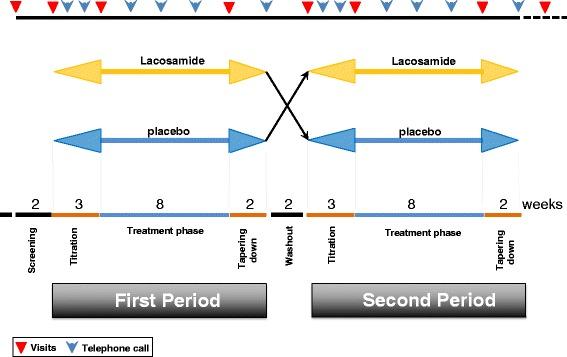
METHODS/DESIGN: The Lacosamide-Efficacy-'N'-Safety in Small fiber neuropathy (LENSS) study is a randomized, double-blind, placebo-controlled, crossover trial in patients with SCN9A-associated small fiber neuropathy, with the primary objective to evaluate the efficacy of lacosamide versus placebo. Eligible patients (the aim is to recruit 25) fulfilling the inclusion and exclusion criteria will be randomized to receive lacosamide (200 mg b.i.d.) or placebo during the first double-blinded treatment period (8 weeks), which is preceded by a titration period (3 weeks). The first treatment period will be followed by a tapering period (2 weeks). After a 2-week washout period, patients will crossover to the alternate arm for the second period consisting of an equal titration phase, treatment period, and tapering period. The primary efficacy endpoint will be the proportion of patients demonstrating a 1-point average pain score reduction compared to baseline using the Pain Intensity Numerical Rating Scale. We assume a response rate of approximately 60 % based on the criteria composed by the Initiative on Methods, Measurement, and Pain Assessment in Clinical Trials (IMMPACT) group for measurement of pain. Patients withdrawing from the study will be considered non- responders. Secondary outcomes will include changes in maximum pain score, the Small Fiber Neuropathy Symptoms Inventory Questionnaire, sleep quality and the quality of life assessment, patients' global impressions of change, and safety and tolerability measurements. Sensitivity analyses will include assessing the proportion of patients having ≥ 2 points average pain improvement compared to the baseline Pain Intensity Numerical Rating Scale scores.
DISCUSSION
This is the first study that will be evaluating the efficacy, safety, and tolerability of lacosamide versus placebo in patients with SCN9A-associated small fiber neuropathy. The findings may increase the knowledge on lacosamide as a potential treatment option in patients with painful neuropathies, considering the central role of Nav1.7 in pain.
TRIAL REGISTRATION
ClinicalTrials.gov, NCT01911975 . Registered on 13 July 2013.
背景
小纤维神经病变通常会导致相当程度的疼痛和自主神经症状。编码Nav1.7电压门控钠通道的SCN9A基因功能获得性突变已在小纤维神经病变中被报道,这表明部分患者存在潜在的遗传基础。目前可用的钠通道阻滞剂缺乏选择性,会导致心脏和中枢神经系统副作用。拉科酰胺是一种抗惊厥药,可阻断Nav1.3、Nav1.7和Nav1.8,并使通道稳定在缓慢失活状态。由于小纤维神经病变中的多个Nav1.7突变显示缓慢失活受损,拉科酰胺可能有效。
方法/设计:拉科酰胺治疗小纤维神经病变的疗效、安全性和耐受性(LENSS)研究是一项针对SCN9A相关小纤维神经病变患者的随机、双盲、安慰剂对照、交叉试验,主要目的是评估拉科酰胺与安慰剂的疗效。符合纳入和排除标准的合格患者(目标招募25名)将在第一个双盲治疗期(8周)随机接受拉科酰胺(200mg,每日两次)或安慰剂治疗,在此之前有一个滴定期(3周)。第一个治疗期之后是减量期(2周)。经过2周的洗脱期后,患者将交叉至另一组进行第二个治疗期,包括相同的滴定阶段、治疗期和减量期。主要疗效终点将是使用疼痛强度数字评定量表显示与基线相比平均疼痛评分降低1分的患者比例。根据临床试验方法、测量和疼痛评估倡议(IMMPACT)组制定的疼痛测量标准,我们假设缓解率约为60%。退出研究的患者将被视为无反应者。次要结局将包括最大疼痛评分的变化、小纤维神经病变症状量表问卷、睡眠质量和生活质量评估、患者对变化的总体印象以及安全性和耐受性测量。敏感性分析将包括评估与基线疼痛强度数字评定量表评分相比平均疼痛改善≥2分的患者比例。
讨论
这是第一项评估拉科酰胺与安慰剂在SCN9A相关小纤维神经病变患者中的疗效、安全性和耐受性的研究。考虑到Nav1.7在疼痛中的核心作用,这些发现可能会增加对拉科酰胺作为疼痛性神经病变患者潜在治疗选择的认识。
试验注册
ClinicalTrials.gov,NCT01911975。于2013年7月13日注册。
 Zotero 插件