
一种综合多组学方法揭示了用维生素E补充青草或干草对瘤胃微生物群及其功能的影响。
An Integrated Multi-Omics Approach Reveals the Effects of Supplementing Grass or Grass Hay with Vitamin E on the Rumen Microbiome and Its Function.
作者信息
Belanche Alejandro, Kingston-Smith Alison H, Newbold Charles J
机构信息
Institute of Biological, Environmental and Rural Sciences, Aberystwyth University Aberystwyth, UK.
出版信息
Front Microbiol. 2016 Jun 10;7:905. doi: 10.3389/fmicb.2016.00905. eCollection 2016.
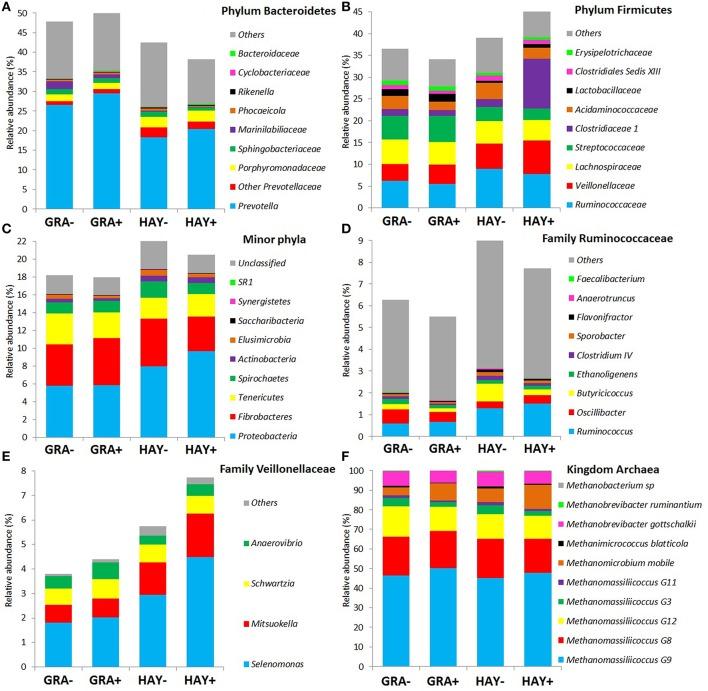
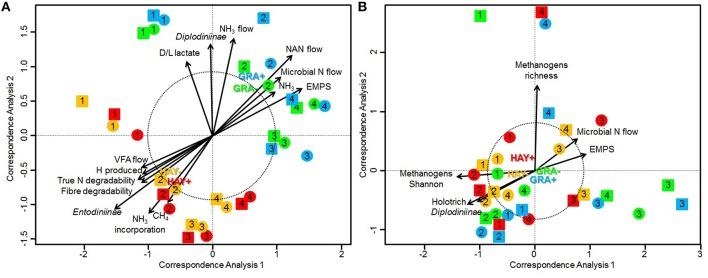
Rumen function is generally suboptimal leading to losses in methane and nitrogen. Analysis of the rumen microbiome is thus important to understanding the underlying microbial activity under different feeding strategies. This study investigated the effect of forage conservation method and vitamin E supplementation on rumen function using a rumen simulation technique. Ryegrass (GRA) or ryegrass hay (HAY) was supplemented with 20% concentrate containing zero or 50 IU/d vitamin E, as α-tocopheryl acetate, according to a 2 × 2 factorial design. The forage conservation method did not substantially change the nutrient composition but had a profound impact on the structure and diversity of the rumen microbiome. HAY diets promoted a more complex bacterial community (+38 OTUs) dominated by Firmicutes. This bacterial adaptation, together with increased rumen protozoa levels and methanogen diversity, was associated with greater fiber disappearance (+12%) in HAY diets, but also with greater rumen true N degradability (+7%) than GRA diets. HAY diets also had a higher metabolic H recovery and methane production (+35%) suggesting more efficient inter-species H transfer between bacteria, protozoa and methanogens. Contrarily, GRA diets promoted more simplified methanogen and bacterial communities, which were dominated by Bacteroidetes and Lactobacillus, thus lactate formation may have acted as an alternative H sink in GRA diets. Moreover the structure of the bacterial community with GRA diets was highly correlated with N utilization, and GRA diets promoted greater bacterial growth and microbial protein synthesis (+16%), as well as a more efficient microbial protein synthesis (+22%). A dose-response experiment using batch cultures revealed that vitamin E supplementation increased rumen fermentation in terms of total VFA and gas production, with protozoal activity higher when supplying α-tocopheryl acetate vs. α-tocopherol. Moreover, α-tocopheryl acetate promoted a small increase in feed degradability (+8%), possibly as a result of its antioxidant properties which led to higher bacterial and protozoal levels. Vitamin E supplementation also modified the levels of some methanogen species indicating that they may be particularly sensitive to oxidative stresses. Our findings suggested that when possible, grass should be fed instead of grass hay, in order to improve rumen function and to decrease the environmental impact of livestock agriculture.
瘤胃功能通常欠佳,导致甲烷和氮的损失。因此,分析瘤胃微生物群对于理解不同饲养策略下潜在的微生物活性很重要。本研究使用瘤胃模拟技术,调查了饲草保存方法和维生素E添加对瘤胃功能的影响。根据2×2析因设计,黑麦草(GRA)或黑麦草干草(HAY)补充20%的精饲料,精饲料中含有零或50 IU/d的维生素E(以醋酸α-生育酚形式)。饲草保存方法并未显著改变营养成分,但对瘤胃微生物群的结构和多样性产生了深远影响。HAY日粮促进了以厚壁菌门为主导的更复杂细菌群落(增加38个操作分类单元)。这种细菌适应性,连同瘤胃原生动物水平和产甲烷菌多样性的增加,与HAY日粮中更高的纤维消失率(增加12%)有关,但也与比GRA日粮更高的瘤胃真N降解率(增加7%)有关。HAY日粮还具有更高的代谢H回收率和甲烷产量(增加35%),表明细菌、原生动物和产甲烷菌之间的种间H转移更有效。相反,GRA日粮促进了更简化的产甲烷菌和细菌群落,这些群落以拟杆菌门和乳酸杆菌为主导,因此乳酸形成可能在GRA日粮中充当了替代H汇。此外,GRA日粮的细菌群落结构与N利用高度相关,GRA日粮促进了更大的细菌生长和微生物蛋白合成(增加16%),以及更有效的微生物蛋白合成(增加22%)。使用分批培养的剂量反应实验表明,添加维生素E在总挥发性脂肪酸和气体产生方面增加了瘤胃发酵,供应醋酸α-生育酚时原生动物活性高于供应α-生育酚时。此外,醋酸α-生育酚促进了饲料降解率的小幅增加(增加8%),这可能是由于其抗氧化特性导致细菌和原生动物水平更高。添加维生素E还改变了一些产甲烷菌物种的水平,表明它们可能对氧化应激特别敏感。我们的研究结果表明,在可能的情况下,应饲喂青草而非干草,以改善瘤胃功能并降低畜牧业对环境的影响。
 Zotero 插件