
健康个体与肠易激综合征患者在注射促肾上腺皮质激素释放激素后结肠扩张期间杏仁核和血浆去甲肾上腺素的差异激活
Differential Activation in Amygdala and Plasma Noradrenaline during Colorectal Distention by Administration of Corticotropin-Releasing Hormone between Healthy Individuals and Patients with Irritable Bowel Syndrome.
作者信息
Tanaka Yukari, Kanazawa Motoyori, Kano Michiko, Morishita Joe, Hamaguchi Toyohiro, Van Oudenhove Lukas, Ly Huynh Giao, Dupont Patrick, Tack Jan, Yamaguchi Takuhiro, Yanai Kazuhiko, Tashiro Manabu, Fukudo Shin
机构信息
Department of Integrative Genomics, Tohoku Medical Megabank Organization, Tohoku University, Sendai, Japan.
Department of Behavioral Medicine, Tohoku University Graduate School of Medicine, Sendai, Japan.
出版信息
PLoS One. 2016 Jul 22;11(7):e0157347. doi: 10.1371/journal.pone.0157347. eCollection 2016.
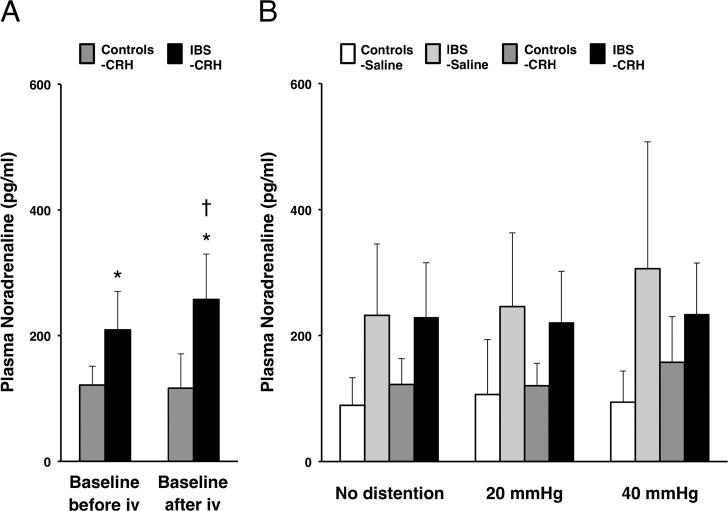
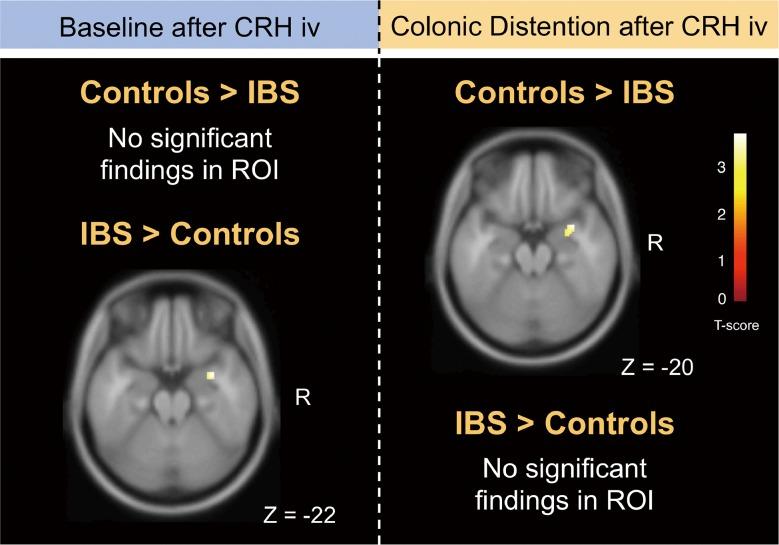
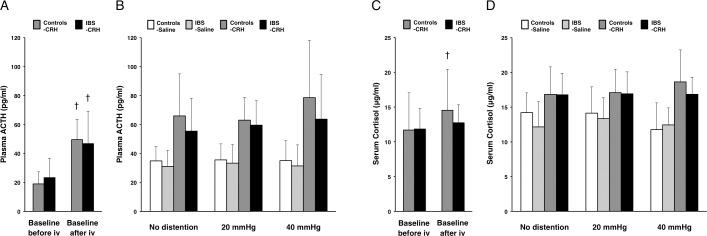
Irritable bowel syndrome (IBS) often comorbids mood and anxiety disorders. Corticotropin-releasing hormone (CRH) is a major mediator of the stress response in the brain-gut axis, but it is not clear how CRH agonists change human brain responses to interoceptive stimuli. We tested the hypothesis that brain activation in response to colorectal distention is enhanced after CRH injection in IBS patients compared to healthy controls. Brain H215O- positron emission tomography (PET) was performed in 16 male IBS patients and 16 age-matched male controls during baseline, no distention, mild and intense distention of the colorectum using barostat bag inflation. Either CRH (2 μg/kg) or saline (1:1) was then injected intravenously and the same distention protocol was repeated. Plasma adrenocorticotropic hormone (ACTH), serum cortisol and plasma noradrenaline levels were measured at each stimulation. At baseline, CRH without colorectal distention induced more activation in the right amygdala in IBS patients than in controls. During intense distention after CRH injection, controls showed significantly greater activation than IBS patients in the right amygdala. Plasma ACTH and serum cortisol secretion showed a significant interaction between drug (CRH, saline) and distention. Plasma noradrenaline at baseline significantly increased after CRH injection compared to before injection in IBS. Further, plasma noradrenaline showed a significant group (IBS, controls) by drug by distention interaction. Exogenous CRH differentially sensitizes brain regions of the emotional-arousal circuitry within the visceral pain matrix to colorectal distention and synergetic activation of noradrenergic function in IBS patients and healthy individuals.
肠易激综合征(IBS)常与情绪和焦虑障碍共病。促肾上腺皮质激素释放激素(CRH)是脑-肠轴应激反应的主要介质,但尚不清楚CRH激动剂如何改变人类大脑对体内感觉刺激的反应。我们检验了这样一个假设:与健康对照相比,IBS患者注射CRH后,对结直肠扩张的脑激活增强。对16名男性IBS患者和16名年龄匹配的男性对照进行脑H215O-正电子发射断层扫描(PET),在基线、无扩张、轻度和强烈结直肠扩张时使用恒压器气囊充气。然后静脉注射CRH(2μg/kg)或生理盐水(1:1),并重复相同的扩张方案。在每次刺激时测量血浆促肾上腺皮质激素(ACTH)、血清皮质醇和血浆去甲肾上腺素水平。在基线时,未进行结直肠扩张的CRH在IBS患者右侧杏仁核诱导的激活比对照组更多。在注射CRH后的强烈扩张期间,对照组在右侧杏仁核的激活明显大于IBS患者。血浆ACTH和血清皮质醇分泌显示药物(CRH、生理盐水)和扩张之间存在显著交互作用。与注射前相比,IBS患者注射CRH后基线时的血浆去甲肾上腺素显著增加。此外,血浆去甲肾上腺素显示出显著的组(IBS、对照组)×药物×扩张交互作用。外源性CRH使内脏痛觉矩阵内情绪唤醒回路的脑区对结直肠扩张产生不同的敏感性,并协同激活IBS患者和健康个体的去甲肾上腺素能功能。

 Zotero 插件