
利用美国医保理赔数据预测50岁及以上骨质疏松症患者即将发生骨折的风险。
Predicting imminent risk for fracture in patients aged 50 or older with osteoporosis using US claims data.
作者信息
Bonafede M, Shi N, Barron R, Li X, Crittenden D B, Chandler D
机构信息
Truven Health Analytics, Cambridge, MA, USA.
Amgen Inc., One Amgen Center Drive, Thousand Oaks, CA, USA.
出版信息
Arch Osteoporos. 2016 Dec;11(1):26. doi: 10.1007/s11657-016-0280-5. Epub 2016 Jul 30.
UNLABELLED
Patient characteristics contributing to imminent risk for fracture, defined as risk of near-term fracture within the next 12 to 24 months, have not been well defined. In patients without recent fracture, we identified factors predicting imminent risk for vertebral/nonvertebral fracture, including falls, age, comorbidities, and other potential fall risk factors.
PURPOSE
Several factors contribute to long-term fracture risk in patients with osteoporosis, including age, bone mineral density, and fracture history. Some patients may be at imminent risk for fracture, defined here as a risk of near-term fracture within 12-24 months. Many patient characteristics contributing to imminent risk for fracture have not been well defined. This case-control study used US commercial and Medicare supplemental insured data for women and men without recent fracture to identify factors associated with imminent risk for fracture.
METHODS
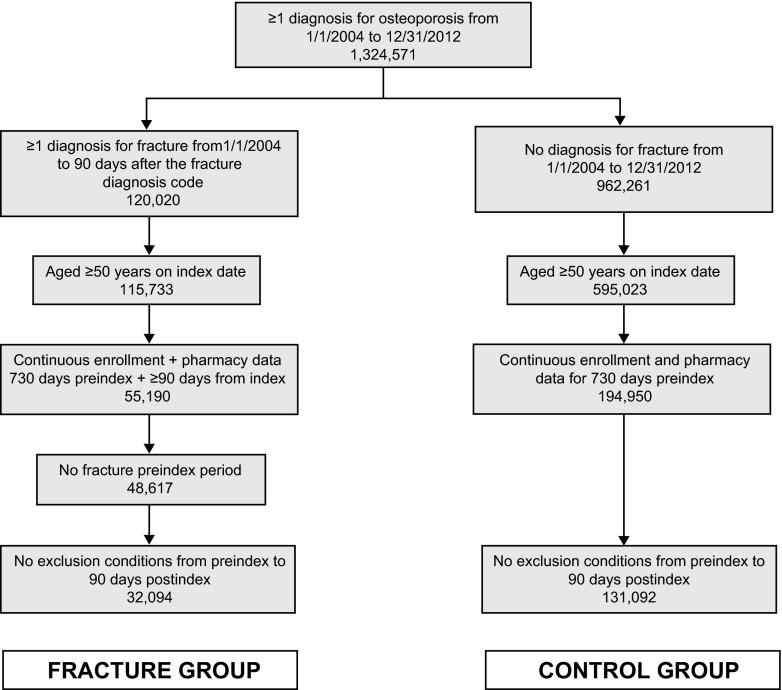
Patients included were aged ≥50 with osteoporosis, had a vertebral or nonvertebral fracture claim (index date; fracture group) or no fracture claim (control group) from January 1, 2006, to September 30, 2012, continuously enrolled and without fracture in the 24 months before index. Potential risk factors during the period before fracture were assessed.
RESULTS
Using data from 12 months before fracture, factors significantly associated with imminent risk for fracture were previous falls, older age, poorer health status, specific comorbidities (psychosis, Alzheimer's disease, central nervous system disease), and other fall risk factors (wheelchair use, psychoactive medication use, mobility impairment). Similar findings were observed with data from 24 months before fracture.
CONCLUSIONS
In patients with osteoporosis and no recent fracture, falls, older age, poorer health status, comorbidities, and other potential fall risk factors were predictive of imminent risk for fracture. Identification of factors associated with imminent risk for vertebral/nonvertebral fracture may help identify and risk stratify those patients most in need of immediate and appropriate treatment to decrease fracture risk.
未标注
导致骨折紧迫风险(定义为未来12至24个月内近期骨折的风险)的患者特征尚未明确界定。在近期未发生骨折的患者中,我们确定了预测椎体/非椎体骨折紧迫风险的因素,包括跌倒、年龄、合并症以及其他潜在的跌倒风险因素。
目的
骨质疏松症患者的长期骨折风险受多种因素影响,包括年龄、骨密度和骨折史。一些患者可能面临骨折紧迫风险,此处定义为12 - 24个月内近期骨折的风险。许多导致骨折紧迫风险的患者特征尚未明确界定。本病例对照研究使用美国商业保险和医疗保险补充参保数据,针对近期未发生骨折的女性和男性,以确定与骨折紧迫风险相关的因素。
方法
纳入的患者年龄≥50岁,患有骨质疏松症,在2006年1月1日至2012年9月30日期间有椎体或非椎体骨折索赔记录(索引日期;骨折组)或无骨折索赔记录(对照组),持续参保且在索引日期前24个月内未发生骨折。评估骨折前期间的潜在风险因素。
结果
使用骨折前12个月的数据,与骨折紧迫风险显著相关的因素包括既往跌倒、年龄较大、健康状况较差、特定合并症(精神病、阿尔茨海默病、中枢神经系统疾病)以及其他跌倒风险因素(使用轮椅、使用精神活性药物、行动障碍)。使用骨折前24个月的数据也观察到类似结果。
结论
在患有骨质疏松症且近期未发生骨折的患者中,跌倒、年龄较大、健康状况较差、合并症以及其他潜在的跌倒风险因素可预测骨折紧迫风险。识别与椎体/非椎体骨折紧迫风险相关的因素可能有助于识别那些最需要立即进行适当治疗以降低骨折风险的患者并对其进行风险分层。

 Zotero 插件