
睾酮对睾丸雌性化小鼠肝脏、肌肉和脂肪组织中脂质和葡萄糖代谢靶点有不同的调节作用。
Testosterone differentially regulates targets of lipid and glucose metabolism in liver, muscle and adipose tissues of the testicular feminised mouse.
作者信息
Kelly Daniel M, Akhtar Samia, Sellers Donna J, Muraleedharan Vakkat, Channer Kevin S, Jones T Hugh
机构信息
Department of Oncology and Metabolism, Medical School, The University of Sheffield, Sheffield, UK.
Biomolecular Research Centre, Sheffield Hallam University, Sheffield, UK.
出版信息
Endocrine. 2016 Nov;54(2):504-515. doi: 10.1007/s12020-016-1019-1. Epub 2016 Aug 4.
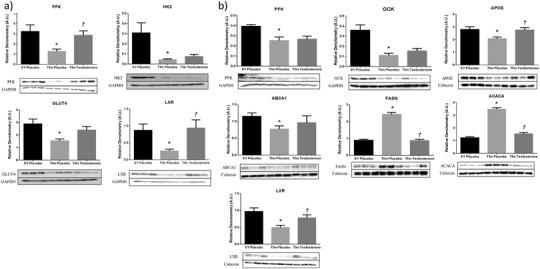
Testosterone deficiency is commonly associated with obesity, metabolic syndrome, type 2 diabetes and their clinical consequences-hepatic steatosis and atherosclerosis. The testicular feminised mouse (non-functional androgen receptor and low testosterone) develops fatty liver and aortic lipid streaks on a high-fat diet, whereas androgen-replete XY littermate controls do not. Testosterone treatment ameliorates these effects, although the underlying mechanisms remain unknown. We compared the influence of testosterone on the expression of regulatory targets of glucose, cholesterol and lipid metabolism in muscle, liver, abdominal subcutaneous and visceral adipose tissue. Testicular feminised mice displayed significantly reduced GLUT4 in muscle and glycolytic enzymes in muscle, liver and abdominal subcutaneous but not visceral adipose tissue. Lipoprotein lipase required for fatty acid uptake was only reduced in subcutaneous adipose tissue; enzymes of fatty acid synthesis were increased in liver and subcutaneous tissue. Stearoyl-CoA desaturase-1 that catalyses oleic acid synthesis and is associated with insulin resistance was increased in visceral adipose tissue and cholesterol efflux components (ABCA1, apoE) were decreased in subcutaneous and liver tissue. Master regulator nuclear receptors involved in metabolism-Liver X receptor expression was suppressed in all tissues except visceral adipose tissue, whereas PPARγ was lower in abdominal subcutaneous and visceral adipose tissue and PPARα only in abdominal subcutaneous. Testosterone treatment improved the expression (androgen receptor independent) of some targets but not all. These exploratory data suggest that androgen deficiency may reduce the buffering capability for glucose uptake and utilisation in abdominal subcutaneous and muscle and fatty acids in abdominal subcutaneous. This would lead to an overspill and uptake of excess glucose and triglycerides into visceral adipose tissue, liver and arterial walls.
睾酮缺乏通常与肥胖、代谢综合征、2型糖尿病及其临床后果——肝脂肪变性和动脉粥样硬化相关。睾丸雌性化小鼠(雄激素受体无功能且睾酮水平低)在高脂饮食下会出现脂肪肝和主动脉脂质条纹,而雄激素充足的XY同窝对照小鼠则不会。睾酮治疗可改善这些影响,但其潜在机制尚不清楚。我们比较了睾酮对肌肉、肝脏、腹部皮下和内脏脂肪组织中葡萄糖、胆固醇和脂质代谢调节靶点表达的影响。睾丸雌性化小鼠肌肉中的葡萄糖转运蛋白4(GLUT4)以及肌肉、肝脏和腹部皮下而非内脏脂肪组织中的糖酵解酶显著减少。脂肪酸摄取所需的脂蛋白脂肪酶仅在皮下脂肪组织中减少;肝脏和皮下组织中脂肪酸合成酶增加。在内脏脂肪组织中,催化油酸合成并与胰岛素抵抗相关的硬脂酰辅酶A去饱和酶-1增加,而皮下和肝脏组织中胆固醇流出成分(ABCA1、载脂蛋白E)减少。参与代谢的主要调节因子核受体——肝脏X受体的表达在除内脏脂肪组织外的所有组织中均受到抑制,而过氧化物酶体增殖物激活受体γ(PPARγ)在腹部皮下和内脏脂肪组织中较低,过氧化物酶体增殖物激活受体α(PPARα)仅在腹部皮下较低。睾酮治疗改善了一些靶点的表达(不依赖雄激素受体),但并非全部。这些探索性数据表明,雄激素缺乏可能会降低腹部皮下和肌肉对葡萄糖摄取和利用以及腹部皮下对脂肪酸的缓冲能力。这将导致过量的葡萄糖和甘油三酯溢出并被摄取到内脏脂肪组织、肝脏和动脉壁中。

 Zotero 插件