
印度改善糖尿病风险行为的移动健康干预:一项前瞻性平行组队列研究。
mHealth Intervention to Improve Diabetes Risk Behaviors in India: A Prospective, Parallel Group Cohort Study.
作者信息
Pfammatter Angela, Spring Bonnie, Saligram Nalini, Davé Raj, Gowda Arun, Blais Linelle, Arora Monika, Ranjani Harish, Ganda Om, Hedeker Donald, Reddy Sethu, Ramalingam Sandhya
机构信息
Northwestern University Feinberg School of Medicine, Chicago, IL, United States.
出版信息
J Med Internet Res. 2016 Aug 5;18(8):e207. doi: 10.2196/jmir.5712.
BACKGROUND
In low/middle income countries like India, diabetes is prevalent and health care access limited. Most adults have a mobile phone, creating potential for mHealth interventions to improve public health. To examine the feasibility and initial evidence of effectiveness of mDiabetes, a text messaging program to improve diabetes risk behaviors, a global nonprofit organization (Arogya World) implemented mDiabetes among one million Indian adults.
OBJECTIVE
A prospective, parallel cohort design was applied to examine whether mDiabetes improved fruit, vegetable, and fat intakes and exercise.
METHODS
Intervention participants were randomly selected from the one million Nokia subscribers who elected to opt in to mDiabetes. Control group participants were randomly selected from non-Nokia mobile phone subscribers. mDiabetes participants received 56 text messages in their choice of 12 languages over 6 months; control participants received no contact. Messages were designed to motivate improvement in diabetes risk behaviors and increase awareness about the causes and complications of diabetes. Participant health behaviors (exercise and fruit, vegetable, and fat intake) were assessed between 2012 and 2013 via telephone surveys by blinded assessors at baseline and 6 months later. Data were cleaned and analyzed in 2014 and 2015.
RESULTS
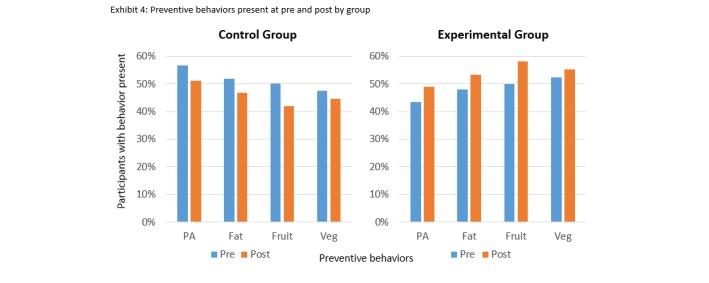
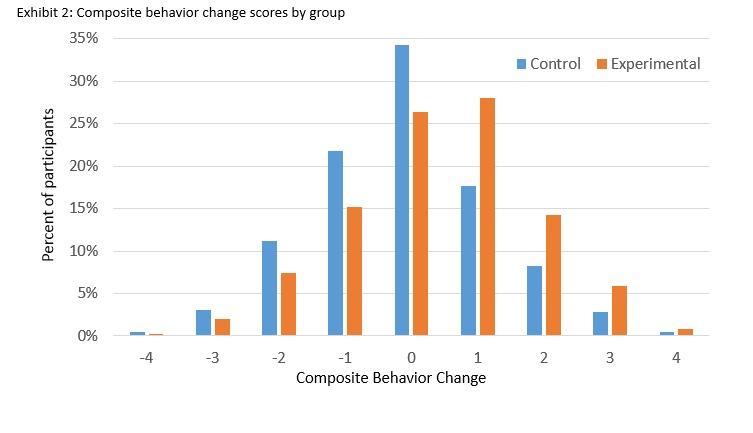
982 participants in the intervention group and 943 in the control group consented to take the phone survey at baselne. At the end of the 6-month period, 611 (62.22%) in the intervention and 632 (67.02%) in the control group completed the follow-up telephone survey. Participants receiving texts demonstrated greater improvement in a health behavior composite score over 6 months, compared with those who received no messages F(1, 1238) = 30.181, P<.001, 95% CI, 0.251-0.531. Fewer intervention participants demonstrated health behavior decline compared with controls. Improved fruit, vegetable, and fat consumption (P<.01) but not exercise were observed in those receiving messages, as compared with controls.
CONCLUSIONS
A text messaging intervention was feasible and showed initial evidence of effectiveness in improving diabetes-related health behaviors, demonstrating the potential to facilitate population-level behavior change in a low/middle income country.
TRIAL REGISTRATION
Australian New Zealand Clinical Trials Registry (ACTRN): 12615000423516; https://www.anzctr.org.au/Trial/Registration/TrialReview.aspx?id=367946&isReview=true (Archived by WebCite at http://www.webcitation.org/6j5ptaJgF).
背景
在印度这样的低收入/中等收入国家,糖尿病普遍存在且医疗保健服务有限。大多数成年人都有手机,这为移动健康干预措施改善公众健康创造了潜力。为了检验mDiabetes(一项旨在改善糖尿病风险行为的短信项目)的可行性和初步有效性证据,一个全球非营利组织(阿罗伽世界)在100万印度成年人中实施了mDiabetes项目。
目的
采用前瞻性平行队列设计,以检验mDiabetes项目是否改善了水果、蔬菜和脂肪摄入量以及运动量。
方法
干预参与者从选择加入mDiabetes项目的100万诺基亚用户中随机选取。对照组参与者从非诺基亚手机用户中随机选取。mDiabetes项目参与者在6个月内收到了他们选择的12种语言中的56条短信;对照组参与者未接受任何联系。短信旨在激励改善糖尿病风险行为,并提高对糖尿病病因和并发症的认识。2012年至2013年期间,由不知情的评估人员通过电话调查在基线和6个月后对参与者的健康行为(运动以及水果、蔬菜和脂肪摄入量)进行评估。2014年和2015年对数据进行清理和分析。
结果
干预组982名参与者和对照组943名参与者同意在基线时接受电话调查。在6个月结束时,干预组611名(62.22%)和对照组632名(67.02%)完成了随访电话调查。与未收到短信的参与者相比,收到短信的参与者在6个月内健康行为综合得分有更大改善,F(1, 1238) = 30.181,P <.001,95%置信区间为0.251 - 0.531。与对照组相比,干预组中健康行为下降的参与者更少。与对照组相比,收到短信的参与者在水果、蔬菜和脂肪消费方面有所改善(P <.01),但运动量没有改善。
结论
短信干预是可行的,并显示出在改善糖尿病相关健康行为方面的初步有效性证据,证明了在低收入/中等收入国家促进人群层面行为改变的潜力。
试验注册
澳大利亚新西兰临床试验注册中心(ACTRN):12615000423516;https://www.anzctr.org.au/Trial/Registration/TrialReview.aspx?id=367946&isReview=true(由WebCite存档于http://www.webcitation.org/6j5ptaJgF)。
 Zotero 插件