
越南母亲的婴幼儿喂养方式因种族而异。
Infant and young child feeding practices differ by ethnicity of Vietnamese mothers.
作者信息
Nguyen Tuan T, Nguyen Phuong H, Hajeebhoy Nemat, Nguyen Huan V, Frongillo Edward A
机构信息
Technical Specialist in Measurement, Learning & Evaluation, Vietnam, Alive & Thrive, Alive & Thrive Project, FHI 360, 7th floor, Ha Noi Tourist Building, 18 Ly Thuong Kiet street, Ha Noi, Vietnam.
International Food Policy Research Institute (IFPRI), Washington, DC, USA.
出版信息
BMC Pregnancy Childbirth. 2016 Aug 8;16(1):214. doi: 10.1186/s12884-016-0995-8.
BACKGROUND
Limited studies have examined ethnic variation in breastfeeding and complementary feeding practices in developing countries. This study investigated ethnic variation in feeding practices in mothers with children 0-23 months old in Vietnam.
METHODS
We used data on 1875 women who came from the ethnic majority, Kinh (n = 989, randomly sampled from 9875 surveyed Kinh mothers, 10 % from each province) and three ethnic minorities: E De-Mnong (n = 309), Thai-Muong (n = 229) and Tay-Nung (n = 348). Ethnic minorities were compared with the Kinh group using logistic regression model.
RESULTS
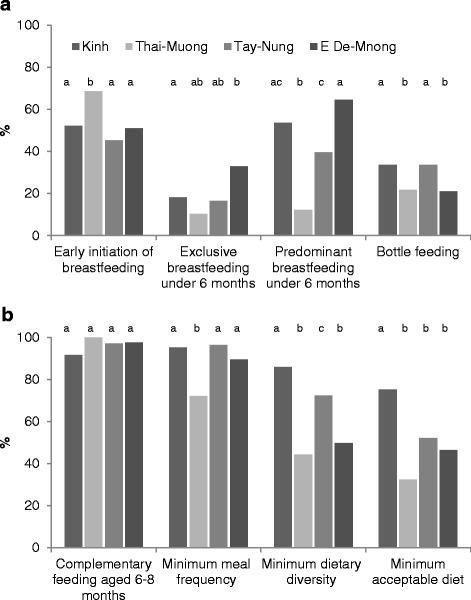
Prevalence of breastfeeding initiation within an hour of birth was 69 % in Thai-Muong, but 50 % in other ethnicities. In logistic regression, the prevalence of breastfeeding within one hour was lower in Tay-Nung (OR: 0.54; 95 % CI: 0.38, 0.77) than the majority Kinh. Prevalence of exclusive breastfeeding under 6 months was 18, 10, 17, and 33 % in Kinh, Thai-Muong, Tay-Nung, and E De-Mnong, respectively; compared to the majority Kinh, the prevalence was lower in Thai-Muong (OR: 0.42; 95 % CI: 0.25, 0.71) and higher in E De-Mnong (OR: 1.99; 95 % CI: 1.04, 3.82). Overall prevalence of bottle feeding in Thai-Muong and E De-Mnong (20 %) was lower than in Kinh (~33 %): Thai-Muong (OR: 0.50; 95 % CI: 0.37, 0.68) and E De-Mnong (OR: 0.69; 95 % CI: 0.50, 0.95). Compared with Kinh (75 %), fewer ethnic minority children received minimum acceptable diets (33 % in Thai-Muong, 46 % in E De-Mnong, and 52 % in Tay-Nung; P < 0.05). Prevalence of minimum acceptable diet (met both dietary frequency and diversity) was lower in Thai-Muong (OR: 0.23; 95 % CI: 0.11, 0.46), Tay-Nung (OR: 0.52; 95 % CI: 0.39, 0.69), and E De-Mnong (OR: 0.55; 95 % CI: 0.33, 0.89) than the majority Kinh.
CONCLUSIONS
Breastfeeding practices were suboptimal and differed by ethnicity, which suggests need for tailored interventions at multiple levels to address ethnic-specific challenges and norms. Complementary feeding practices were less optimal among ethnic minorities compared to Kinh, which suggests need for broad intervention including improved food availability, accessibility, and security.
背景
在发展中国家,针对母乳喂养和辅食喂养方式中的种族差异开展的研究有限。本研究调查了越南0至23个月儿童母亲的喂养方式中的种族差异。
方法
我们使用了1875名女性的数据,她们来自占多数的京族(n = 989,从9875名接受调查的京族母亲中随机抽取,每个省份抽取10%)以及三个少数民族:埃地孟高族(n = 309)、泰芒族(n = 229)和岱侬族(n = 348)。使用逻辑回归模型将少数民族与京族群体进行比较。
结果
泰芒族在出生后一小时内开始母乳喂养的比例为69%,而其他种族约为50%。在逻辑回归中,岱侬族在出生后一小时内进行母乳喂养的比例低于占多数的京族(比值比:0.54;95%置信区间:0.38,0.77)。京族、泰芒族、岱侬族和埃地孟高族6个月以下纯母乳喂养的比例分别为18%、10%、17%和33%;与占多数的京族相比,泰芒族的比例较低(比值比:0.42;95%置信区间:0.25,0.71),而埃地孟高族的比例较高(比值比:1.99;95%置信区间:1.04,3.82)。泰芒族和埃地孟高族奶瓶喂养的总体比例(约20%)低于京族(约33%):泰芒族(比值比:0.50;95%置信区间:0.37,0.68)和埃地孟高族(比值比:0.69;95%置信区间:0.50,0.95)。与京族(75%)相比,接受最低可接受饮食的少数民族儿童较少(泰芒族为33%,埃地孟高族为46%,岱侬族为52%;P < 0.05)。泰芒族(比值比:0.23;95%置信区间:0.11,0.46)、岱侬族(比值比:0.52;95%置信区间:0.39,0.69)和埃地孟高族(比值比:0.55;95%置信区间:0.33,0.89)最低可接受饮食(在饮食频率和多样性方面均达标)的比例低于占多数的京族。
结论
母乳喂养方式并不理想,且因种族而异,这表明需要在多个层面进行针对性干预,以应对特定种族的挑战和规范。与京族相比,少数民族的辅食喂养方式不太理想,这表明需要进行广泛干预,包括改善食物供应、可及性和安全性。
 Zotero 插件