
人类的性别、衰老与长寿:一个有趣/被忽视的情况的更新,为针对性别的医学铺平道路。
Gender, aging and longevity in humans: an update of an intriguing/neglected scenario paving the way to a gender-specific medicine.
作者信息
Ostan Rita, Monti Daniela, Gueresi Paola, Bussolotto Mauro, Franceschi Claudio, Baggio Giovannella
机构信息
Interdepartmental Centre "L. Galvani" (CIG) and Department of Experimental, Diagnostic and Specialty Medicine (DIMES), University of Bologna, Via San Giacomo 12, 40126 Bologna, Italy.
Department of Clinical and Experimental Biomedical Sciences, University of Florence, Viale Morgagni 50, 50134 Florence, Italy.
出版信息
Clin Sci (Lond). 2016 Oct 1;130(19):1711-25. doi: 10.1042/CS20160004.
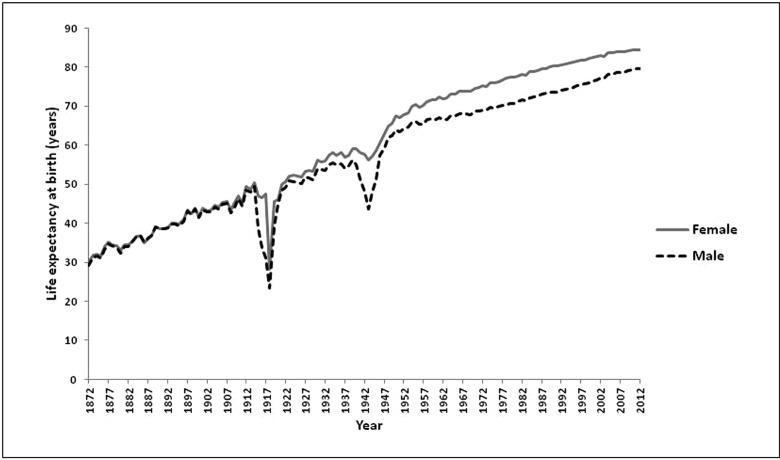
Data showing a remarkable gender difference in life expectancy and mortality, including survival to extreme age, are reviewed starting from clinical and demographic data and stressing the importance of a comprehensive historical perspective and a gene-environment/lifestyle interaction. Gender difference regarding prevalence and incidence of the most important age-related diseases, such as cardiovascular and neurodegenerative diseases, cancer, Type 2 diabetes, disability, autoimmunity and infections, are reviewed and updated with particular attention to the role of the immune system and immunosenescence. On the whole, gender differences appear to be pervasive and still poorly considered and investigated despite their biomedical relevance. The basic biological mechanisms responsible for gender differences in aging and longevity are quite complex and still poorly understood. The present review focuses on centenarians and their offspring as a model of healthy aging and summarizes available knowledge on three basic biological phenomena, i.e. age-related X chromosome inactivation skewing, gut microbiome changes and maternally inherited mitochondrial DNA genetic variants. In conclusion, an appropriate gender-specific medicine approach is urgently needed and should be systematically pursued in studies on healthy aging, longevity and age-related diseases, in a globalized world characterized by great gender differences which have a high impact on health and diseases.
本文从临床和人口统计学数据出发,回顾了显示预期寿命和死亡率方面显著性别差异的数据,包括活到极高年龄的情况,并强调了全面历史视角以及基因-环境/生活方式相互作用的重要性。回顾并更新了关于最重要的与年龄相关疾病(如心血管疾病、神经退行性疾病、癌症、2型糖尿病、残疾、自身免疫性疾病和感染)的患病率和发病率的性别差异,特别关注免疫系统和免疫衰老的作用。总体而言,尽管性别差异具有生物医学相关性,但它们似乎普遍存在,且仍未得到充分考虑和研究。导致衰老和长寿方面性别差异的基本生物学机制相当复杂,目前仍知之甚少。本综述聚焦于百岁老人及其后代这一健康衰老模型,总结了关于三种基本生物学现象的现有知识,即与年龄相关的X染色体失活偏斜、肠道微生物群变化以及母系遗传的线粒体DNA基因变异。总之,在一个性别差异巨大且对健康和疾病有重大影响的全球化世界中,迫切需要一种适当的针对性别的医学方法,并应在健康衰老、长寿和与年龄相关疾病的研究中系统地加以推行。

 Zotero 插件