
高敏C反应蛋白水平与小动脉闭塞患者预后的关联
Association between hs-CRP Levels and the Outcomes of Patients with Small-Artery Occlusion.
作者信息
Qiu Ruiying, Gao Yuan, Hou Dongzhe, Wang Yajing, Yu Changshen, Wang Wanjun, Liu Shoufeng, Gao Chunlin, Tong Xiaoguang, Wu Jialing
机构信息
Department of Neurorehabilitation and Neurology, Tianjin Huanhu Hospital, Tianjin Key Laboratory of Cerebrovascular and Neurodegenerative Diseases Tianjin, China.
Department of Neurosurgery, Tianjin Huanhu Hospital, Tianjin Key Laboratory of Cerebrovascular and Neurodegenerative Diseases Tianjin, China.
出版信息
Front Aging Neurosci. 2016 Aug 9;8:191. doi: 10.3389/fnagi.2016.00191. eCollection 2016.
BACKGROUND
High-sensitivity C-reactive protein (hs-CRP) is not only a marker of inflammation but also a prognostic factor for ischemic stroke. The objective of our study was to investigative the association between hs-CRP levels and outcomes of patients with small-artery occlusion (SAO).
METHODS
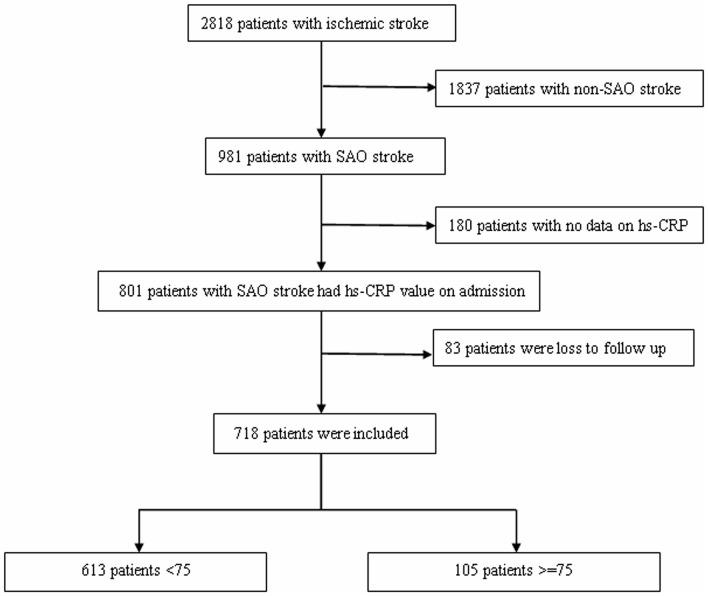
We selected 718 participants diagnosed with SAO (according to Trial of Org 10172 in Acute Stroke Treatment classification) using the stroke registry of the Department of Neurorehabilitation of Tianjin HuanHu Hospital. Hs-CRP values at admission were classified into 3 categories: <0.91 mg/L, 0.91 to <2.77 mg/L, and ≥2.77 mg/L. Patients were divided into two subgroups based on age: the younger subgroup (<75years) and the elder subgroup (≥75 years). Clinical outcomes were evaluated with the modified Rankin scale (mRS) 3 months after the onset of stroke. We examined the relationship between hs-CRP levels at the time of admission and mRS scores using multivariate logistic regression analysis. We also assessed the association between hs-CRP levels and patient outcomes according to age.
RESULTS
Among 718 patients with SAO (mean age, 61.7 ± 11.3 years), median hs-CRP was 1.54 mg/L. Although 628 patients had a favorable outcome, and 90 patients had a poor outcome at 3 months after SAO. Compared with the lowest levels of hs-CRP, those highest levels of hs-CRP (hs-CRP > 2.77 mg/L) were at increased risk of poor outcome (adjusted odds ratio, 1.917; 95% CI, 1.050-3.500; P = 0.034), and more than twice the risk of poor outcome among patients in the younger subgroup (adjusted odds ratio, 2.092; 95% CI, 1.079-4.058; P = 0.029). These associations persisted after adjustment for confounding risk factors. However, hs-CRP levels were not significantly associated with outcome among patients in the elder subgroup.
CONCLUSIONS
Elevated hs-CRP in patients with SAO is an independent predictor of poor prognosis; however, this association is only present in younger patients (<75 years).
背景
高敏C反应蛋白(hs-CRP)不仅是炎症标志物,也是缺血性卒中的预后因素。本研究的目的是探讨hs-CRP水平与小动脉闭塞(SAO)患者预后之间的关联。
方法
我们使用天津环湖医院神经康复科的卒中登记系统,选取了718例诊断为SAO的参与者(根据急性卒中治疗中Org 10172试验分类)。入院时的hs-CRP值分为3类:<0.91mg/L、0.91至<2.77mg/L和≥2.77mg/L。根据年龄将患者分为两个亚组:较年轻亚组(<75岁)和较年长亚组(≥75岁)。在卒中发病3个月后,使用改良Rankin量表(mRS)评估临床结局。我们使用多因素逻辑回归分析来研究入院时hs-CRP水平与mRS评分之间的关系。我们还根据年龄评估了hs-CRP水平与患者预后之间的关联。
结果
在718例SAO患者中(平均年龄61.7±11.3岁),hs-CRP的中位数为1.54mg/L。虽然628例患者预后良好,90例患者在SAO后3个月预后不良。与hs-CRP最低水平相比,最高水平的hs-CRP(hs-CRP>2.77mg/L)预后不良的风险增加(调整后的比值比为1.917;95%CI为1.050-3.500;P=0.034),在较年轻亚组患者中预后不良的风险增加两倍多(调整后的比值比为2.092;95%CI为1.079-4.058;P=0.029)。在对混杂风险因素进行调整后,这些关联仍然存在。然而,hs-CRP水平与较年长亚组患者的预后无显著关联。
结论
SAO患者hs-CRP升高是预后不良的独立预测因素;然而,这种关联仅存在于较年轻患者(<75岁)中。
 Zotero 插件