
微小残留病状态在新诊断的多发性骨髓瘤患者临床结局中的作用:一项荟萃分析。
Role of MRD status in relation to clinical outcomes in newly diagnosed multiple myeloma patients: a meta-analysis.
作者信息
Landgren O, Devlin S, Boulad M, Mailankody S
机构信息
Department of Medicine, Myeloma Service, Memorial Sloan-Kettering Cancer Center, New York, NY, USA.
Department of Epidemiology and Biostatistics, Memorial Sloan-Kettering Cancer Center, New York, NY, USA.
出版信息
Bone Marrow Transplant. 2016 Dec;51(12):1565-1568. doi: 10.1038/bmt.2016.222. Epub 2016 Sep 5.
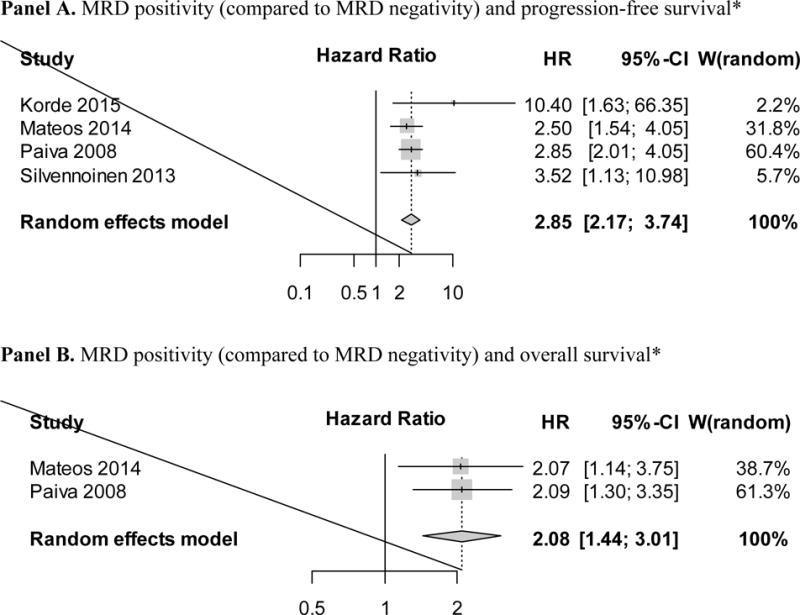
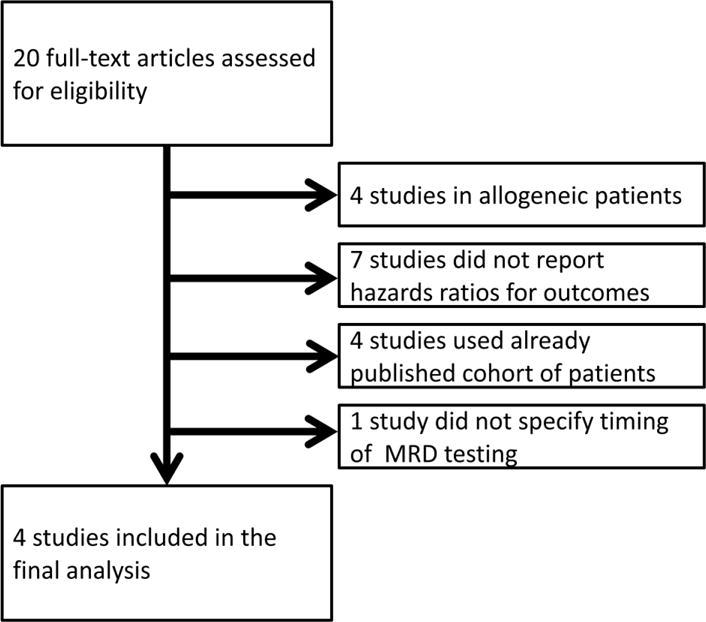
Driven by access to better drugs, on average, newly diagnosed multiple myeloma patients have over 10 years overall survival. Using modern combination therapies-with or without the addition of high-dose melphalan and autologous stem cell transplantation-up to 80% of patients reach a complete response. As a logical and necessary step forward, clinical studies have explored strategies to detect minimal residual disease (MRD) and its correlation with clinical outcomes. In this context, MRD has been proposed as a regulatory end point for drug approval in newly diagnosed multiple myeloma. To better define the role of MRD negativity in relation to clinical outcomes, we undertook a meta-analysis including published clinical trials of newly diagnosed multiple myeloma patients. We applied a random effects model which weighted studies using the inverse-variance method. Studies were combined on the scale of the logarithm of the hazard ratio (HR) and the corresponding s.d. We found that MRD negativity (versus positivity) was associated with better PFS (HR=0.35; 95% confidence interval (CI) 0.27-0.46; P<0.001) and overall survival (HR=0.48; 95% CI 0.33-0.70; P<0.001). Our results show that MRD negativity is a strong predictor of clinical outcomes, supportive of MRD becoming a regulatory end point for drug approval in newly diagnosed multiple myeloma.
在可获得更好药物的推动下,新诊断的多发性骨髓瘤患者总体生存率平均超过10年。使用现代联合疗法(无论是否添加高剂量美法仑和自体干细胞移植),高达80%的患者可达到完全缓解。作为合理且必要的下一步,临床研究探索了检测微小残留病(MRD)及其与临床结局相关性的策略。在此背景下,MRD已被提议作为新诊断多发性骨髓瘤药物批准的监管终点。为了更好地界定MRD阴性与临床结局的关系,我们进行了一项荟萃分析,纳入了已发表的新诊断多发性骨髓瘤患者的临床试验。我们应用随机效应模型,采用逆方差法对研究进行加权。研究在风险比(HR)的对数尺度和相应的标准差上进行合并。我们发现,MRD阴性(与阳性相比)与更好的无进展生存期(HR = 0.35;95%置信区间(CI)0.27 - 0.46;P < 0.001)和总生存期(HR = 0.48;95% CI 0.33 - 0.70;P < 0.001)相关。我们的结果表明,MRD阴性是临床结局的有力预测指标,支持MRD成为新诊断多发性骨髓瘤药物批准的监管终点。
 Zotero 插件