
库欣综合征中肾上腺类固醇生成抑制剂作用的最新进展:关注新疗法。
Updates on the role of adrenal steroidogenesis inhibitors in Cushing's syndrome: a focus on novel therapies.
机构信息
Departments of Medicine and Neurological Surgery, and Northwest Pituitary Center, Oregon Health & Science University, Mail Code: CH8N, 3303 SW Bond Ave, Portland, OR, 97239, USA.
Aix Marseille University, CNRS, CRN2M, Department of Endocrinology, Assistance Publique Hopitaux de Marseille, Marseille, France.
出版信息
Pituitary. 2016 Dec;19(6):643-653. doi: 10.1007/s11102-016-0742-1.
PURPOSE
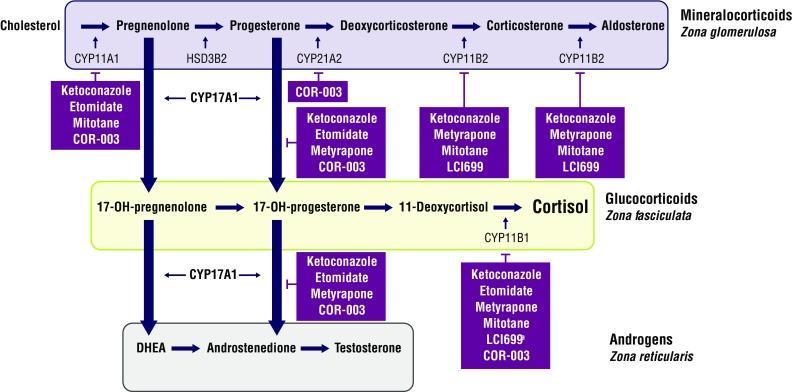
Endogenous Cushing's syndrome (CS) is a rare disease that results from exposure to high levels of cortisol; Cushing's disease (CD) is the most frequent form of CS. Patients with CS suffer from a variety of comorbidities that increase the risk of mortality. Surgical resection of the disease-causing lesion is generally the first-line treatment of CS. However, some patients may not be eligible for surgery due to comorbidities, and approximately 25 % of patients, especially those with CD, have recurrent disease. For these patients, adrenal steroidogenesis inhibitors may control cortisol elevation and subsequent symptomatology. CS is rare overall, and clinical studies of adrenal steroidogenesis inhibitors are often small and, in many cases, data are limited regarding the efficacy and safety of these treatments. Our aim was to better characterize the profiles of efficacy and safety of currently available adrenal steroidogenesis inhibitors, including drugs currently in development.
METHODS
We performed a systematic review of the literature regarding adrenal steroidogenesis inhibitors, focusing on novel drugs.
RESULTS
Currently available adrenal steroidogenesis inhibitors, including ketoconazole, metyrapone, etomidate, and mitotane, have variable efficacy and significant side effects, and none are approved by the US Food and Drug Administration for CS. Therefore, there is a clear need for novel, prospectively studied agents that have greater efficacy and a low rate of adverse side effects. Efficacy and safety data of current and emerging adrenal steroidogenesis inhibitors, including osilodrostat (LCI699) and levoketoconazole (COR-003), show promising results that will have to be confirmed in larger-scale phase 3 studies (currently ongoing).
CONCLUSIONS
The management of CS, and particularly CD, remains challenging. Adrenal steroidogenesis inhibitors can be of major interest to control the hypercortisolism at any time point, either before or after surgery, as discussed in this review.
目的
内源性库欣综合征(CS)是一种罕见的疾病,由暴露于高水平皮质醇引起;库欣病(CD)是 CS 最常见的形式。CS 患者患有多种合并症,这会增加死亡率。手术切除致病病变通常是 CS 的一线治疗方法。然而,由于合并症,一些患者可能不符合手术条件,约 25%的患者,尤其是 CD 患者,疾病会复发。对于这些患者,肾上腺类固醇生成抑制剂可能会控制皮质醇升高和随后的症状。CS 总体上较为罕见,并且肾上腺类固醇生成抑制剂的临床研究通常规模较小,在许多情况下,关于这些治疗方法的疗效和安全性的数据有限。我们的目的是更好地描述现有肾上腺类固醇生成抑制剂的疗效和安全性特征,包括目前正在开发的药物。
方法
我们对有关肾上腺类固醇生成抑制剂的文献进行了系统评价,重点关注新型药物。
结果
目前可用的肾上腺类固醇生成抑制剂,包括酮康唑、美替拉酮、依托咪酯和米托坦,疗效各异,且副作用明显,均未被美国食品和药物管理局批准用于 CS。因此,非常需要新型、前瞻性研究的药物,这些药物具有更高的疗效和较低的不良反应发生率。目前和新兴的肾上腺类固醇生成抑制剂(包括奥昔孕诺酮(LCI699)和左酮康唑(COR-003))的疗效和安全性数据显示出有希望的结果,这些结果将需要在更大规模的 3 期研究(目前正在进行中)中得到证实。
结论
CS,特别是 CD 的治疗仍然具有挑战性。肾上腺类固醇生成抑制剂在手术前后的任何时间点都可以控制皮质醇过多,这在本文中进行了讨论。
 Zotero 插件