
托法替布撤药及重新治疗对患者报告结局的影响:一项针对中度至重度慢性斑块状银屑病患者的3期研究结果
Effect of tofacitinib withdrawal and re-treatment on patient-reported outcomes: results from a Phase 3 study in patients with moderate to severe chronic plaque psoriasis.
作者信息
Griffiths C E M, Vender R, Sofen H, Kircik L, Tan H, Rottinghaus S T, Bachinsky M, Mallbris L, Mamolo C
机构信息
The Dermatology Centre, Salford Royal Hospital, University of Manchester, Manchester Academic Health Science Centre, Manchester, UK.
Dermatrials Research Inc, Hamilton, ON, Canada.
出版信息
J Eur Acad Dermatol Venereol. 2017 Feb;31(2):323-332. doi: 10.1111/jdv.13808. Epub 2016 Sep 7.
BACKGROUND
Tofacitinib is an oral Janus kinase inhibitor being investigated for psoriasis. A Phase 3 withdrawal/re-treatment study (NCT01186744; OPT Retreatment) showed tofacitinib re-treatment was effective in patients with chronic plaque psoriasis.
OBJECTIVES
To describe the effects of tofacitinib withdrawal/re-treatment on health-related quality of life (HRQoL) and disease symptoms measured by patient-reported outcomes (PROs).
METHODS
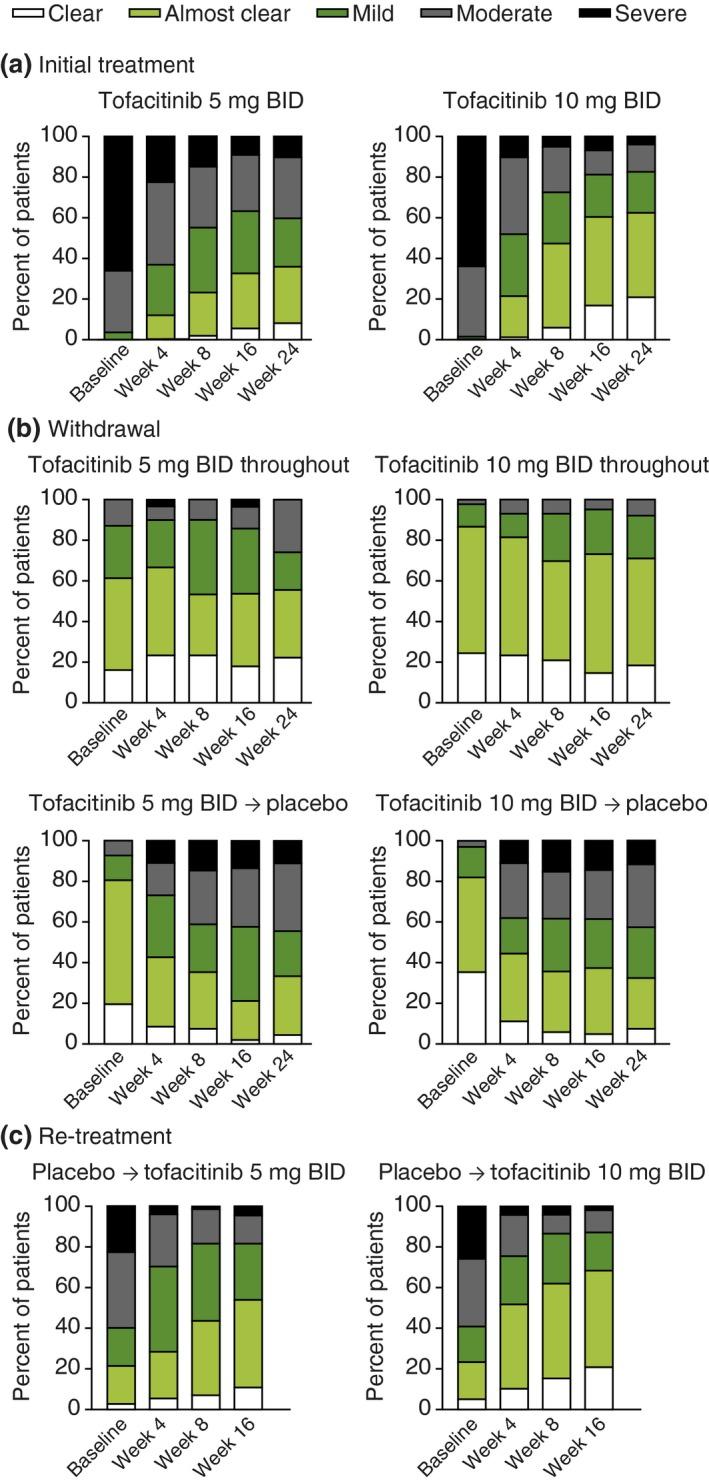
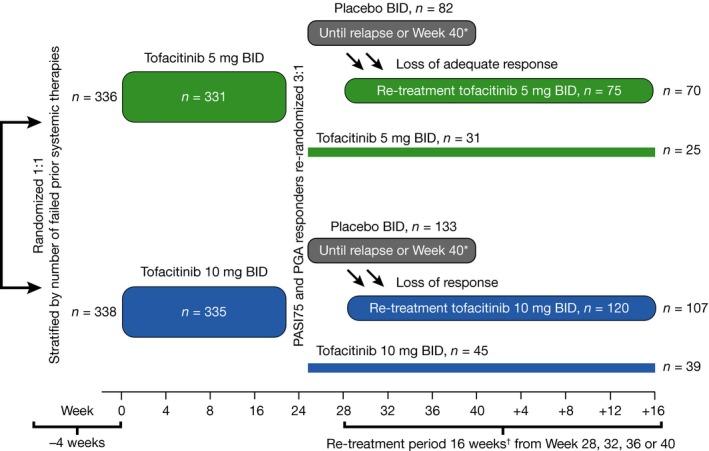
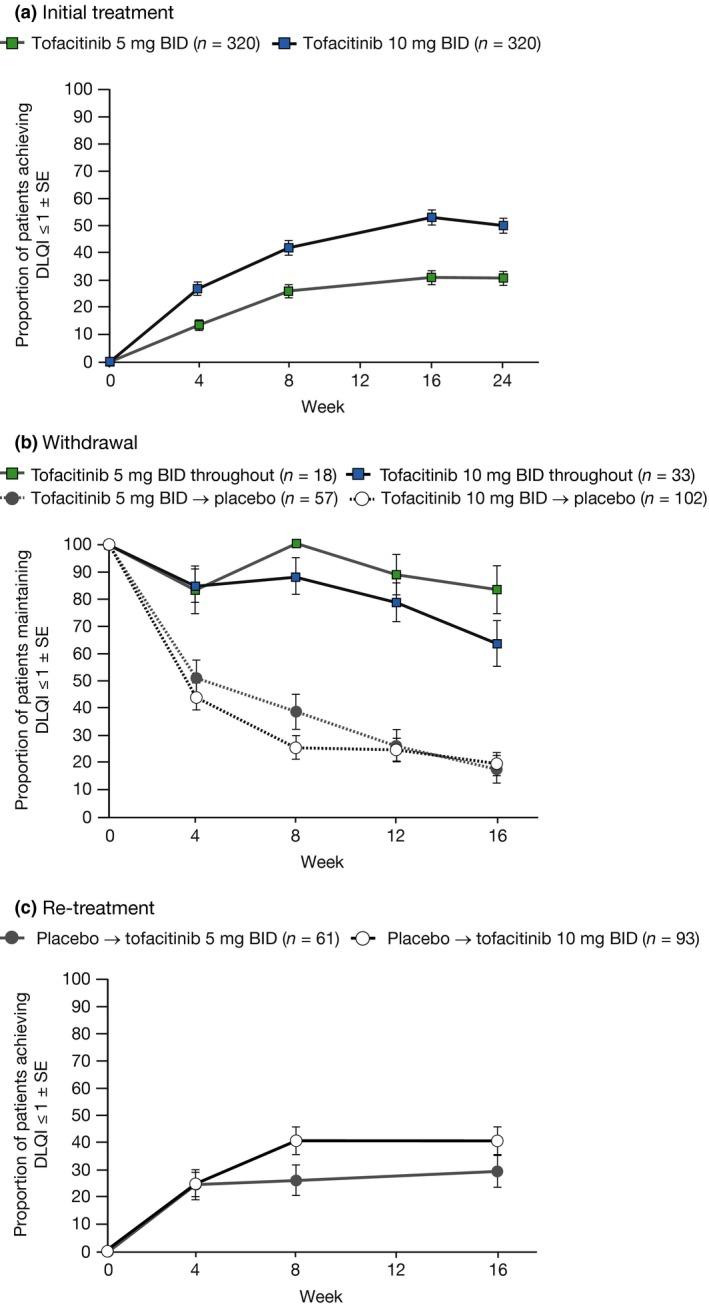
The study was divided into initial treatment, treatment withdrawal, and re-treatment periods. Initial treatment: patients were randomized to receive tofacitinib 5 (n = 331) or 10 mg (n = 335) BID for 24 weeks. Treatment withdrawal: patients who achieved both ≥ 75% reduction in Psoriasis Area and Severity Index (PASI) score from baseline and Physician's Global Assessment of 'clear'/'almost clear' at Week (W)24 received placebo (withdrawal) or the previous dose (continuous treatment). Re-treatment: at relapse (> 50% loss of W24 PASI response) or at W40, patients received their initial tofacitinib dose. PROs included: Dermatology Life Quality Index (DLQI), Itch Severity Item (ISI), Short Form-36 (SF-36) and Patient's Global Assessment (PtGA).
RESULTS
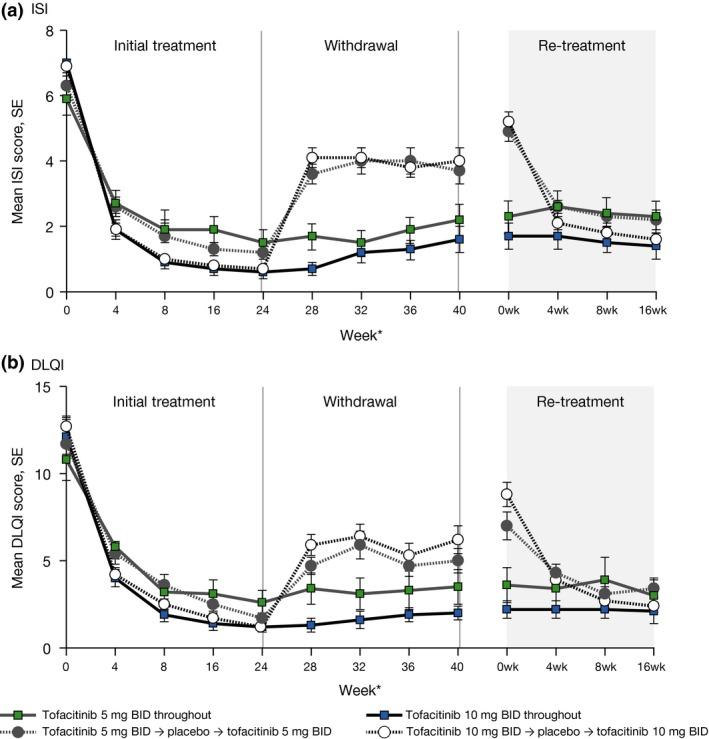
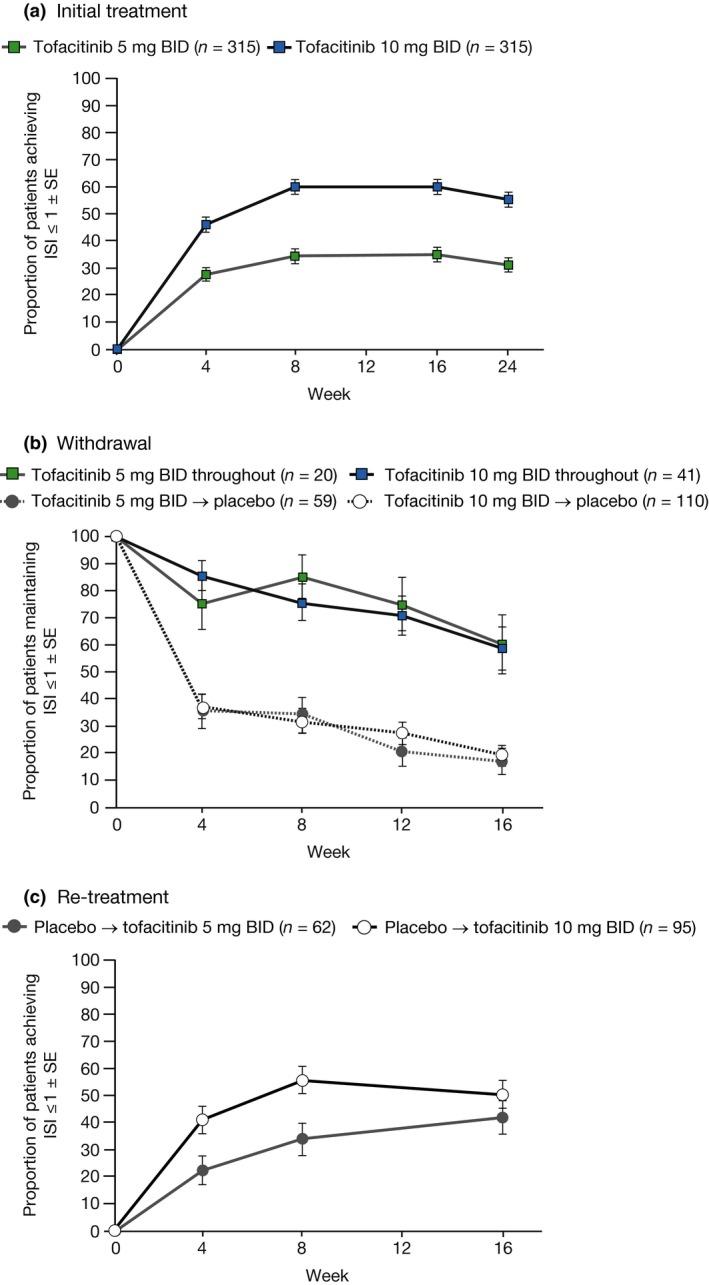
After initial treatment with tofacitinib 5 and 10 mg BID, substantial and significant improvements were reported for mean DLQI (baseline: 12.6 and 12.6; W24: 5.1 and 2.6) and ISI (baseline: 6.7 and 6.9; W24: 2.9 and 1.6). Patients continuously treated with tofacitinib 5 and 10 mg BID maintained those improvements through Week 56 (DLQI: 3.0 and 2.1; ISI: 2.3 and 1.4). By W40, patients withdrawn from tofacitinib 5 and 10 mg BID showed worsening in DLQI (5.0 and 6.2) and ISI (3.7 and 4.0) scores; improvements were regained upon re-treatment (W56, DLQI: 3.4 and 2.4; ISI: 2.2 and 1.6). Similar results were reported for PtGA and SF-36.
CONCLUSION
Continuous tofacitinib treatment provided sustained improvement in HRQoL and disease symptoms. Patients randomized to treatment withdrawal lost initial improvements. Upon re-treatment, improvements were recaptured to levels comparable to those seen with continuous treatment.
背景
托法替布是一种口服的Janus激酶抑制剂,正在进行银屑病方面的研究。一项3期撤药/再治疗研究(NCT01186744;OPT再治疗)表明,托法替布再治疗对慢性斑块状银屑病患者有效。
目的
描述托法替布撤药/再治疗对健康相关生活质量(HRQoL)以及通过患者报告结局(PROs)测量的疾病症状的影响。
方法
该研究分为初始治疗、治疗撤药和再治疗阶段。初始治疗:患者被随机分为接受每日两次5mg(n = 331)或10mg(n = 335)托法替布治疗24周。治疗撤药:在第24周达到银屑病面积和严重程度指数(PASI)评分较基线降低≥75%且医生整体评估为“清除”/“几乎清除”的患者接受安慰剂(撤药)或先前剂量(持续治疗)。再治疗:在复发时(第24周PASI反应丧失>50%)或在第40周,患者接受其初始托法替布剂量。PROs包括:皮肤病生活质量指数(DLQI)、瘙痒严重程度项目(ISI)、简明健康状况调查量表(SF - 36)和患者整体评估(PtGA)。
结果
在接受每日两次5mg和10mg托法替布初始治疗后,平均DLQI(基线:12.6和12.6;第24周:5.1和2.6)和ISI(基线:6.7和6.9;第24周:2.9和1.6)有显著且实质性改善。接受每日两次5mg和10mg托法替布持续治疗的患者在第56周维持了这些改善(DLQI:3.0和2.1;ISI:2.3和1.4)。到第40周时,停用每日两次5mg和10mg托法替布的患者DLQI(5.0和6.2)和ISI(3.7和4.0)评分恶化;再治疗后恢复改善(第56周,DLQI:3.4和2.4;ISI:2.2和1.6)。PtGA和SF - 36也有类似结果。
结论
托法替布持续治疗可使HRQoL和疾病症状持续改善。随机接受治疗撤药的患者失去了最初的改善。再治疗后,改善恢复到与持续治疗相当的水平。
 Zotero 插件