
激肽释放酶4和基质金属蛋白酶-20在恶性、良性及浸润性牙源性肿瘤中的免疫表达
Kallikrein 4 and matrix metalloproteinase-20 immunoexpression in malignant, benign and infiltrative odontogenic tumors.
作者信息
Crivelini Marcelo Macedo, Oliveira Denise Tostes, de Mesquita Ricardo Alves, de Sousa Suzana Cantanhede Orsini Machado, Loyola Adriano Motta
机构信息
Department of Pathology and Clinical Propedeutics, Araçatuba School of Dentistry, Universidade Estadual Paulista, Araçatuba, Brazil.
Department of Stomatology, Bauru School of Dentistry, University of São Paulo, São Paulo, Brazil.
出版信息
J Oral Maxillofac Pathol. 2016 May-Aug;20(2):246-51. doi: 10.4103/0973-029X.185927.
CONTEXT
Matrix metalloproteinase-20 (MMP20) (enamelysin) and kallikrein 4 (KLK4) are enzymes secreted by ameloblasts that play an important role in enamel matrix degradation during amelogenesis. However, studies have shown that neoplastic cells can produce such enzymes, which may affect the tumor infiltrative and metastatic behaviors.
AIMS
The aim of this study is to assess the biological role of MMP20 and KLK4 in odontogenic tumors.
MATERIALS AND METHODS
The enzymes were analyzed immunohistochemically in ameloblastoma, adenomatoid odontogenic tumor (AOT), calcifying epithelial odontogenic tumor, keratocystic odontogenic tumor with or without recurrence and odontogenic carcinoma.
STATISTICAL ANALYSIS USED
Clinicopathological parameters were statistically correlated with protein expression using the Fisher's exact test. Kruskal-Wallis and Wilcoxon-independent methods were used to evaluate the differences in median values.
RESULTS
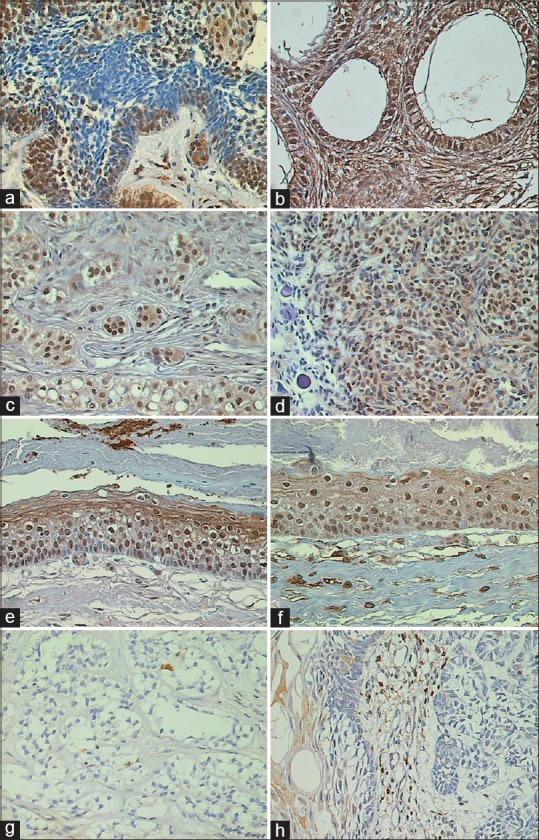
Positive Immunoexpression was detected in all benign lesions, with a prevalence of 75-100% immunolabeled cells. Patients were predominantly young, Caucasian, female, with slow-growing tumors located in the mandible causing asymptomatic swelling. No KLK4 expression was seen in carcinomas, and the amount of MMP20-positive cells varied between 20% and 80%. Rapid evolution, recurrence and age >60 years characterized the malignant nature of these lesions.
CONCLUSIONS
Data showed that KLK4 and MMP20 enzymes may not be crucial to tumoral infiltrative capacity, especially in malignant tumors, considering the diversity and peculiarity of these lesions. The significant immunoexpression in benign lesions, remarkably in AOT, is likely associated with differentiated tumor cells that can produce and degrade enamel matrix-like substances. This would be expected since the histogenesis of odontogenic tumors commonly comes from epithelium that recently performed a secretory activity in tooth formation.
背景
基质金属蛋白酶-20(MMP20)(釉质溶解素)和激肽释放酶4(KLK4)是成釉细胞分泌的酶,在釉质形成过程中对釉质基质降解起重要作用。然而,研究表明肿瘤细胞也可产生这些酶,这可能影响肿瘤的浸润和转移行为。
目的
本研究旨在评估MMP20和KLK4在牙源性肿瘤中的生物学作用。
材料与方法
采用免疫组织化学方法分析成釉细胞瘤、腺样牙源性肿瘤(AOT)、牙源性钙化上皮瘤、伴或不伴复发的牙源性角化囊性瘤及牙源性癌中的这些酶。
所用统计分析方法
采用Fisher精确检验对临床病理参数与蛋白表达进行统计学相关性分析。使用Kruskal-Wallis和Wilcoxon独立方法评估中位数差异。
结果
在所有良性病变中均检测到阳性免疫表达,免疫标记细胞的发生率为75%-100%。患者主要为年轻的白种女性,肿瘤生长缓慢,位于下颌骨,引起无症状肿胀。在癌中未见KLK4表达,MMP20阳性细胞数量在20%至80%之间变化。这些病变的恶性特征为进展迅速、复发且年龄>60岁。
结论
数据表明,考虑到这些病变的多样性和特殊性,KLK4和MMP20酶可能对肿瘤的浸润能力并非至关重要,尤其是在恶性肿瘤中。良性病变中显著的免疫表达,特别是在AOT中,可能与能够产生和降解釉质基质样物质的分化肿瘤细胞有关。鉴于牙源性肿瘤的组织发生通常源于在牙齿形成过程中近期进行分泌活动的上皮,这是可以预期的。
 Zotero 插件