
含GluN2D的N-甲基-D-天冬氨酸受体介导海马中间神经元的突触传递并调节中间神经元活性。
GluN2D-Containing N-methyl-d-Aspartate Receptors Mediate Synaptic Transmission in Hippocampal Interneurons and Regulate Interneuron Activity.
作者信息
Perszyk Riley E, DiRaddo John O, Strong Katie L, Low Chian-Ming, Ogden Kevin K, Khatri Alpa, Vargish Geoffrey A, Pelkey Kenneth A, Tricoire Ludovic, Liotta Dennis C, Smith Yoland, McBain Chris J, Traynelis Stephen F
机构信息
Departments of Pharmacology (R.E.P., J.O.D., K.K.O., A.K., S.F.T.), Chemistry (J.O.D., K.L.S., D.C.L.), Neurology (Y.S.), Yerkes National Primate Research Center (Y.S.), and Morris K. Udall Center of Excellence for Parkinson's Disease Research (Y.S.), Emory University, Atlanta, Georgia; Departments of Pharmacology and Anaesthesiology (C.-M.L.), Yong Loo Lin School of Medicine, National University of Singapore, Singapore; and Program in Developmental Neurobiology, Eunice Kennedy-Shriver National Institute of Child Health and Human Development (G.A.V., K.A.P., L.T., C.J.M.), National Institutes of Health, Bethesda, Maryland.
Departments of Pharmacology (R.E.P., J.O.D., K.K.O., A.K., S.F.T.), Chemistry (J.O.D., K.L.S., D.C.L.), Neurology (Y.S.), Yerkes National Primate Research Center (Y.S.), and Morris K. Udall Center of Excellence for Parkinson's Disease Research (Y.S.), Emory University, Atlanta, Georgia; Departments of Pharmacology and Anaesthesiology (C.-M.L.), Yong Loo Lin School of Medicine, National University of Singapore, Singapore; and Program in Developmental Neurobiology, Eunice Kennedy-Shriver National Institute of Child Health and Human Development (G.A.V., K.A.P., L.T., C.J.M.), National Institutes of Health, Bethesda, Maryland
出版信息
Mol Pharmacol. 2016 Dec;90(6):689-702. doi: 10.1124/mol.116.105130. Epub 2016 Sep 13.
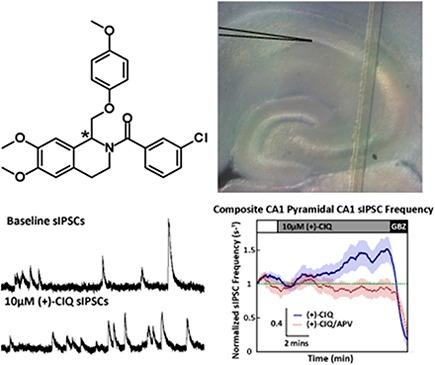
N-methyl-d-aspartate receptors (NMDARs) are ionotropic glutamatergic receptors that have been implicated in learning, development, and neuropathological conditions. They are typically composed of GluN1 and GluN2A-D subunits. Whereas a great deal is known about the role of GluN2A- and GluN2B-containing NMDARs, much less is known about GluN2D-containing NMDARs. Here we explore the subunit composition of synaptic NMDARs on hippocampal interneurons. GluN2D mRNA was detected by single-cell PCR and in situ hybridization in diverse interneuron subtypes in the CA1 region of the hippocampus. The GluN2D subunit was detectable by immunoblotting and immunohistochemistry in all subfields of the hippocampus in young and adult mice. In whole-cell patch-clamp recordings from acute hippocampal slices, (+)-CIQ, the active enantiomer of the positive allosteric modulator CIQ, significantly enhanced the amplitude of the NMDAR component of miniature excitatory postsynaptic currents (mEPSCs) in CA1 interneurons but not in pyramidal cells. (+)-CIQ had no effect in slices from Grin2d-/- mice, suggesting that GluN2D-containing NMDARs participate in excitatory synaptic transmission onto hippocampal interneurons. The time course of the NMDAR component of the mEPSC was unaffected by (+)-CIQ potentiation and was not accelerated in slices from Grin2d-/- mice compared with wild-type, suggesting that GluN2D does not detectably slow the NMDAR EPSC time course at this age. (+)-CIQ increased the activity of CA1 interneurons as detected by the rate and net charge transfer of spontaneous inhibitory postsynaptic currents (sIPSCs) recorded from CA1 pyramidal cells. These data provide evidence that interneurons contain synaptic NMDARs possessing a GluN2D subunit, which can influence interneuron function and signal processing.
N-甲基-D-天冬氨酸受体(NMDARs)是离子型谷氨酸能受体,与学习、发育及神经病理状况有关。它们通常由GluN1和GluN2A-D亚基组成。尽管人们对含GluN2A和GluN2B的NMDARs的作用了解很多,但对含GluN2D的NMDARs却知之甚少。在此,我们探究海马中间神经元上突触NMDARs的亚基组成。通过单细胞PCR和原位杂交在海马CA1区不同的中间神经元亚型中检测到了GluN2D mRNA。在幼年和成年小鼠海马的所有亚区,通过免疫印迹和免疫组化均可检测到GluN2D亚基。在急性海马脑片的全细胞膜片钳记录中,正性变构调节剂CIQ的活性对映体(+)-CIQ可显著增强CA1中间神经元微小兴奋性突触后电流(mEPSCs)中NMDAR成分的幅度,但对锥体细胞无此作用。(+)-CIQ对Grin2d-/-小鼠脑片无影响,这表明含GluN2D的NMDARs参与了对海马中间神经元的兴奋性突触传递。mEPSC的NMDAR成分的时间进程不受(+)-CIQ增强作用的影响,与野生型相比,Grin2d-/-小鼠脑片中该时间进程也未加速,这表明在这个年龄,GluN2D不会显著减慢NMDAR兴奋性突触后电流的时间进程。如通过记录CA1锥体细胞的自发抑制性突触后电流(sIPSCs)的频率和净电荷转移所检测到的,(+)-CIQ增加了CA1中间神经元的活性。这些数据提供了证据,表明中间神经元含有具有GluN2D亚基的突触NMDARs,其可影响中间神经元功能和信号处理。
 Zotero 插件