
基于电话的健康指导对慢性病患者的有效性:一项随机对照试验。
Effectiveness of Telephone-Based Health Coaching for Patients with Chronic Conditions: A Randomised Controlled Trial.
作者信息
Härter Martin, Dirmaier Jörg, Dwinger Sarah, Kriston Levente, Herbarth Lutz, Siegmund-Schultze Elisabeth, Bermejo Isaac, Matschinger Herbert, Heider Dirk, König Hans-Helmut
机构信息
Department of Medical Psychology, University Medical Centre Hamburg-Eppendorf, Hamburg, Germany.
Kaufmännische Krankenkasse-KKH, Hannover, Germany.
出版信息
PLoS One. 2016 Sep 15;11(9):e0161269. doi: 10.1371/journal.pone.0161269. eCollection 2016.
BACKGROUND
Chronic diseases, like diabetes mellitus, heart disease and cancer are leading causes of death and disability. These conditions are at least partially preventable or modifiable, e.g. by enhancing patients' self-management. We aimed to examine the effectiveness of telephone-based health coaching (TBHC) in chronically ill patients.
METHODS AND FINDINGS
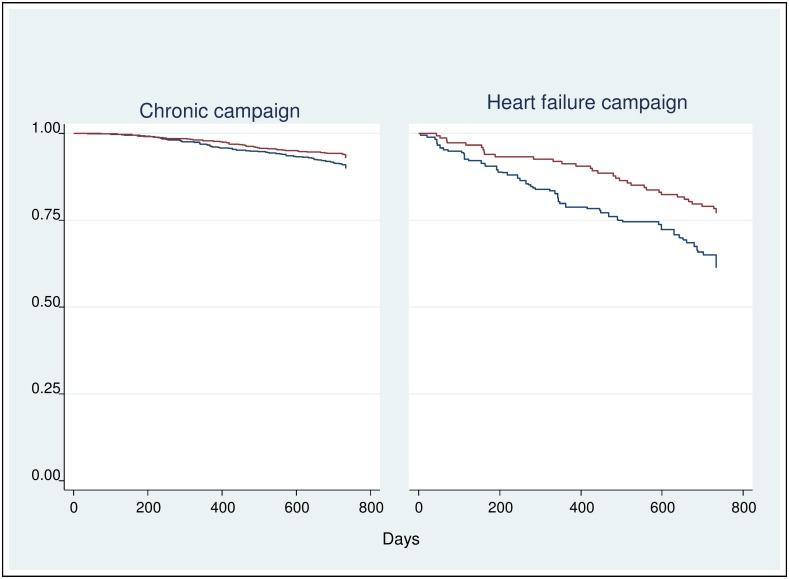
This prospective, pragmatic randomized controlled trial compares an intervention group (IG) of participants in TBHC to a control group (CG) without TBHC. Endpoints were assessed two years after enrolment. Three different groups of insurees with 1) multiple conditions (chronic campaign), 2) heart failure (heart failure campaign), or 3) chronic mental illness conditions (mental health campaign) were targeted. The telephone coaching included evidence-based information and was based on the concepts of motivational interviewing, shared decision-making, and collaborative goal setting. Patients received an average of 12.9 calls. Primary outcome was time from enrolment until hospital readmission within a two-year follow-up period. Secondary outcomes comprised the probability of hospital readmission, number of daily defined medication doses (DDD), frequency and duration of inability to work, and mortality within two years. All outcomes were collected from routine data provided by the statutory health insurance. As informed consent was obtained after randomization, propensity score matching (PSM) was used to minimize selection bias introduced by decliners. For the analysis of hospital readmission and mortality, we calculated Kaplan-Meier curves and estimated hazard ratios (HR). Probability of hospital readmission and probability of death were analysed by calculating odds ratios (OR). Quantity of health service use and inability to work were analysed by linear random effects regression models. PSM resulted in patient samples of 5,309 (IG: 2,713; CG: 2,596) in the chronic campaign, of 660 (IG: 338; CG: 322) in the heart failure campaign, and of 239 (IG: 101; KG: 138) in the mental health campaign. In none of the three campaigns, there were significant differences between IG and CG in time until hospital readmission. In the chronic campaign, the probability of hospital readmission was higher in the IG than in the CG (OR = 1.13; p = 0.045); no significant differences could be found for the other two campaigns. In the heart failure campaign, the IG showed a significantly reduced number of hospital admissions (-0.41; p = 0.012), although the corresponding reduction in the number of hospital days was not significant. In the chronic campaign, the IG showed significantly increased number of DDDs. Most striking, there were significant differences in mortality between IG and CG in the chronic campaign (OR = 0.64; p = 0.005) as well as in the heart failure campaign (OR = 0.44; p = 0.001).
CONCLUSIONS
While TBHC seems to reduce hospitalization only in specific patient groups, it may reduce mortality in patients with chronic somatic conditions. Further research should examine intervention effects in various subgroups of patients, for example for different diagnostic groups within the chronic campaign, or duration of coaching.
TRIAL REGISTRATION
German Clinical Trials Register DRKS00000584.
背景
糖尿病、心脏病和癌症等慢性病是导致死亡和残疾的主要原因。这些疾病至少在一定程度上是可预防或可改善的,例如通过加强患者的自我管理。我们旨在研究基于电话的健康指导(TBHC)对慢性病患者的有效性。
方法与结果
这项前瞻性、实用性随机对照试验将参与TBHC的干预组(IG)与未接受TBHC的对照组(CG)进行比较。在入组两年后评估终点指标。针对三类不同的被保险人:1)患有多种疾病的人群(慢性病项目)、2)心力衰竭患者(心力衰竭项目)或3)患有慢性精神疾病的人群(心理健康项目)。电话指导包括基于证据的信息,并基于动机性访谈、共同决策和协作目标设定的理念。患者平均接到12.9次电话。主要结局是从入组到两年随访期内再次入院的时间。次要结局包括再次入院的概率、每日规定剂量药物(DDD)的数量、无法工作的频率和持续时间以及两年内的死亡率。所有结局均从法定健康保险提供的常规数据中收集。由于随机分组后才获得知情同意,因此采用倾向得分匹配(PSM)来尽量减少拒绝参与者引入的选择偏倚。对于再次入院和死亡率的分析,我们计算了Kaplan-Meier曲线并估计了风险比(HR)。通过计算比值比(OR)分析再次入院的概率和死亡概率。通过线性随机效应回归模型分析卫生服务使用量和无法工作的情况。PSM在慢性病项目中产生了5309名患者样本(IG:2713名;CG:2596名),在心力衰竭项目中产生了660名患者样本(IG:338名;CG:322名),在心理健康项目中产生了239名患者样本(IG:101名;KG:138名)。在这三个项目中,IG和CG在再次入院时间方面均无显著差异。在慢性病项目中,IG再次入院的概率高于CG(OR = 1.13;p = 0.045);在其他两个项目中未发现显著差异。在心力衰竭项目中,IG的入院次数显著减少(-0.41;p = 0.012),尽管住院天数的相应减少不显著。在慢性病项目中,IG的DDD数量显著增加。最显著的是,在慢性病项目(OR = 0.64;p = 0.00)以及心力衰竭项目(OR = 0.44;p = 0.001)中,IG和CG在死亡率方面存在显著差异。
结论
虽然TBHC似乎仅在特定患者群体中减少住院次数,但它可能降低慢性躯体疾病患者的死亡率。进一步的研究应考察在不同患者亚组中的干预效果,例如在慢性病项目中的不同诊断组,或指导的持续时间。
试验注册
德国临床试验注册中心DRKS00000584 。
 Zotero 插件