
设计的邻氨基苯甲酰辅酶A合成酶PqsA小分子抑制剂可阻断铜绿假单胞菌中的喹诺酮生物合成。
Designed Small-Molecule Inhibitors of the Anthranilyl-CoA Synthetase PqsA Block Quinolone Biosynthesis in Pseudomonas aeruginosa.
作者信息
Ji Cheng, Sharma Indrajeet, Pratihar Debarshi, Hudson L Lynn, Maura Damien, Guney Tezcan, Rahme Laurence G, Pesci Everett C, Coleman James P, Tan Derek S
机构信息
Chemical Biology Program, Memorial Sloan Kettering Cancer Center, 1275 York Avenue, Box 422, New York, New York 10065, United States
Department of Microbiology and Immunology, The Brody School of Medicine, East Carolina University , 600 Moye Boulevard, Greenville, North Carolina 27834, United States.
出版信息
ACS Chem Biol. 2016 Nov 18;11(11):3061-3067. doi: 10.1021/acschembio.6b00575. Epub 2016 Sep 22.
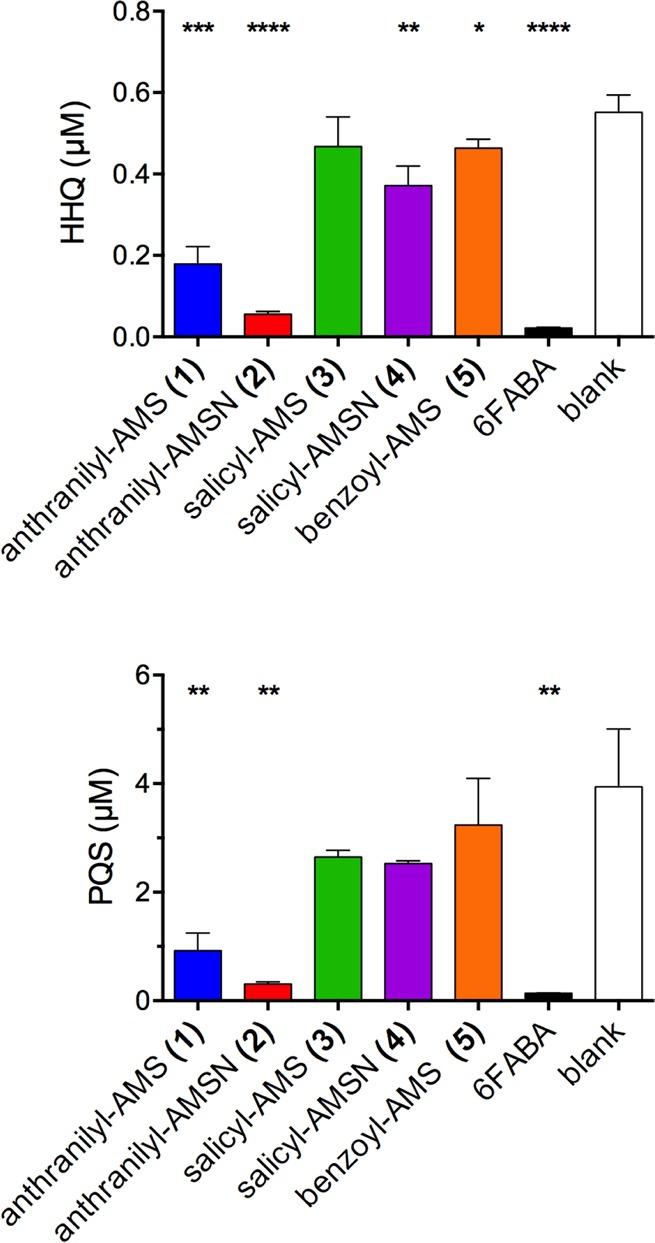
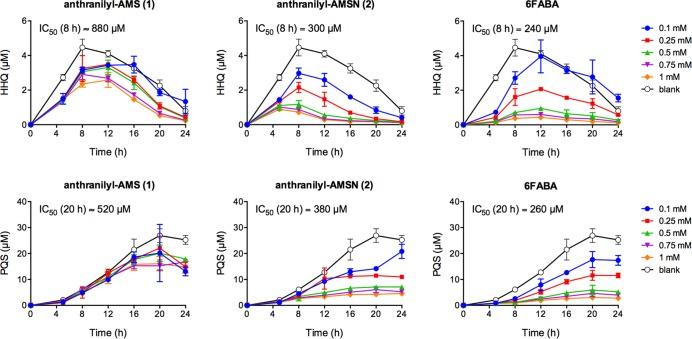
The Gram-negative bacterial pathogen Pseudomonas aeruginosa uses three interconnected intercellular signaling systems regulated by the transcription factors LasR, RhlR, and MvfR (PqsR), which mediate bacterial cell-cell communication via small-molecule natural products and control the production of a variety of virulence factors. The MvfR system is activated by and controls the biosynthesis of the quinolone quorum sensing factors HHQ and PQS. A key step in the biosynthesis of these quinolones is catalyzed by the anthranilyl-CoA synthetase PqsA. To develop inhibitors of PqsA as novel potential antivirulence antibiotics, we report herein the design and synthesis of sulfonyladeonsine-based mimics of the anthranilyl-AMP reaction intermediate that is bound tightly by PqsA. Biochemical, microbiological, and pharmacological studies identified two potent PqsA inhibitors, anthranilyl-AMS (1) and anthranilyl-AMSN (2), that decreased HHQ and PQS production in P. aeruginosa strain PA14. However, these compounds did not inhibit production of the virulence factor pyocyanin. Moreover, they exhibited limited bacterial penetration in compound accumulation studies. This work provides the most potent PqsA inhibitors reported to date and sets the stage for future efforts to develop analogues with improved cellular activity to investigate further the complex relationships between quinolone biosynthesis and virulence factor production in P. aeruginosa and the therapeutic potential of targeting PqsA.
革兰氏阴性细菌病原体铜绿假单胞菌利用由转录因子LasR、RhlR和MvfR(PqsR)调控的三个相互关联的细胞间信号系统,这些转录因子通过小分子天然产物介导细菌细胞间通讯,并控制多种毒力因子的产生。MvfR系统由喹诺酮群体感应因子HHQ和PQS激活并控制其生物合成。这些喹诺酮生物合成中的关键步骤由邻氨基苯甲酰辅酶A合成酶PqsA催化。为了开发PqsA抑制剂作为新型潜在的抗毒力抗生素,我们在此报告基于磺酰腺苷的邻氨基苯甲酰-AMP反应中间体模拟物的设计与合成,该中间体被PqsA紧密结合。生化、微生物学和药理学研究鉴定出两种有效的PqsA抑制剂,邻氨基苯甲酰-AMS(1)和邻氨基苯甲酰-AMSN(2),它们可降低铜绿假单胞菌PA14菌株中HHQ和PQS的产生。然而,这些化合物并未抑制毒力因子绿脓菌素的产生。此外,在化合物积累研究中,它们表现出有限的细菌穿透力。这项工作提供了迄今为止报道的最有效的PqsA抑制剂,并为未来开发具有改善细胞活性的类似物奠定了基础,以便进一步研究铜绿假单胞菌中喹诺酮生物合成与毒力因子产生之间的复杂关系以及靶向PqsA的治疗潜力。


 Zotero 插件