
运动机能不全综合征与日本老年女性的身体组成及心脏代谢紊乱有关。
Locomotive syndrome is associated with body composition and cardiometabolic disorders in elderly Japanese women.
作者信息
Nakamura Misa, Kobashi Yosuke, Hashizume Hiroshi, Oka Hiroyuki, Kono Ryohei, Nomura Sachiko, Maeno Akihiro, Yoshida Munehito, Utsunomiya Hirotoshi
机构信息
Department of Rehabilitation, Osaka Kawasaki Rehabilitation University, 158 Mizuma, Kaizuka, Osaka, 597-0104, Japan.
Department of Rehabilitation Medicine, Wakayama Medical University, 811-1 Kimiidera, Wakayama, Wakayama, 641-8510, Japan.
出版信息
BMC Geriatr. 2016 Sep 27;16(1):166. doi: 10.1186/s12877-016-0339-6.
BACKGROUND
A concept referred to as locomotive syndrome (LS) was proposed by the Japanese Orthopaedic Association in order to help identify middle-aged and older adults who may be at high risk of requiring healthcare services because of problems associated with locomotion. Cardiometabolic disorders, including obesity, hypertension, diabetes, and dyslipidemia, have a high prevalence worldwide. The purpose of this study was to determine the associations between LS and both body composition and cardiometabolic disorders.
METHODS
The study participants were 165 healthy adult Japanese women volunteers living in rural areas. LS was defined as a score ≥16 on the 25-question Geriatric Locomotive Function Scale (GLFS-25). Height, body weight, body fat percentage, body mass index (BMI), and bone status were measured. Bone status was evaluated by quantitative ultrasound (i.e., the speed of sound [SOS] of the calcaneus) and was expressed as the percent of Young Adult Mean of the SOS (%YAM). Comorbid conditions of hypertension, hyperlipidemia, and diabetes were assessed using self-report questionnaires.
RESULTS
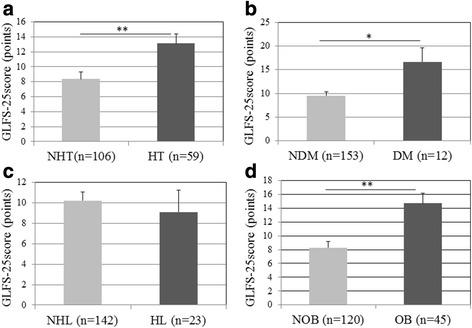
Twenty-nine participants (17.6 %) were classed as having LS. The LS group was older, shorter, and had a higher body fat percentage, a higher BMI, and lower bone status than the non-LS group. Multiple logistic regression analysis showed that participants with a BMI ≥23.5 kg/m had a significantly higher risk for LS than those with a BMI <23.5 kg/m (odds ratio [OR] = 3.78, p < 0.01). Furthermore, GLFS-25 scores were higher in participants with than those without hypertension, diabetes, or obesity, and significantly increased with the number of present disorders.
CONCLUSIONS
These findings suggest that BMI may be a useful screening tool for LS. Furthermore, because hypertension and diabetes were associated with LS, the prevention of these disorders accompanied by weight management may help protect against LS.
背景
日本矫形外科学会提出了一种称为运动机能不全综合征(LS)的概念,以帮助识别因运动相关问题而可能有较高医疗服务需求风险的中老年人。包括肥胖、高血压、糖尿病和血脂异常在内的心脏代谢紊乱在全球范围内普遍存在。本研究的目的是确定LS与身体成分和心脏代谢紊乱之间的关联。
方法
研究参与者为165名居住在农村地区的健康成年日本女性志愿者。LS被定义为在25个问题的老年运动机能量表(GLFS-25)上得分≥16分。测量身高、体重、体脂百分比、体重指数(BMI)和骨骼状况。通过定量超声(即跟骨的声速[SOS])评估骨骼状况,并表示为SOS的青年成人平均值的百分比(%YAM)。使用自我报告问卷评估高血压、高脂血症和糖尿病的合并症。
结果
29名参与者(17.6%)被归类为患有LS。LS组比非LS组年龄更大、身高更矮、体脂百分比更高、BMI更高且骨骼状况更低。多因素逻辑回归分析显示,BMI≥23.5 kg/m²的参与者患LS的风险显著高于BMI<23.5 kg/m²的参与者(比值比[OR]=3.78,p<0.01)。此外,患有高血压、糖尿病或肥胖症的参与者的GLFS-25得分高于未患这些疾病的参与者,并且随着现有疾病数量的增加而显著升高。
结论
这些发现表明BMI可能是LS的一种有用筛查工具。此外,由于高血压和糖尿病与LS有关,预防这些疾病并进行体重管理可能有助于预防LS。

 Zotero 插件