
自然语言处理(NLP)在马德里一项基于文本的心理健康干预中预测自杀意念和精神症状的新应用。
Novel Use of Natural Language Processing (NLP) to Predict Suicidal Ideation and Psychiatric Symptoms in a Text-Based Mental Health Intervention in Madrid.
作者信息
Cook Benjamin L, Progovac Ana M, Chen Pei, Mullin Brian, Hou Sherry, Baca-Garcia Enrique
机构信息
Health Equity Research Laboratory, Cambridge Health Alliance, Department of Psychiatry, Harvard Medical School, 1035 Cambridge Street, Suite 26, Cambridge, MA 02141, USA.
Wired Informatics, 265 Franklin Street, Suite 1702, Boston, MA 02110, USA.
出版信息
Comput Math Methods Med. 2016;2016:8708434. doi: 10.1155/2016/8708434. Epub 2016 Sep 26.
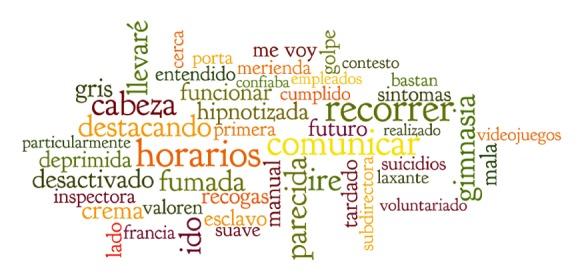
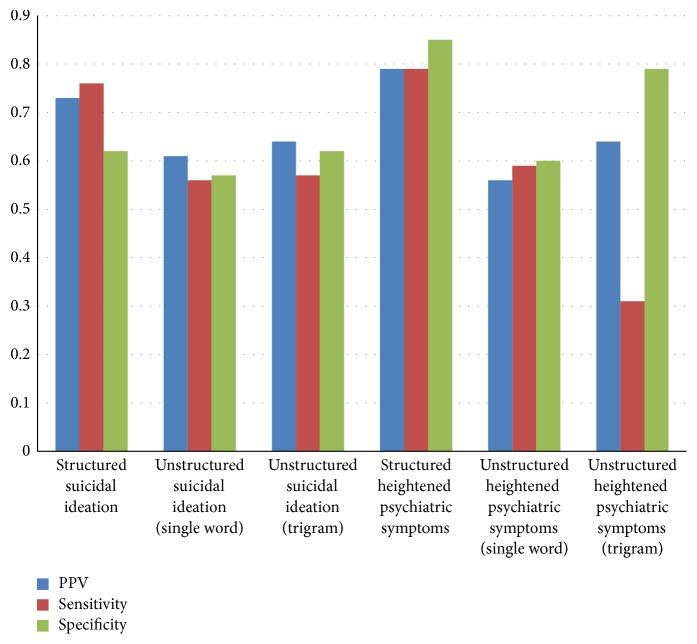
Natural language processing (NLP) and machine learning were used to predict suicidal ideation and heightened psychiatric symptoms among adults recently discharged from psychiatric inpatient or emergency room settings in Madrid, Spain. Participants responded to structured mental and physical health instruments at multiple follow-up points. Outcome variables of interest were suicidal ideation and psychiatric symptoms (GHQ-12). Predictor variables included structured items (e.g., relating to sleep and well-being) and responses to one unstructured question, "how do you feel today?" We compared NLP-based models using the unstructured question with logistic regression prediction models using structured data. The PPV, sensitivity, and specificity for NLP-based models of suicidal ideation were 0.61, 0.56, and 0.57, respectively, compared to 0.73, 0.76, and 0.62 of structured data-based models. The PPV, sensitivity, and specificity for NLP-based models of heightened psychiatric symptoms (GHQ-12 ≥ 4) were 0.56, 0.59, and 0.60, respectively, compared to 0.79, 0.79, and 0.85 in structured models. NLP-based models were able to generate relatively high predictive values based solely on responses to a simple general mood question. These models have promise for rapidly identifying persons at risk of suicide or psychological distress and could provide a low-cost screening alternative in settings where lengthy structured item surveys are not feasible.
自然语言处理(NLP)和机器学习被用于预测西班牙马德里近期从精神病住院部或急诊室出院的成年人中的自杀意念及加重的精神症状。参与者在多个随访点对结构化的心理和身体健康量表做出回应。感兴趣的结果变量为自杀意念和精神症状(一般健康问卷-12项,GHQ-12)。预测变量包括结构化项目(如与睡眠和幸福感相关的项目)以及对一个非结构化问题“你今天感觉如何?”的回答。我们将使用非结构化问题的基于NLP的模型与使用结构化数据的逻辑回归预测模型进行了比较。基于NLP的自杀意念模型的阳性预测值、敏感性和特异性分别为0.61、0.56和0.57,而基于结构化数据的模型分别为0.73、0.76和0.62。基于NLP的精神症状加重(GHQ-12≥4)模型的阳性预测值、敏感性和特异性分别为0.56、0.59和0.60,而结构化模型分别为0.79、0.79和0.85。基于NLP的模型仅根据对一个简单的总体情绪问题的回答就能产生相对较高的预测值。这些模型有望快速识别有自杀或心理困扰风险的人,并能在无法进行冗长的结构化项目调查的环境中提供一种低成本的筛查方法。

 Zotero 插件