
带蝎刺的蛇:来自长腺蓝珊瑚蛇(Calliophis bivirgatus)毒液的新型三指毒素钠通道激活剂
The Snake with the Scorpion's Sting: Novel Three-Finger Toxin Sodium Channel Activators from the Venom of the Long-Glanded Blue Coral Snake (Calliophis bivirgatus).
作者信息
Yang Daryl C, Deuis Jennifer R, Dashevsky Daniel, Dobson James, Jackson Timothy N W, Brust Andreas, Xie Bing, Koludarov Ivan, Debono Jordan, Hendrikx Iwan, Hodgson Wayne C, Josh Peter, Nouwens Amanda, Baillie Gregory J, Bruxner Timothy J C, Alewood Paul F, Lim Kelvin Kok Peng, Frank Nathaniel, Vetter Irina, Fry Bryan G
机构信息
Department of Pharmacology, Biomedicine Discovery Institute, Monash University, Clayton 3168, Australia.
Venom Evolution Lab, School of Biological Sciences, University of Queensland, St. Lucia 4072, Australia.
出版信息
Toxins (Basel). 2016 Oct 18;8(10):303. doi: 10.3390/toxins8100303.
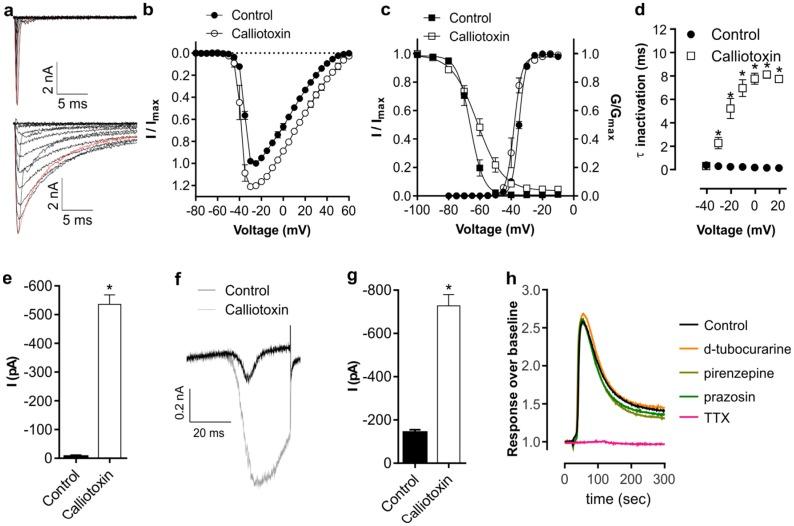
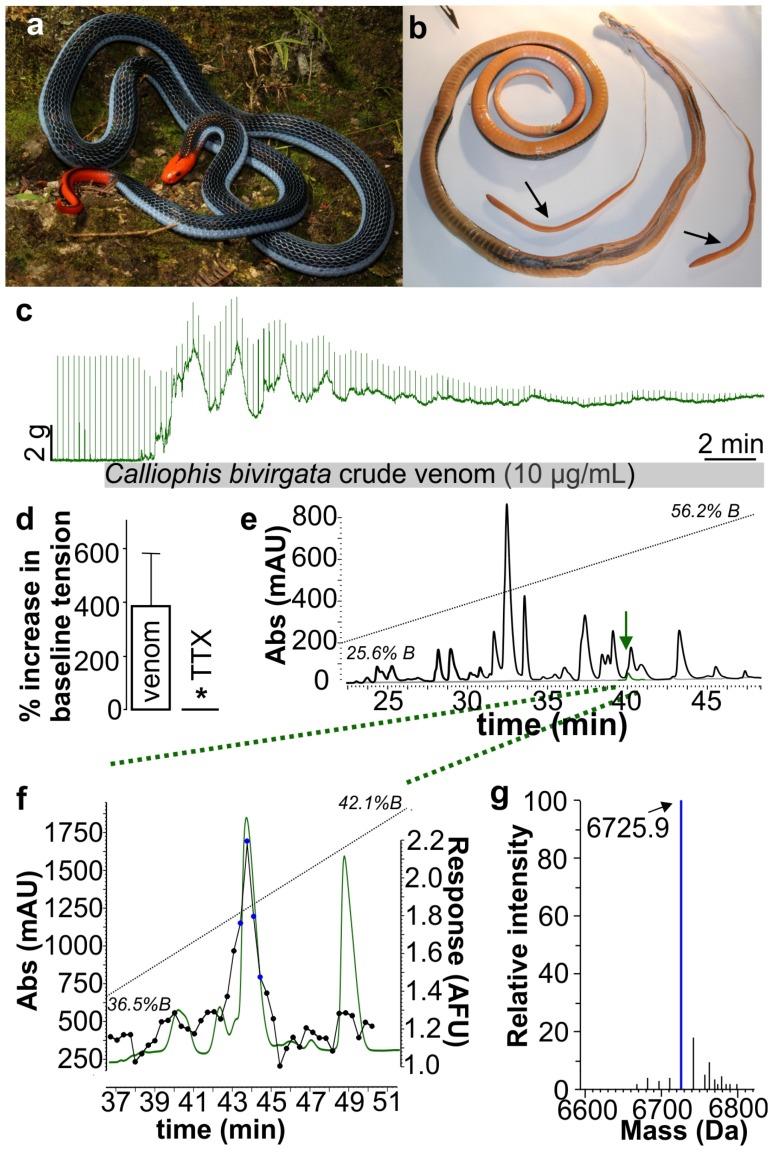
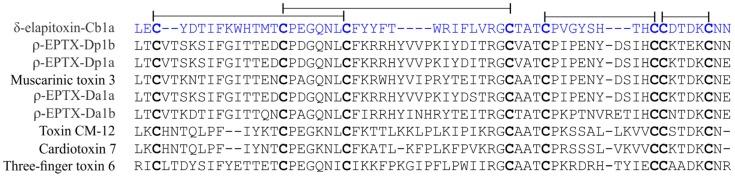
Millions of years of evolution have fine-tuned the ability of venom peptides to rapidly incapacitate both prey and potential predators. Toxicofera reptiles are characterized by serous-secreting mandibular or maxillary glands with heightened levels of protein expression. These glands are the core anatomical components of the toxicoferan venom system, which exists in myriad points along an evolutionary continuum. Neofunctionalisation of toxins is facilitated by positive selection at functional hotspots on the ancestral protein and venom proteins have undergone dynamic diversification in helodermatid and varanid lizards as well as advanced snakes. A spectacular point on the venom system continuum is the long-glanded blue coral snake (), a specialist feeder that preys on fast moving, venomous snakes which have both a high likelihood of prey escape but also represent significant danger to the predator itself. The maxillary venom glands of extend one quarter of the snake's body length and nestle within the rib cavity. Despite the snake's notoriety its venom has remained largely unstudied. Here we show that the venom uniquely produces spastic paralysis, in contrast to the flaccid paralysis typically produced by neurotoxic snake venoms. The toxin responsible, which we have called calliotoxin (δ-elapitoxin-Cb1a), is a three-finger toxin (3FTx). Calliotoxin shifts the voltage-dependence of Na1.4 activation to more hyperpolarised potentials, inhibits inactivation, and produces large ramp currents, consistent with its profound effects on contractile force in an isolated skeletal muscle preparation. Voltage-gated sodium channels (Na) are a particularly attractive pharmacological target as they are involved in almost all physiological processes including action potential generation and conduction. Accordingly, venom peptides that interfere with Na function provide a key defensive and predatory advantage to a range of invertebrate venomous species including cone snails, scorpions, spiders, and anemones. Enhanced activation or delayed inactivation of sodium channels by toxins is associated with the extremely rapid onset of tetanic/excitatory paralysis in envenomed prey animals. A strong selection pressure exists for the evolution of such toxins where there is a high chance of prey escape. However, despite their prevalence in other venomous species, toxins causing delay of sodium channel inhibition have never previously been described in vertebrate venoms. Here we show that Na modulators, convergent with those of invertebrates, have evolved in the venom of the long-glanded coral snake. Calliotoxin represents a functionally novel class of 3FTx and a structurally novel class of Na toxins that will provide significant insights into the pharmacology and physiology of Na. The toxin represents a remarkable case of functional convergence between invertebrate and vertebrate venom systems in response to similar selection pressures. These results underscore the dynamic evolution of the Toxicofera reptile system and reinforces the value of using evolution as a roadmap for biodiscovery.
数百万年的进化已将毒液肽迅速使猎物和潜在捕食者丧失行动能力的能力优化至极致。毒蜥类爬行动物的特征是具有分泌浆液的下颌腺或上颌腺,其蛋白质表达水平较高。这些腺体是毒蜥类毒液系统的核心解剖组成部分,该系统在进化连续体上存在于无数个节点。毒素的新功能化通过祖先蛋白功能热点处的正选择得以促进,毒液蛋白在毒蜥科蜥蜴、巨蜥以及高等蛇类中经历了动态多样化。毒液系统连续体上一个引人注目的例子是长腺蓝珊瑚蛇,它是一种专门捕食快速移动的毒蛇的捕食者,这些猎物不仅很有可能逃脱,而且对捕食者本身也构成重大危险。长腺蓝珊瑚蛇的上颌毒液腺延伸至蛇身体长度的四分之一,并位于肋骨腔内。尽管这种蛇声名狼藉,但其毒液在很大程度上仍未得到研究。在这里我们表明,与通常由神经毒性蛇毒产生的松驰性麻痹不同,这种毒液独特地产生痉挛性麻痹。起作用的毒素,我们称之为卡里毒素(δ - 眼镜蛇毒素 - Cb1a),是一种三指毒素(3FTx)。卡里毒素将Na1.4激活的电压依赖性转移到更超极化的电位,抑制失活,并产生大的斜坡电流,这与其对离体骨骼肌制剂收缩力的深远影响一致。电压门控钠通道(Na)是一个特别有吸引力的药理学靶点,因为它们几乎参与了所有生理过程,包括动作电位的产生和传导。因此,干扰Na功能的毒液肽为一系列无脊椎有毒物种提供了关键的防御和捕食优势,包括芋螺、蝎子、蜘蛛和海葵。毒素增强钠通道的激活或延迟其失活与被毒液攻击的猎物动物中强直性/兴奋性麻痹的极快速发作有关。在猎物很有可能逃脱的情况下,对于此类毒素的进化存在强大的选择压力。然而,尽管它们在其他有毒物种中普遍存在,但此前从未在脊椎动物毒液中描述过导致钠通道抑制延迟的毒素。在这里我们表明,与无脊椎动物的类似物趋同的Na调节剂已在长腺珊瑚蛇的毒液中进化。卡里毒素代表了一类功能新颖的3FTx和一类结构新颖的Na毒素,这将为Na的药理学和生理学提供重要见解。这种毒素代表了无脊椎动物和脊椎动物毒液系统在应对相似选择压力时功能趋同的一个显著例子。这些结果强调了毒蜥类爬行动物系统的动态进化,并强化了将进化用作生物发现路线图的价值。
 Zotero 插件