
生物多样性虚拟实验室(BioVeL):一个用于生物多样性科学与生态学数据分析及建模的虚拟实验室。
BioVeL: a virtual laboratory for data analysis and modelling in biodiversity science and ecology.
作者信息
Hardisty Alex R, Bacall Finn, Beard Niall, Balcázar-Vargas Maria-Paula, Balech Bachir, Barcza Zoltán, Bourlat Sarah J, De Giovanni Renato, de Jong Yde, De Leo Francesca, Dobor Laura, Donvito Giacinto, Fellows Donal, Guerra Antonio Fernandez, Ferreira Nuno, Fetyukova Yuliya, Fosso Bruno, Giddy Jonathan, Goble Carole, Güntsch Anton, Haines Robert, Ernst Vera Hernández, Hettling Hannes, Hidy Dóra, Horváth Ferenc, Ittzés Dóra, Ittzés Péter, Jones Andrew, Kottmann Renzo, Kulawik Robert, Leidenberger Sonja, Lyytikäinen-Saarenmaa Päivi, Mathew Cherian, Morrison Norman, Nenadic Aleksandra, de la Hidalga Abraham Nieva, Obst Matthias, Oostermeijer Gerard, Paymal Elisabeth, Pesole Graziano, Pinto Salvatore, Poigné Axel, Fernandez Francisco Quevedo, Santamaria Monica, Saarenmaa Hannu, Sipos Gergely, Sylla Karl-Heinz, Tähtinen Marko, Vicario Saverio, Vos Rutger Aldo, Williams Alan R, Yilmaz Pelin
机构信息
School of Computer Science and Informatics, Cardiff University, Queens Buildings, 5 The Parade, Cardiff, CF24 3AA, UK.
School of Computer Science, University of Manchester, Kilburn Building, Oxford Road, Manchester, M13 9PL, UK.
出版信息
BMC Ecol. 2016 Oct 20;16(1):49. doi: 10.1186/s12898-016-0103-y.
BACKGROUND
Making forecasts about biodiversity and giving support to policy relies increasingly on large collections of data held electronically, and on substantial computational capability and capacity to analyse, model, simulate and predict using such data. However, the physically distributed nature of data resources and of expertise in advanced analytical tools creates many challenges for the modern scientist. Across the wider biological sciences, presenting such capabilities on the Internet (as "Web services") and using scientific workflow systems to compose them for particular tasks is a practical way to carry out robust "in silico" science. However, use of this approach in biodiversity science and ecology has thus far been quite limited.
RESULTS
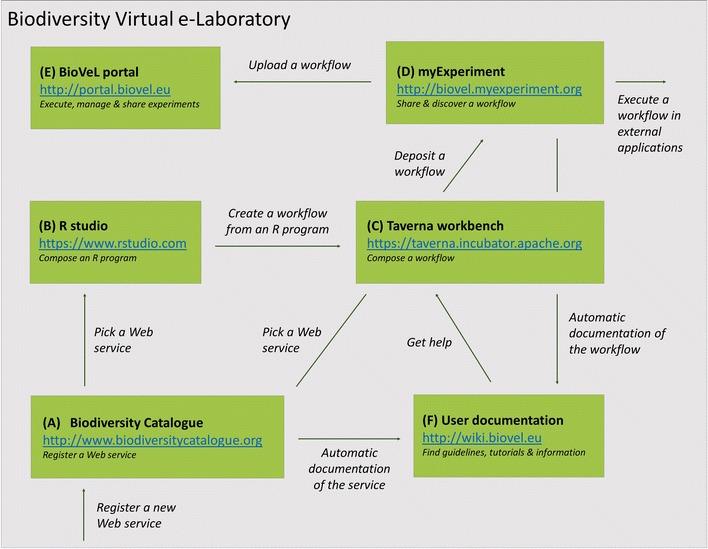
BioVeL is a virtual laboratory for data analysis and modelling in biodiversity science and ecology, freely accessible via the Internet. BioVeL includes functions for accessing and analysing data through curated Web services; for performing complex in silico analysis through exposure of R programs, workflows, and batch processing functions; for on-line collaboration through sharing of workflows and workflow runs; for experiment documentation through reproducibility and repeatability; and for computational support via seamless connections to supporting computing infrastructures. We developed and improved more than 60 Web services with significant potential in many different kinds of data analysis and modelling tasks. We composed reusable workflows using these Web services, also incorporating R programs. Deploying these tools into an easy-to-use and accessible 'virtual laboratory', free via the Internet, we applied the workflows in several diverse case studies. We opened the virtual laboratory for public use and through a programme of external engagement we actively encouraged scientists and third party application and tool developers to try out the services and contribute to the activity.
CONCLUSIONS
Our work shows we can deliver an operational, scalable and flexible Internet-based virtual laboratory to meet new demands for data processing and analysis in biodiversity science and ecology. In particular, we have successfully integrated existing and popular tools and practices from different scientific disciplines to be used in biodiversity and ecological research.
背景
对生物多样性进行预测并为政策提供支持越来越依赖于以电子方式保存的大量数据,以及利用这些数据进行分析、建模、模拟和预测的强大计算能力。然而,数据资源和先进分析工具专业知识的物理分布特性给现代科学家带来了诸多挑战。在更广泛的生物科学领域,通过互联网呈现这些能力(作为“网络服务”)并使用科学工作流系统将它们组合起来以完成特定任务,是开展稳健的“虚拟”科学的一种实用方法。然而,迄今为止,这种方法在生物多样性科学和生态学中的应用相当有限。
结果
BioVeL是一个用于生物多样性科学和生态学数据分析与建模的虚拟实验室,可通过互联网免费访问。BioVeL包括通过经过策划的网络服务访问和分析数据的功能;通过公开R程序、工作流和批处理功能进行复杂的虚拟分析的功能;通过共享工作流和工作流运行进行在线协作的功能;通过可重复性和可再现性进行实验记录的功能;以及通过与支持计算基础设施的无缝连接提供计算支持的功能。我们开发并改进了60多个在许多不同类型的数据分析和建模任务中具有巨大潜力的网络服务。我们使用这些网络服务编写了可重复使用的工作流,还纳入了R程序。将这些工具部署到一个易于使用且可通过互联网免费访问的“虚拟实验室”中,我们在几个不同的案例研究中应用了这些工作流。我们开放了虚拟实验室供公众使用,并通过一系列外部参与活动积极鼓励科学家以及第三方应用程序和工具开发者试用这些服务并参与相关活动。
结论
我们的工作表明,我们能够提供一个可操作、可扩展且灵活的基于互联网的虚拟实验室,以满足生物多样性科学和生态学中数据处理与分析的新需求。特别是,我们成功整合了来自不同科学学科的现有且流行的工具和实践,用于生物多样性和生态研究。
 Zotero 插件