
嗜温伯克霍尔德氏菌噬菌体AP3属于短尾噬菌体科,对IIIA谱系的洋葱伯克霍尔德菌具有高效抗菌活性。
The temperate Burkholderia phage AP3 of the Peduovirinae shows efficient antimicrobial activity against B. cenocepacia of the IIIA lineage.
作者信息
Roszniowski Bartosz, Latka Agnieszka, Maciejewska Barbara, Vandenheuvel Dieter, Olszak Tomasz, Briers Yves, Holt Giles S, Valvano Miguel A, Lavigne Rob, Smith Darren L, Drulis-Kawa Zuzanna
机构信息
Institute of Genetics and Microbiology, University of Wroclaw, Przybyszewskiego 63/77, 51-148, Wroclaw, Poland.
Laboratory of Gene Technology, KU Leuven, Kasteelpark Arenberg 21, box 2462, 3001, Leuven, Belgium.
出版信息
Appl Microbiol Biotechnol. 2017 Feb;101(3):1203-1216. doi: 10.1007/s00253-016-7924-7. Epub 2016 Oct 21.
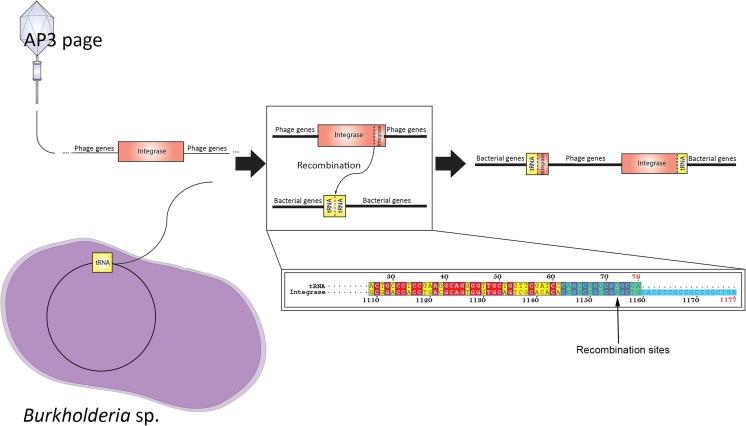
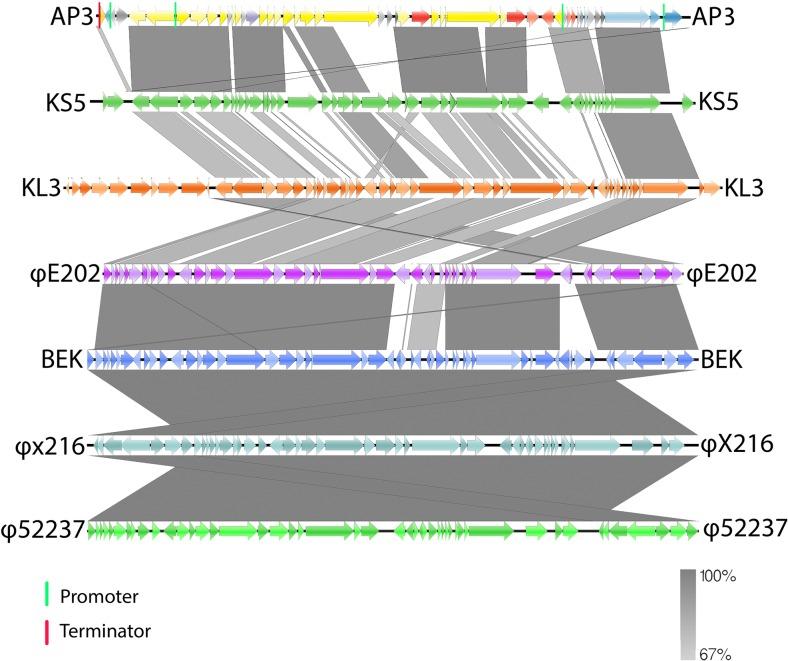
Burkholderia phage AP3 (vB_BceM_AP3) is a temperate virus of the Myoviridae and the Peduovirinae subfamily (P2likevirus genus). This phage specifically infects multidrug-resistant clinical Burkholderia cenocepacia lineage IIIA strains commonly isolated from cystic fibrosis patients. AP3 exhibits high pairwise nucleotide identity (61.7 %) to Burkholderia phage KS5, specific to the same B. cenocepacia host, and has 46.7-49.5 % identity to phages infecting other species of Burkholderia. The lysis cassette of these related phages has a similar organization (putative antiholin, putative holin, endolysin, and spanins) and shows 29-98 % homology between specific lysis genes, in contrast to Enterobacteria phage P2, the hallmark phage of this genus. The AP3 and KS5 lysis genes have conserved locations and high amino acid sequence similarity. The AP3 bacteriophage particles remain infective up to 5 h at pH 4-10 and are stable at 60 °C for 30 min, but are sensitive to chloroform, with no remaining infective particles after 24 h of treatment. AP3 lysogeny can occur by stable genomic integration and by pseudo-lysogeny. The lysogenic bacterial mutants did not exhibit any significant changes in virulence compared to wild-type host strain when tested in the Galleria mellonella moth wax model. Moreover, AP3 treatment of larvae infected with B. cenocepacia revealed a significant increase (P < 0.0001) in larvae survival in comparison to AP3-untreated infected larvae. AP3 showed robust lytic activity, as evidenced by its broad host range, the absence of increased virulence in lysogenic isolates, the lack of bacterial gene disruption conditioned by bacterial tRNA downstream integration site, and the absence of detected toxin sequences. These data suggest that the AP3 phage is a promising potent agent against bacteria belonging to the most common B. cenocepacia IIIA lineage strains.
伯克霍尔德菌噬菌体AP3(vB_BceM_AP3)是一种肌尾噬菌体科、佩德沃病毒亚科(P2样病毒属)的温和病毒。该噬菌体特异性感染通常从囊性纤维化患者中分离出的多重耐药临床洋葱伯克霍尔德菌IIIA型菌株。AP3与针对同一洋葱伯克霍尔德菌宿主的伯克霍尔德菌噬菌体KS5具有较高的成对核苷酸同一性(61.7%),与感染其他伯克霍尔德菌属物种的噬菌体具有46.7 - 49.5%的同一性。这些相关噬菌体的裂解盒具有相似的组织架构(推定的抗溶菌素、推定的溶菌素、内溶素和膜贯穿蛋白),并且特定裂解基因之间显示出29 - 98%的同源性,这与该属的标志性噬菌体——肠道杆菌噬菌体P2不同。AP3和KS5的裂解基因具有保守的位置和高氨基酸序列相似性。AP3噬菌体颗粒在pH 4 - 10条件下长达5小时仍具有感染性,在60°C下30分钟稳定,但对氯仿敏感,处理24小时后无剩余感染性颗粒。AP3溶原性可通过稳定的基因组整合和假溶原性发生。在大蜡螟蛾蜡模型中测试时,与野生型宿主菌株相比,溶原性细菌突变体在毒力方面未表现出任何显著变化。此外,用AP3处理感染洋葱伯克霍尔德菌的幼虫后发现,与未用AP3处理的感染幼虫相比,幼虫存活率显著提高(P < 0.000)。AP3表现出强大的裂解活性,其广泛的宿主范围、溶原性分离株中毒力未增加、细菌tRNA下游整合位点未导致细菌基因破坏以及未检测到毒素序列均证明了这一点。这些数据表明,AP3噬菌体是一种有前景的有效制剂,可对抗属于最常见的洋葱伯克霍尔德菌IIIA型菌株的细菌。




 Zotero 插件