
使用TempEst(原Path-O-Gen)探索异时序列的时间结构。
Exploring the temporal structure of heterochronous sequences using TempEst (formerly Path-O-Gen).
作者信息
Rambaut Andrew, Lam Tommy T, Max Carvalho Luiz, Pybus Oliver G
机构信息
Institute of Evolutionary Biology,; Centre for Immunity, Infection and Evolution, University of Edinburgh, Ashworth Laboratories, King's Buildings, Edinburgh EH9 3JT, UK.
School of Public Health, University of Hong Kong, Hong Kong SAR, China and.
出版信息
Virus Evol. 2016 Apr 9;2(1):vew007. doi: 10.1093/ve/vew007. eCollection 2016 Jan.
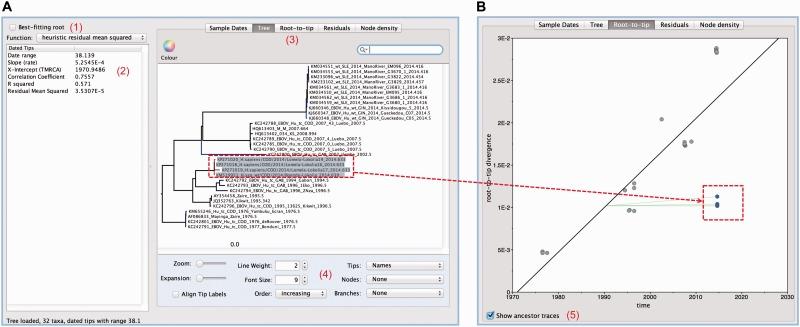
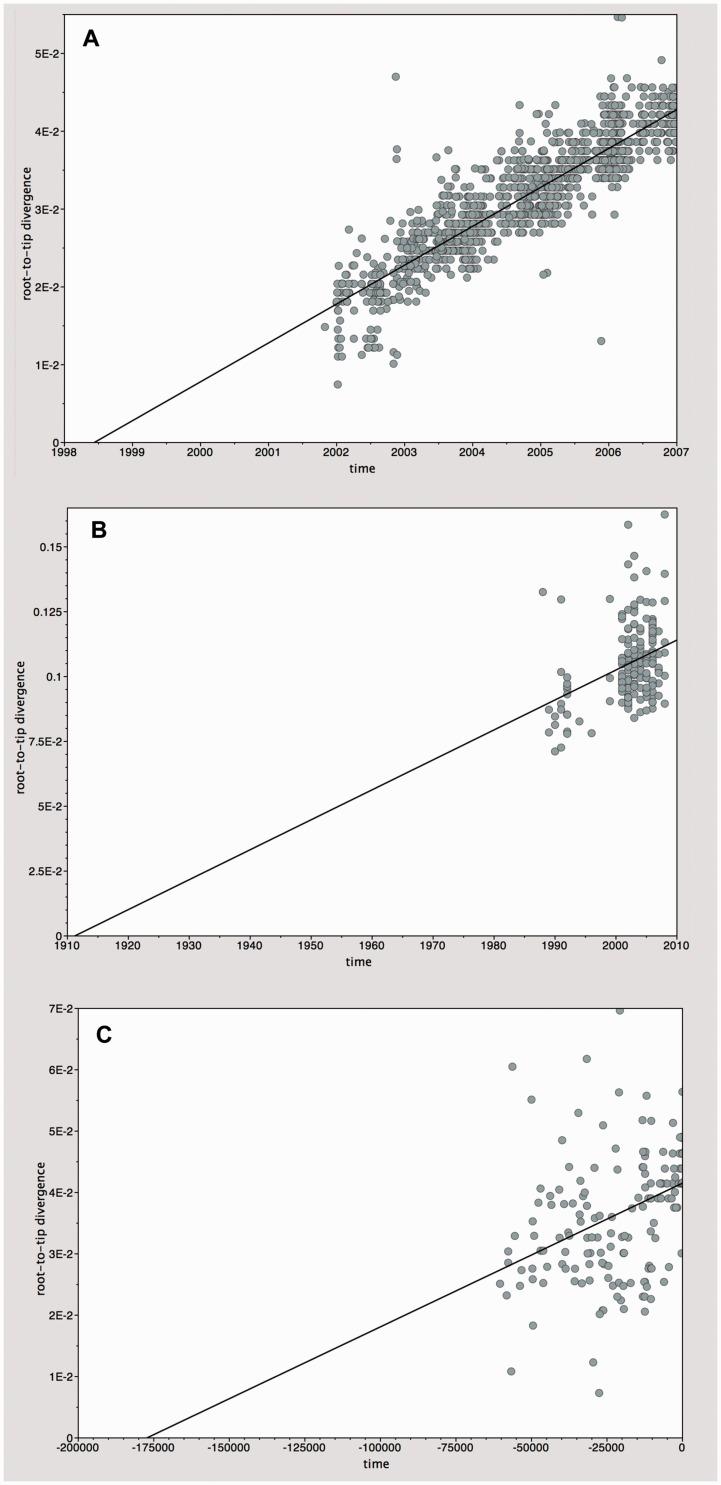
Gene sequences sampled at different points in time can be used to infer molecular phylogenies on a natural timescale of months or years, provided that the sequences in question undergo measurable amounts of evolutionary change between sampling times. Data sets with this property are termed heterochronous and have become increasingly common in several fields of biology, most notably the molecular epidemiology of rapidly evolving viruses. Here we introduce the cross-platform software tool, TempEst (formerly known as Path-O-Gen), for the visualization and analysis of temporally sampled sequence data. Given a molecular phylogeny and the dates of sampling for each sequence, TempEst uses an interactive regression approach to explore the association between genetic divergence through time and sampling dates. TempEst can be used to (1) assess whether there is sufficient temporal signal in the data to proceed with phylogenetic molecular clock analysis, and (2) identify sequences whose genetic divergence and sampling date are incongruent. Examination of the latter can help identify data quality problems, including errors in data annotation, sample contamination, sequence recombination, or alignment error. We recommend that all users of the molecular clock models implemented in BEAST first check their data using TempEst prior to analysis.
在数月或数年的自然时间尺度上,不同时间点采集的基因序列可用于推断分子系统发育,前提是所讨论的序列在采样时间之间经历了可测量的进化变化量。具有此特性的数据集被称为异时数据集,并且在生物学的几个领域中越来越普遍,最显著的是快速进化病毒的分子流行病学。在这里,我们介绍跨平台软件工具TempEst(以前称为Path-O-Gen),用于可视化和分析时间采样的序列数据。给定一个分子系统发育和每个序列的采样日期,TempEst使用交互式回归方法来探索随时间的遗传分化与采样日期之间的关联。TempEst可用于:(1)评估数据中是否有足够的时间信号来进行系统发育分子钟分析,以及(2)识别其遗传分化和采样日期不一致的序列。检查后者有助于识别数据质量问题,包括数据注释错误、样本污染、序列重组或比对错误。我们建议在使用BEAST实现的分子钟模型进行分析之前,所有用户首先使用TempEst检查他们的数据。

 Zotero 插件